New Virus, Old Wounds
Graphic by Angie Li
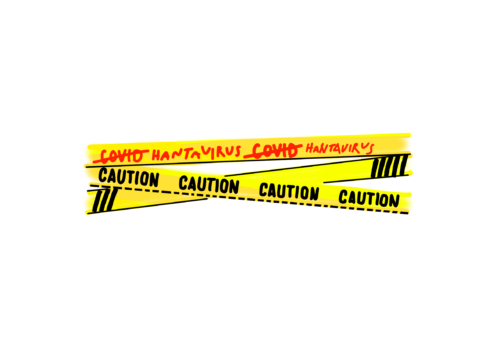
In recent weeks, headlines about a hantavirus outbreak linked to a cruise ship in the South Atlantic have been impossible to avoid. Public health agencies have repeatedly emphasized that the outbreak, caused by the Andes strain of hantavirus, involves a limited number of cases tied to a specific exposure rather than widespread community transmission.
In many ways, those reassurances echo the language that became familiar during the early months of COVID, when concerns about how viruses spread transformed everyday life: six-foot distancing signs covered the entrances of stores and schools, classrooms moved outdoors … ordinary social interaction became defined by caution. Reactions to hantavirus news have varied sharply, from indifference to fear of another disruption. Against that backdrop, it is understandable that health officials have stressed that the current outbreak poses a low risk to the broader public and is not considered another COVID-19-scale event.
The news about hantavirus arrives at a strange time for Harvard undergraduates: rows of white folding chairs are beginning to appear in the Yard, crews are assembling stages and sound systems, and families are finalizing their travel plans as Harvard prepares for Commencement.
Seeing all of this—all while updates about a hantavirus flare-up across my social media feeds—I can’t help but be reminded of how quickly normal life was disrupted during COVID and how incomplete it left certain things.
I find myself wondering if another pandemic were to emerge, how would we respond differently this time? Would people move faster, remembering how much was disrupted in 2020? Or instead, would we be less concerned, having watched life so quickly resume to normalcy? I honestly am not entirely sure.
This question is difficult because people experienced COVID in very different ways depending on their age, circumstances, and stage of life. As a result, reactions to news about hantavirus outbreaks also differ. To me, the biggest fault line seems generational.
Older generations do not appear to be very concerned. Many older adults seem relatively calm about this specific outbreak, especially as health officials emphasize that they’re closely monitoring the situation. I think this reaction is striking when you consider that older adults bear the highest medical risk from COVID-19. In the United States, people aged 65 and older account for a large majority of COVID-19 deaths, and infection fatality rates climb sharply with age. Even when surviving infection, older adults’ lifespans are significantly reduced.
Instead, it feels like younger generations are carrying most of the anxiety. Since the outbreak was first announced, my entire social media feed has become filled with hantavirus memes or people who have “done the research” explaining their theories about what will happen next. I consistently see people posting flashbacks to how they looked in 2020; even “quarantine core” has re-emerged, with people posting videos using audios and trends that previously ruled TikTok back when lockdown first took place.
Clearly, younger generations seem to carry more of the lingering psychological aftershocks.
For many within this younger population, the fear attached to the outbreak has less to do with medical risk than with the possibility of disruption itself. During formative years, many young people experienced how quickly everyday routines could disappear.
School closures, initially presented as temporary, lasted for months. At the same time, milestones, proms, graduations, performances, orientations, and senior trips were canceled, postponed, or significantly altered, creating a sense of social loss and disconnection.
Studies support the idea that this went beyond disappointment. A 2025 Gallup poll found that 45% of parents of school-age children said the pandemic negatively affected their child’s social skills, and 42% said it harmed their child’s mental health. A University of Michigan study also found that children in remote schools experienced more peer problems, hyperactivity, and behavioral issues than children learning in person, while parents were less likely to say their child had enough opportunities to socialize.
Clearly, the pandemic affected how we interact socially. However, what’s even more interesting is that this experience also changed how many younger people respond to institutional reassurance.
During COVID, timelines for returning to normalcy frequently shifted as conditions evolved, leaving many students with a lasting sense of false hope and uncertainty around officials’ predictions. Many of us were told over and over during COVID that “school will resume in two weeks,” then “after break,” then “next semester,” only to see those dates slip away.
It makes sense that, as a result, parts of younger generations seem almost immune to reassurance regarding hantavirus, as they interpret these reassurances through memories of past disruptions. It is not only about what is being said now, but also how this similar assurance unfolded when we were younger.
It is not yet clear whether society as a whole will tend to overreact or underprepare for future diseases. Some people will almost certainly overreact if this happens again, becoming more scared and willing to take even more extreme measures than before. In contrast, others will underreact, driven by current political fatigue and convinced that the last round of shutdowns was already far too broad. I still remember how, in the early months of the pandemic, before there was a clear understanding of how the virus operated, uncertainty turned into rules that took away far more than was necessary. Schools, sporting events, and buildings were all altered in some way, despite little evidence that these policies reduced spread. Even children’s playgrounds were taped off—something that felt very dystopian at the time—because people were convinced that metal or plastic surfaces would continue to hold the virus, even though later evidence showed that surface transmission was a minor route compared to airborne spread.
Those varying levels of reaction—some people ready to shrug off new threats, others bracing for the worst—should make us aware that we still have not reached consensus on a plan of action we would actually agree on if this were to happen again. That uncertainty now hangs over every new outbreak.
Aurora Charbonneau ’29 (auroracharbonneau@college.harvard.edu) wishes the class of 2026 a happy graduation.