Dr. Jason Furman Becomes Director of the Mossavar-Rahmani Center for Business and Government
Graphic by Neshama Ryman

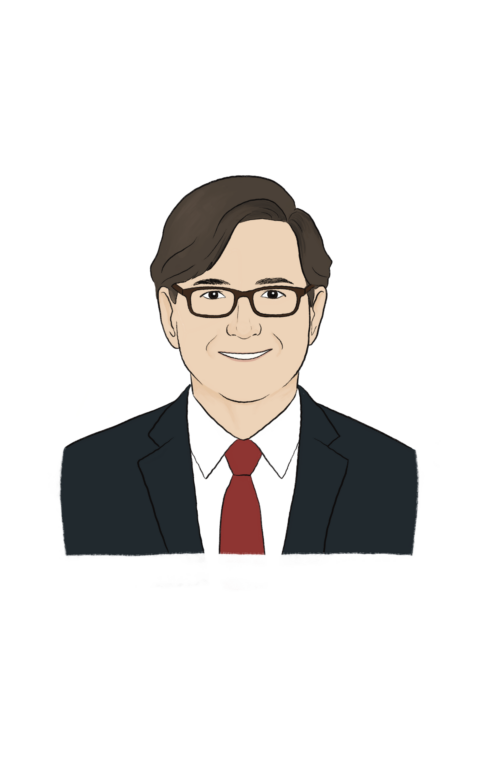
On April 30, 2026, Aetna Professor of the Practice of Economic Policy Jason Furman ’92 was announced as the next co-director of the Mossavar-Rahmani Center for Business and Government, previously held by former Charles W. Eliot University Professor and Harvard University President Emeritus Larry Summers ’82, who resigned from the University following the release of files detailing his relationship with Jeffrey Epstein.
Prior to joining Harvard’s faculty, Furman worked in the White House for 10 years, spending two years under Clinton and eight under Obama. During his time in Washington, Furman chaired the Council of Economic Advisers.
Furman continues the precedent established by Summers, who came into the role after serving in the White House as director of the National Economic Council, as the economy stabilized from the 2008 recession. During his time as director, Summers sought to examine shifts in the global economic order, the effects of new technologies, and the outcomes of the economic crisis. In his leadership role, Furman seeks to expand the Center by bringing in more faculty from across the University, increasing undergraduate involvement, and deepening M-RCBG’s focus on AI.
Furman currently leads the M-RCBG alongside Public Policy Lecturer John Haigh ’82, who has served as co-director since 2011.
The M-RCBG aims to generate research and policy analysis for issues involving the public and private sectors. The Center produces policy research in four fields: enduring prosperity; energy, the environment, and technology; China and the global economy; and market capitalism.
“The through line for all of them is that you can’t think about the economy without thinking about the role that businesses have in the economy and the role the government has in the economy,” Furman said in an interview with the “Harvard Independent.”
Each area includes several ongoing projects, dedicated to specific topics such as education policy, climate policy, and corporate responsibility. Many of the programs also have fellowships; for example, the Global Food Systems Program offers the Ray Goldberg Student Fellowship for students interested in researching food and agricultural production and policy.
In the wake of recent political tension on Harvard’s campus, the Center has remained bipartisan.
“The Center operates under Harvard’s institutional neutrality rules, so it does not have its own policies that it’s pushing,” Furman explained. “The goal would be to always have different voices, different perspectives at the table, and so it’s convening a forum that better ideas would emerge from, as opposed to endorsing and pushing a specific solution.”
Institutional neutrality does not mean avoiding politics; affiliates of the Center recognize the importance of international leaders in setting the tone for the public and private spheres. “We recently met together with them in Beijing to basically build mutual understanding and better bridges around a number of the most difficult issues around globalization,” Furman explained. He also has interfaced with members of the Federal Reserve System and Chinese economists.
Building this network of policymakers bolsters student education, which Furman notes the Center already expands beyond the College curriculum via research. “Another thing we’re trying to do is get students to just learn and carry things forward. This isn’t a think tank in Washington, where your goal is to change legislation tomorrow,” he said. “Our goal is as much to help students know how to do it even better in the future than we know how to do it now, and to bring more faculty onto it.”
With this in mind, one of Furman’s goals as director is to expand the Center to include more members from the University’s various schools, to create a space where University affiliates can collaborate to address key issues. “You have these great people working on problems, but they’re working in their different silos and not talking to each other,” he noted.
“I want to make us a real hub where if you’re interested in one of our topics and you come to a seminar we hold on it, you get somebody from the business school, someone from the economics department, someone from the Law School, all of whom are thinking about different things together in one place.”
Furman also hopes to increase undergraduate involvement in the Center. He believes that the key to doing so is to make the M-RCBG exciting by offering special opportunities, such as inviting senior policymakers or hosting seminars. “Everyone at Harvard is incredibly busy; they all have tons of things they can do,” he said. “I have no power over anyone except the power to create an exciting space that people want to come to and contribute to.” Furthermore, as a professor in the Economics Department and co-teacher of the largest undergraduate course, ECON 10A, Furman believes he can promote the Center to his students.
Considering the rapid development and prominence of technology in recent years, Furman recognizes that the Center needs to expand opportunities in artificial intelligence research. Furman sees AI as an essential challenge of the era: while many institutions are currently studying the field, the technology is evolving so rapidly that university research may struggle to keep up. Understanding AI demands interdisciplinary expertise, exacerbating the difficulty in developing a sufficient body of scholarship.
“You really need both economics, but also national security, and also maybe some law, maybe some technologies, computer science, etc.,” he said. “Just the interdisciplinary nature of the questions, with no discipline having a monopoly on the wisdom needed to answer them, makes that topic especially challenging, and we won’t be an exception to that.”
Furman developed this perspective as chair of the CEA. “What I tried to do there was make something where the whole was greater than the sum of the parts that brought together the different types of people and their different talents and knowledge.”
However, he finds that his time leading the CEA was different from his time leading the M-RCBG due to the government’s hierarchical model. There, the council members worked directly for him, while at the Center, affiliates and faculty are working together on their own projects. “This is very much a set a table, get people excited, have things come out of it.”
From his time in government, Furman also learned important lessons about developing economic policy and working with businesses. “One is you can’t make any economic policy without listening to businesses, because they know about some things much more than the government does,” he said. “The second is it’s extremely dangerous to take everything businesses say at face value, because they’re very self-interested.”
Therefore, formulating economic policy requires a balance between leveraging business expertise and recognizing potentially biased information. “The best way to do that is: one, to listen; two, to be skeptical; and three, to actually know something about the topic, so that you can ask hard questions and have an ability to sort of tell right from wrong.”
Over the summer, Furman intends to learn from other center directors as well as the University’s faculty. Since starting as director, faculty members have already approached Furman with ideas for initiatives.
“I don’t have fully worked out answers to anything, and by the way, I don’t think the right thing would be to have fully worked out answers. You have to listen and learn.”
Julia Bouchut ’29 (julia_bouchut@college.harvard.edu) is the Associate News Editor of the “Harvard Independent.”