Boys Don’t Cry
Graphic by Mia Stewart

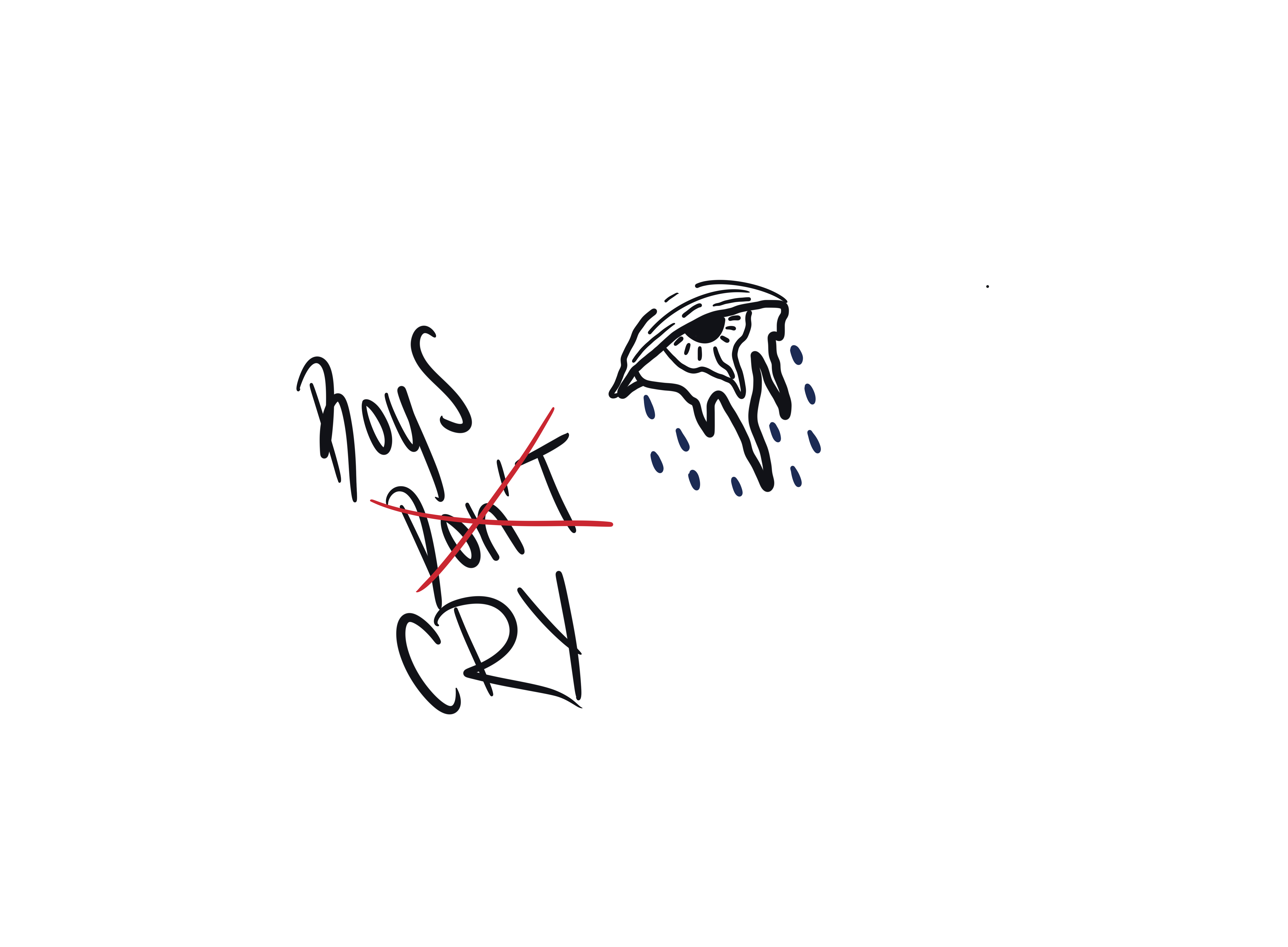
Ask any Major League Baseball fan, and they will tell you that the Los Angeles Dodgers have an unfair advantage. With the highest payroll in the league and a roster stacked with talent, the team consistently makes headlines. One miscommunication, however, sparked questions about the team’s chemistry.
In a June 24 game against the Minnesota Twins, Shohei Ohtani, widely regarded as one of the greatest players ever, took the mound. The Dodgers’ regular catcher was out with an injury, so second-year catcher Dalton Rushing served as the backstop. In the second inning, the duo fell out of sync several times, leading opponents to score runs. After on- and off-field talks, it was clear that the young catcher was extremely frustrated with himself, and since Ohtani is so beloved, Rushing received the brunt of fans’ disapproval online.
What stood out to me was Rushing’s comments after the game. Cameras had clearly shown the 25-year-old receiving reinforcement and advice from manager Dave Roberts and veteran Freddie Freeman. “It’s embarrassing that I need support like that […] I’m a grown man,” Rushing admitted.
Rushing’s discomfort with receiving support exposes a deeper, more damaging expectation embedded in professional sports and society: that athletes must project invincibility, whatever adversity they face. This perspective is both unfair and dangerous to athletes and the wider population that idolizes them, as it dissuades them from expressing and dealing with their emotions.
The Macho Expectation
The narrative of the “macho man” has existed for centuries. Rooted in an era of rigid gender roles that tasked men with providing for the family, traditional masculinity in colonial Mexico demanded the aggression necessary to defend one’s own. While the core tenets of this masculinity aren’t entirely condemnable, machismo has repeatedly been distorted to endorse self-reliance and unchecked pride.
Often deemed today as “toxic masculinity,” this pattern is inherently ingrained in professional sports. The principles that machismo promotes in men seem to be the same ideals that all “great” athletes are expected to embody: toughness, triumph over adversity, and unwavering self-assertiveness. It is no surprise, then, that these ideals of independence permeate athletes across every sport; to compete at the highest level, many believe, requires projecting dominance and control at all times. As a result, many look down upon external displays of emotional struggle. Tears are a cardinal sin for an athlete.
When Chicago Bears quarterback Caleb Williams was in college at the University of Southern California, he faced backlash after a loss to the University of Washington on Nov. 4, 2023—but not because of the final score. Distraught after the loss that all but ended USC’s championship hopes, a tearful Williams collapsed into his mother’s arms.
Much of the football world was appalled by his reaction: Williams was supposed to be the leader of the USC team, and he began bawling? Jason Whitlock, a host for “Blaze TV,” bashed the quarterback for failing to display what he considered true leadership. “America did not become the leader of the free world, and football did not become America’s national pastime because men exhibited the emotional control of 12-year-old girls,” Whitlock said.
Reporter Charly Arnolt likewise slammed Williams. “Grown men—at least real men—have some pride and dignity […] how is [Williams’s emotional response] deemed acceptable,” she said.
Williams was only 21 years old.
What these detractors misunderstood was Williams’ dedication and love of the sport. How is it reasonable to expect someone not to be upset after they’ve devoted so much time to the sport? Instead, athletes should be praised for the bravery it takes to express their feelings—not shamed for falling short of some outdated notion of a “real man.” Hiding these battles misrepresents what it takes to be successful and constructs a false reality, not only for broader audiences, but also for many young fans who idolize these athletes.
Similarly, National Basketball Association phenom Victor Wembanyama of the San Antonio Spurs drew criticism for his own display of raw emotion. After defeating the defending champion Oklahoma City Thunder in the Western Conference Finals, Wembanyama was seen crying on the court. NBA Champion and Hall of Famer Kevin Garnett was upset by the scene. “That was too emotional for me […] You’ve got to go through the Finals now,” he said.
Wembanyama was just 22, returning from a sophomore season cut short by blood clots—the same condition that has sidelined many NBA bigs and even forced legend Chris Bosh into retirement. He had just led the Spurs to the NBA Finals after back-to-back losing seasons. Yet, he was criticized because the job wasn’t finished. As a young star, Wembanyama is playing on the global stage with many constantly ready to call him out for any mistake. Is it reasonable to expect him to also hide his feelings? “I refuse to carry the burden of having to hide my emotions,” Wembanyama said in defense.
Behind the Scenes
Future generations deserve to watch their idols and learn that maturity and peak performance are born from emotional honesty—not from a hardened refusal to feel at all. Whether this vulnerability comes on or off the court should depend on the athlete, not the media.
Many studies have shown that emotion suppression can increase the risk of earlier mortality. So why do we keep telling young athletes that toughness means never crying, never showing emotion? These athletes already face many stresses from handling the expectations of family, friends, and fans, not to mention the constant threat of injury, hyper-competitive environments, and so much more.
Sure, these athletes face extreme harsh criticism from fans. Often, though, these competitors’ harshest critics are themselves. Boston Red Sox outfielder Jarren Duran revealed he attempted to take his own life after poor performances in the 2021 and 2022 seasons. Fortunately, his attempt was unsuccessful, but Duran’s story reveals the sheer pressure these athletes face. There is no reason for these same athletes to also be expected to hide these emotions and woes to meet some outdated expectation of manhood.
Accepting Support
Rushing’s embarrassment over his outward display of emotion reveals a deeper flaw in how we view support. A strong support system does not mean depending on others to survive—it means leaning on others to soften life’s blows. Wanting this foundation isn’t a weakness. No one should have to weather life’s triumphs and pitfalls alone.
Unfortunately, the community surrounding an athlete isn’t always a source of strength. Toxic coaching, destructive fans, and worse can further exacerbate personal struggles rather than relieve them. Still, these experiences, however traumatizing, should not dissuade anyone from seeking out a support system they can actually rely on.
Showing emotion and needing help are not signs of a weak athlete or even a weak man. In my opinion, allowing oneself to be open and grateful isn’t a weakness, it’s a strength. It takes bravery to show the world what they are going through. It takes humility to acknowledge your own shortcomings and allow others to help you build a stronger front. Maybe these ideals do not align with an archaic ideal of masculinity. Maybe that’s a good thing.
Tyler Dang ’28 (tylerdang@college.harvard.edu) is the Sports Editor of the “Harvard Independent.”