Harvard Expands Campus Security Amid Growing Safety Concerns
Graphic by Sage Willey

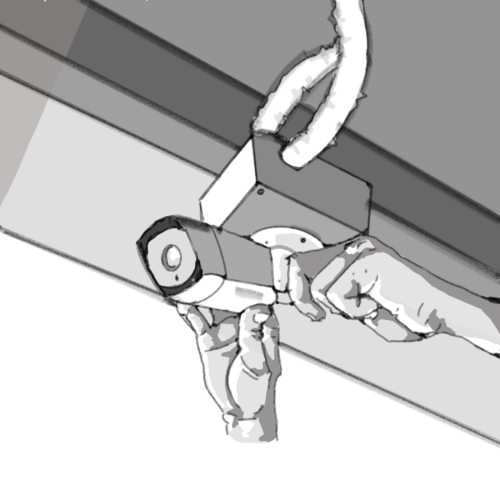
Harvard is expanding campus security measures ahead of the 2026–27 academic year, including plans to install additional security cameras outside academic buildings and throughout the River and Quad residential areas. The University has not announced when installation will begin, though administrators have described the expansion as part of a broader effort to modernize campus security and improve responses to criminal incidents.
The changes follow a year of heightened concern regarding student safety after the fatal shooting at Brown University and several violent incidents in Cambridge and the surrounding area. They also come as Harvard continues to face broader institutional challenges, including scrutiny over professors’ connections to disgraced financier Jeffrey Epstein and a legal dispute with the federal government over withheld funding.
The shooting occurred on Dec. 13, 2025, while students at both Brown and Harvard were undergoing their final examination period as the fall semester ended. A gunman opened fire inside the University’s Barus and Holley Building, killing two Brown undergraduate students and injuring several others. Federal investigations later identified Claudio Manuel Neves Valente as the shooter and reported that he had planned the attack for an extended period, though authorities were unable to determine why he targeted Brown students specifically.
Although Harvard did not immediately comment on the shooting, the University sent a campus-wide email on Wednesday, Dec. 17, announcing additional security measures. It stated that beginning the following morning, access to all Faculty of Arts and Sciences buildings would require a Harvard ID card, in accordance with the University’s standard winter recess procedures. Security guards were also stationed at the main entrances of buildings where final exams were taking place, while Harvard University Police Department officers maintained an increased presence across campus. “While there is no information indicating a credible threat to our campus, HUPD and Securitas will also continue to closely monitor campus buildings out of an abundance of caution,” the communication stated.
In December 2025, two days after the same gunman carried out the mass shooting at Brown University, Massachusetts Institute of Technology professor Nuno F. G. Loureiro was fatally shot at his home in Brookline, a town just miles away from Cambridge. Authorities later determined that the gunman had returned to Massachusetts following the Brown attack, heightening concerns in the Harvard community about his proximity to campus even as the University said it had no information indicating a credible threat.
The ID card access requirement introduced during winter recess was later extended through the end of the spring semester. Under the policy, students, faculty, and staff were required to swipe their Harvard IDs to enter all Faculty of Arts and Sciences buildings, including the School of Engineering and Applied Sciences facilities in Allston, Massachusetts. Although restricted access during winter recess was standard practice, maintaining the requirement throughout the spring semester marked a broader change to normal campus operations. Enforcement, however, was reportedly inconsistent during the policy’s early months, with some major Faculty of Arts and Sciences buildings remaining accessible without an ID swipe. Sever Hall and Boylston Hall, for example, both classroom buildings with heavy daily traffic, are not equipped with scanning infrastructure on their front doors.
The University later strengthened enforcement after community concerns emerged that the announced restrictions had not been fully implemented. Administrators assured affiliates that the extension was not prompted by a specific threat but was part of a broader effort to strengthen campus security amid several violent incidents in Cambridge and the surrounding area.
The City of Cambridge recorded an increase in robberies and aggravated assaults in March 2026, although overall reported crime remained below the level recorded during the same period in 2025. In May, an armed man fired an assault-style weapon at passing vehicles on Memorial Drive near River Street, only a few blocks from Mather House. He injured two people before being taken into custody. Cambridge also recorded a fatal shooting near Broadway and Norfolk Street on July 4, 2026, marking the city’s second reported homicide of the year.
As Harvard has responded to concerns about physical security on and around campus, the University has also confronted how to maintain campus order without unduly restricting protests or free expression.
Harvard has also strengthened its procedures for responding to campus demonstrations. In April 2025, the University authorized the president to convene a faculty panel of the University Committee on Rights and Responsibilities to investigate alleged violations of Harvard’s protest and Campus Use policies in cases involving students from multiple schools. Unlike previous years, the committee was granted the ability to determine facts and impose disciplinary measures. Although framed as an effort to protect free expression, the measures also reflect Harvard’s broader attempt to maintain campus order and prevent demonstrations from interfering with students’ ability to learn in a safe environment.
According to a report by the “Harvard Crimson,” a college administrator also informed students that the cameras could potentially be used to enforce Harvard’s Campus Use policies, which regulate protests and demonstrations, though a University spokesperson declined to confirm whether they would serve that purpose.
Harvard’s security efforts are expected to continue during the coming academic year. After introducing active shooter preparedness sessions for undergraduates in Houses and first-year dormitories during the spring, HUPD and Harvard College plan to continue the sessions into the fall and expand them across the residential system, with the goal of reaching every undergraduate residential space within two years. The training outlines how students should respond during an active shooter emergency, including when to run, hide, or, as a last resort, fight.
Nashla Turcios ’28 (nashlaturcios@college.harvard.edu) writes News for the “Harvard Independent.”