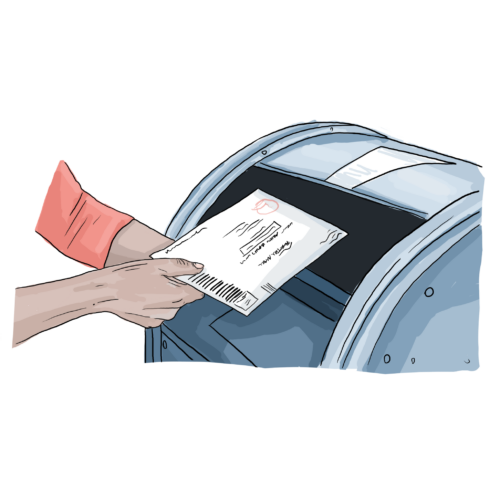
The Future of Mail-in Ballots
Graphic by Miranda Chao Hwang

The U.S. Supreme Court’s term ended on June 30 with the release of seven high-profile decisions. One of the most controversial decisions was Watson v. Republican National Committee, which allowed Mississippi to continue counting absentee ballots postmarked by Election Day but received up to five days later. The Supreme Court voted 5-4 on the decision, with Chief Justice John Roberts and Justices Amy Coney Barrett, Sonia Sotomayor, Elena Kagan, and Ketanji Jackson voting in the affirmative.
Professors at the Harvard Kennedy School and the Harvard Law School reflected on how the decision reveals recent trends in the federal government’s attempts to control state decision-making and prevent mail-in voting. Many students who go to a college outside of their home state use mail-in ballots for federal, state, and local elections, whether in their home communities or elsewhere. At Harvard in particular, over 82% of students come from outside Massachusetts.
Rules around mail-in ballots have become increasingly relevant given that the number of Americans who vote by mail has risen consistently since 1996, with the exception of the pandemic-driven spike in 2020. Beyond absentee ballots, mail-in ballots have become more common for people who don’t trust polling facilities, worry they will face protesters or federal officials trying to sway their decision, and more.
“If you have concerns about election integrity, and in particular, if you are someone who’s concerned that federal officials might show up at polling places, or that there aren’t going to be enough polling places and so there are going to be overflow lines […] for any number of reasons, vote by mail solves a number of potential problems,” Matthew Baum, the inaugural Marvin Kalb Professor of Global Communications at the Harvard Kennedy School, said in an interview with the “Harvard Independent.”
In Watson v. RNC, the RNC and Mississippi Republican Party filed a lawsuit against Michael Watson, the Mississippi Secretary of State, to enjoin him and election commissioners from counting mail-in ballots received after Election Day. In this suit, the RNC followed President Donald Trump’s recent attempts to prevent mail-in ballots from being received after Election Day, such as Executive Order 14248, which multiple federal courts stopped with permanent injunctions.
This original suit was filed in January 2024 and rejected by the U.S. District Court for the Southern District of Mississippi, before being reversed and vacated in part by the U.S. Court of Appeals for the Fifth Circuit in October. Mississippi then petitioned for the case to be taken by the Supreme Court, which the Supreme Court granted in November 2025.
“The question [of Watson v. RNC] was whether that [counting mail-in ballots received after Election Day] was inconsistent with the Constitution,” Ruth Greenwood, Assistant Clinical Professor of Law and Director of the Election Law Clinic at Harvard, explained to the “Harvard Independent.” “The argument by the opponents of this was that it would be a problem in terms of election integrity, that people would have a problem in believing that the elections had gone the way they had gone if you add ballots counted that came in after Election Day.”
Many of those in support of the Supreme Court’s decision argue that concerns over election integrity are over-emphasized. President Trump’s Department of Homeland Security recently drafted a press release, which “Politico” viewed and reported on July 16, on multiple election fraud cases, including thousands of non-citizens on the voter rolls in California, New Jersey, Nevada, and Pennsylvania. New Jersey Governor Mikie Sherrill responded to the alleged fraud on X, acknowledging that a software error caused around 6,600 non-citizens to be registered as voters; fewer than 400 actually voted.
“As the Trump Administration tries to weaponize elections for political gain, I am ensuring we protect our elections,” she wrote.
However, Greenwood emphasized that mail-in voting is more about practical considerations about the Post Office than allowing additional votes. “It’s not requiring any state to count ballots that come in after Election Day. But if a state decides that because we all know that the Postal Service can take some time, and there are various people that need to use postal services, then it’s fine for them to count ballots that come in after Election Day,” she said.
Despite almost one-third of Americans voting by mail in the 2024 election, the scope of the case was limited to Mississippi, so the immediate impact on the electoral system would have been limited. “For [the Supreme Court] to have found the other way, it wouldn’t have thrown complete chaos into the elections,” Greenwood continued.
The direct consequences were not the main concern for many voter access advocates, though. The issue remains who controls elections—the states or the federal government. “It would have been a very disturbing sign if the Supreme Court was willing to start getting in and telling states how they should run elections,” Greenwood explained.
Greenwood also pointed out the recent Supreme Court decision Louisiana v. Callais in April 2026 regarding racial gerrymandering, in which the Court ruled against the 1982 amendment to the Voting Rights Act of 1965. The amendment specified that racial gerrymandering could be overturned if it had a discriminatory effect, not just intent. With its recent decision, the Supreme Court now requires proof of intent before it can address gerrymandering.
Baum believed the crux of the issue was still the state-versus-federal debate. “The principle of state control over elections, I think, was indirectly at issue here because this was basically the Trump administration trying to effectively regulate what states can do in terms of counting ballots and what the Postal Service can do in terms of delivering ballots,” he said. He found that attempt to increase federal control concerning.
In Article I, Section 4, Clause 1, also known as the “Elections Clause,” the U.S. Constitution allows for states to run elections. The Supreme Court has often interpreted this broadly, allowing states to handle everything from voting locations to voter fraud protection, as specified in Smiley v. Holm in 1932.
“[The decision] is important because if they had gone the other way, I don’t think people would have been able to trust mail-in voting,” Baum said. Currently, 51% of Americans have a great deal or a fair amount of trust in the mail-in voting system, with 21% planning to vote by mail in the 2026 midterms.
This decision also remains especially relevant for college students, many of whom use mail-in voting because they are no longer living near their home voting precinct. Sophia Gocan ’29, a California resident, plans to vote by mail this upcoming year in both the presidential and gubernatorial elections as she trusts California’s mail-in ballot system and finds voting a high priority. “The gubernatorial election is especially important for me to vote while being away for college since I will likely go back to California post-grad, so it will have an effect on me, as well as the presidentia [election].”
Baum acknowledged the partisan aspect of the issue as well. “I think you would have had to try if you were, let’s say, the opposition in this case, the Democrats, to launch a pretty aggressive campaign to get people to not vote by mail because it would suddenly be really vulnerable,” he added. This campaign may also have involved encouraging people to vote early. There are still other ways that the Trump administration can attempt to stop mail-in voting, but Baum noted at least this particular avenue has been shut down.
For college students and others preparing to vote by mail, this court ruling can prevent concern about when to send in their ballot. If the ruling had gone the other way, many would need to prepare and mail ballots much earlier to avoid them being delayed and therefore invalidated.
Baum remains worried about what mail-in voting will look like in the future. “My expectation is that they will continue to roll out policies designed to make voting by mail more difficult, less frequent, etc.,” he said. “I don’t think they’re done by any means attempting to intervene in this process.” This means students deciding to vote by mail should still get their ballots ready early, as the Trump administration may develop different ways to prevent mail-in ballots from reaching their designated state.
“[I’m worried about voting by mail] mainly due to the fact I have no clue how the mail-in process works—especially because I don’t have my mail-in address until the end of August,” Gocan explained.
“I’ve had students who have not received their absentee ballot, and by the time they realize by the Friday before the election that that’s happened, the only option is to fly at great expense back to vote in person, or to be disenfranchised,” Greenwood said, emphasizing the importance of preparing early if you plan to mail your ballot.
Elle du Pont ’29 (edupont@college.harvard.edu) writes News for the “Harvard Independent.” You can register for an absentee ballot by applying online or downloading the application on your home state’s website. Massachusetts’s can be found here.