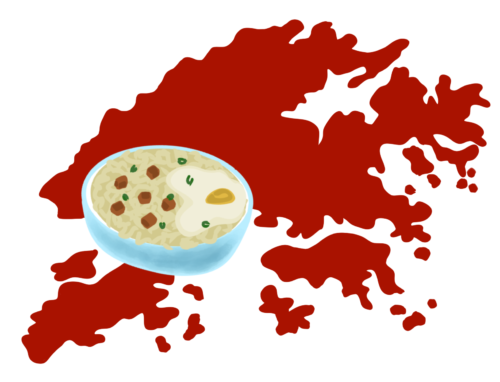
Exploring Worldwide Hometowns: Hong Kong
Graphic by Sarahluna Sassine

When humidity suffocates me and the air smells of seawater tinged with garbage, I know I am home.
This is probably not how the tourism board would introduce the city. They would want to show you Hong Kong Island across Victoria Harbor at night, with its bright skyscrapers backed by mountains. Of course, these attractions make up the Hong Kong I know and love—but so do the wet markets, the bamboo scaffolding, and the overly aggressive air-conditioning that makes you regret wearing shorts despite 100-degree weather.
Hong Kong is a special administrative region of China along its southern coast, packing about 7.5 million people into just 430 square miles. It is one of the world’s most densely populated places, which explains both the skyscrapers and the soaring rent. Its mix of Chinese and Western influences comes from its history as a trading port and more than 150 years of British colonial rule.
I grew up on Hong Kong Island, in a small neighborhood north of Happy Valley, and left for boarding school in the United Kingdom when I was 11. Since then, I have only returned home two or three times a year for the longer school holidays.
I used to feel ashamed of telling people I was from Hong Kong, like it was not a “cool” enough place to be from. When people said they would love to visit, my reflex was always, “Why? There is nothing to do in Hong Kong.” So, for years, I said London instead. And even though I have had my British address for almost a decade, the answer still feels like a small lie.
The longer I spend away, though, the more I miss things, and it is rarely things I would recommend to a visitor.
When I go home, I buy cheap fresh fruit from market stalls where the vendors still give you your change from a bucket. I walk across elevated walkways and get jujubes and candied ginger from the Chinese herb store. I visit my tiny nail salon in an otherwise unremarkable building, where my manicure costs a fraction of what I would pay abroad.
None of this seemed particularly interesting when I was growing up. I paid more attention to how dirty the streets were and how everyone seemed to know each other, which made the city feel smaller than I wanted it to. I wished our Starbucks had a trenta size and thought about how much I wanted to leave.
I also grew up hating Cantonese food. I refused to go to dim sum with my extended family and complained if we made anything steamed for dinner. Now, one of my favorite things to do at home is visit a cha chaan teng, a local cafe whose menu makes perfect sense to locals and possibly no one else. Breakfast might be macaroni in chicken soup with a slice of ham, or instant noodles topped with a fried egg and Spam. I abandon my lattes for a Hong Kong-style milk tea or a yuen yeung, black tea mixed with coffee for anyone unwilling to choose. My personal guilty pleasure is Hong Kong-style bolognese. Its relationship to Italy is distant, but the dish is delicious in its own way, and impossible to replicate.
My childhood complaints about food had exceptions. After tutoring, my brother and I used to run to the corner bakery to buy a six-Hong-Kong-dollar pineapple bun (about 80 cents) from the older man behind the counter. It was a sweet reward for suffering through an hour and a half of Chinese lessons. We were such regulars that he sometimes slipped us hard candies for free.
That bakery is now a “Heytea,” a Chinese bubble tea chain. Every time I go home, something I grew up with has closed, and something new has popped up in its place. Last Christmas, a “Luckin Coffee” replaced my favorite Shanghainese restaurant. The international frozen yogurt chain “Myka” also opened over the summer, with a line stretching down two blocks. The tailor my family went to for decades has been forced to retire because too many of his clients traveled to Shenzhen for cheaper services.
I am not above the new things. I like my triple supreme matcha from “Heytea,” and I’m admittedly a victim of the froyo craze. But enjoying what is new does not stop me from missing what was there before. I spent years wanting to leave Hong Kong, and now that I look forward to going back, I am finding that some of the places I missed the most are gone. I did not appreciate them enough while I was there.
At the same time, growing up abroad has given me new ways to enjoy the city. I look forward to Art Basel, dressing up for dinners with my friends, and morning hikes with my family. Over the summer, I finally had my first (legal) drink in Lan Kwai Fong, even though the “7-Eleven” clerk didn’t seem particularly concerned about the validity of my ID. Some familiar places have disappeared, but I’m just starting to get to know others.
Coming to Harvard means I am even further away from home, with fewer opportunities to go back. Cambridge is quieter, and I am enjoying that. But in October, the air is dry and crisp, and I catch myself missing my warm autumns and the damp, salty smell I used to complain about. Now, when someone asks where I’m from, I say Hong Kong, and when they say they would love to visit, I tell them to bring a jacket for the air conditioning.
Audrey Cheng ’30 (audreycheng1@college.harvard.edu) would give anything for an egg tart.