One Word to Describe “The Social Reckoning”? Flat.
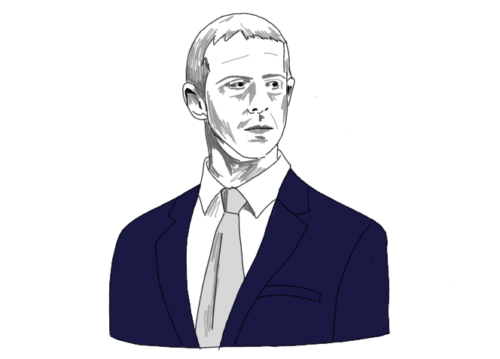
Graphic by Nuala Mernin

On Oct. 9, one of the most iconic Harvard movies released a companion film in theaters called “The Social Reckoning.” While “The Social Network” follows Mark Zuckerberg as he creates Facebook at Harvard and navigates the legal trouble it brings, “The Social Reckoning” takes place about 15 years after Facebook’s launch, after it has grown to shape the American social and political landscape.
The movie documents the build-up to and release of the Facebook Files. The story goes like this. In 2020, Facebook product manager Frances Haugen became concerned that the company was not living up to the values it publicly espoused. Haugen provided data and information to Wall Street Journal reporter Jeff Horwitz, creating the foundation for the Facebook Files. Haugen eventually testified before Congress about Facebook’s unethical work. “The Social Reckoning” follows Frances Haugen (Mikey Madison) and Jeff Horwitz (Jeremy Allen White) up to the congressional hearing.
The movie opens with a prologue titled “White Girl Wasted.” A young blond white woman stands by her broken-down car staring at her phone when two police officers pull over and approach her. The normal check-in spirals into a racist altercation that goes viral on alt-right Facebook. When the police confront the woman about being drunk, she begins yelling racist insults at the Black and Latina officers. It is later revealed that this wasted white girl is whistleblower Frances Haugen’s motivation for investigating how Facebook’s algorithm radicalizes people.
The scene tries to mimic the opening of “The Social Network,” but it does a poor job. In the original film, the rapid dialogue between Mark and his girlfriend Erica is instantly entrancing. Mark’s character is revealed in depth in such a short scene, especially through Mark’s obsession with final clubs. By contrast, the opening scene of “The Social Reckoning” reveals nothing about the movie’s main characters.
Although the opening scene doesn’t depict a real encounter, it was inspired by reality. “I couldn’t find the shape of a movie yet, until I asked Frances what the inciting action was… And she said, ‘I had a friend who had been radicalized by spending too much time on Facebook.’ And I began to imagine the opening scene,” Sorkin said in an interview with “Variety.” Haugen has not spoken about the way her friend’s views changed. Still, the analogous movie character was a strongly progressive woman who shifted to an extremely conservative, hateful viewpoint—knowing what the Facebook algorithm could do to a person motivated Haugen to become a Facebook whistleblower.
Wall Street Journal reporter Jeff Horwitz contacts Haugen soon after she sees the alt-right viral video. Horwitz’s character is a political journalist who is entirely detached from technology. He cannot figure out a car’s GPS, much less create a Facebook profile. Although the plot stalled in some places, especially here, the easy-to-laugh-at jokes kept me entertained.
Horwitz’s new investigative beat is to look deeper into Facebook’s secrets. He reaches out to hundreds of Facebook employees, looking for a way in. Haugen is the only one to respond. At first, she is extremely resistant to giving Horwitz information. As they keep meeting, Haugen repeatedly claims each meeting will be their last. Each time, without fail, she pauses as she leaves and ultimately decides to give Horwitz more information.
This series of repetitive and awkward pauses seems like an attempt at quirkiness but comes off as cliché and eye-roll-worthy. It feels so unnatural and forced that it immediately pulls me out of the movie.
This contributes to Haugen’s character coming off as two-dimensional overall. The movie constructs Haugen in a stereotypical nerdy-girl role. We see her sitting up late at night, home alone, staring at her computer. The film mentions no family, friends, or relationships outside of her work. When a coworker urges her to join a dating site, she does. In her bio, she writes, “I am a data scientist,” stripping her profile of all personality. It is the cliché work-addicted businesswoman with zero intent from the producers to add any layers.
I found it disappointing that Sorkin felt the need to reduce Haugen to a stereotype to fit her into the narrative of the nerdy girl who becomes a powerful woman.
With each meeting, Haugen and Horwitz uncover a clear narrative of Facebook’s disregard for the public good in favor of the company’s profits. Meanwhile, the COVID-19 pandemic is spreading around the world.
Haugen knows people will start working from home because of the pandemic, so she suddenly moves to Puerto Rico, stalling Horwitz’s investigation. In the movie, she explains her move as a circulatory condition that is more manageable in warmer climates. The circulatory condition is based in reality; Haugen also moved to Puerto Rico because the island is a tax haven. Living in Puerto Rico makes Haugen exempt from taxes on her cryptocurrency gains. The movie’s exclusion of this certainly makes Haugen seem more sympathetic and helpless, once again boxing her into a cliché.
Throughout the film, Haugen’s laptop features a sticker of the crimson, gold, and black Harvard crest. The film never references it explicitly, but Haugen received her MBA at Harvard Business School. Her time at the University isn’t a major part of the movie’s plot, but the discreet callbacks to “The Social Network” reference Harvard and its prestige, which are central to the movie’s themes. It felt like a weak attempt to tie “The Social Reckoning” back to its predecessor, but it cannot just piggyback on that to succeed.
Though there is plenty to scorn, the film has some positives—for instance, Jeremy Strong’s performance as Zuckerberg. It was startling and more three-dimensional than the other characters, possibly because of his commitment to method acting. For one, Strong’s odd haircut and unnerving stare mirror Zuckerberg’s. Furthermore, Strong’s infrequent, robotic speech, paired with his unusual body language, creates a Zuckerberg doppelganger.
There was surprisingly little reckoning in “The Social Reckoning.” The movie ends before any reckoning takes place. Just as Haugen and Horwitz are bringing the evidence against Facebook, the credits roll. We see a plan for reckoning, but the film never carries it out on screen.
“The Social Reckoning” tried to warn and call to action, but the script and flat characters undermined any sense of seriousness. The lack of depth in the characters, especially Haugen, made it difficult to become invested in their struggles and perseverance. This is exactly the fear audiences have for sequels to fan-favorite films. “The Social Reckoning” is another example of a movie with only a fraction of its predecessor’s style. It begs the question: should they have made a sequel at all? The movie actively detracts from “The Social Network”’s reputation simply by association. The two will forever be linked in the audience’s minds.
Furthermore, this sequel tries to expose the corrupt Zuckerberg but instead undermines the severity of his actions. By fictionalizing his harmful company policies and political influence, the movie distracts from the reality that Zuckerberg himself faced no real reckoning.
Even though it fits the pattern of subpar sequels, “The Social Reckoning” is worth a watch from the comfort of home. This docudrama/legal thriller is entertaining despite its flatness.
Kathleen Shovlin ’29 (klshovlin@college.harvard.edu) is comping the “Harvard Independent.”