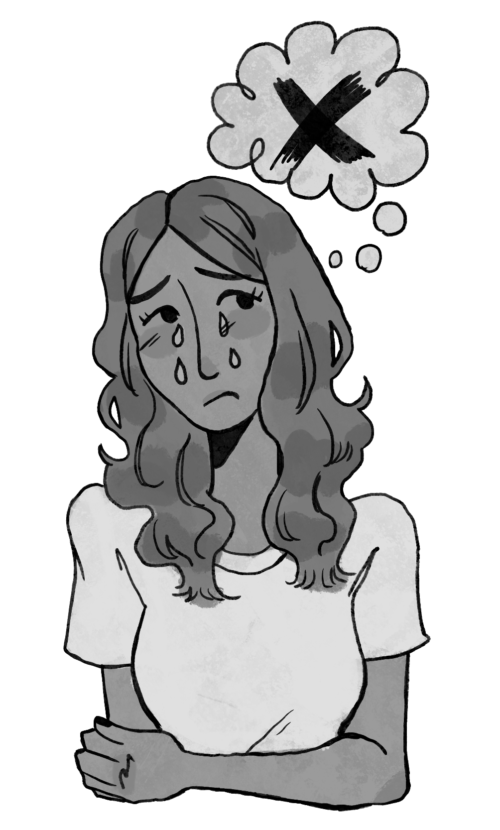
Inadequacy in Gender Equity is Institutional
Graphic by Taylor Bierwerth

In kindergarten, one of my closest male friends shoved a banana into my crotch at lunch. Uncomfortable with the sensation, I told my teacher and asked to be moved away from him in the seating assignment. The next thing I knew, I was dragged into the principal’s office and asked to report it. I was 5—what could I have possibly known about sexuality and, in that regard, what invaded it? The next day, that boy sat next to me again, none the wiser about what he had done. During the most foundational developmental years, the one core principle of consent was completely ignored.
From this starting point, inadequate gender equity takes root in educational institutions. The lessons that prevail when schools inadequately address sexual misconduct and inequity follow students from kindergarten to graduation, when they apply what they believe is the correct reasoning to these difficult sexual experiences.
At what age is it too young to teach children that they can say “No” to unwanted physical touch? While education surrounding consent has increased in recent years, particularly through sexual education programs, students my age, now almost adults, still struggle to determine what the word means truly.
I continued to experience this lack of understanding into my junior year of high school, when my boyfriend frequently told me, “Come on, everyone is doing it,” when I argued for sexual abstinence. Growing up religious, I considered purity as important as breathing. But I loved him. After numerous rejections, I finally conceded under coercion. It was twisted, having intimacy with someone I loved but not feeling fully present. Some moments were fully consensual, while others were forced upon me: my body constrained by the conflicting feelings of love, unable to maintain a harsh “No.”
That loss of purity broke my soul and morals, and I began to see my own perceptions of reality shift. For some, this was not rape; it was simply me doing my part as a girlfriend. For me, however, it was nonconsensual intimacy disguised as love. I can never get that purity back.
Since that moment, I have not felt myself completely: I was changing my beliefs to fit the desire of someone I thought to be a lover. I thought back to kindergarten and the continuous lack of education around bodily autonomy, and I wondered what kind of man that boy grew up to be. Would he, like my ex-boyfriend had, coerce a woman into “consensual” sex after months of pleading? Would he recount that it was her duty as a girlfriend to provide him with pleasure?
In this way, the very institutions that were supposed to protect us as children failed to teach us respect for even our own bodies in nuanced situations. Sadly, we were failed by our education systems as children—and continue to be failed by the meager amounts of sexual education we have as adults-to-be.
During the first month of my first year of college, someone asked me out. Once again, I faced the same pressuring question: “Are you sure? It’ll be fun!” After having to respond multiple times, I learned that being educated does not guarantee someone will accept a single “No.” Harvard’s plan for preventing sexual coercion and assault on campus is a few modules and one entryway meeting dedicated to Title IX. A step above previous years of education, to be sure—yet still far from sufficient.
With the mishandled “Cornell 7” case coming to light, it becomes impossible to ignore how “elite” institutions continue to fail to protect and educate students. The allegations demonstrate the consequences of treating consent as something students should already understand by the time they reach college and raise underlying questions about the inadequacy of consent education across all grade levels. Most striking, some of Cornell’s eventual disciplinary sanctions included reflection papers. Education became part of the response, not part of the prevention.
Harvard should not wait for education to become the punishment.
After completing the modules and meeting with the entryway, I noticed that the preparation and ways to assess the situations I had been in were lacking. What about a boyfriend who promised intimacy as a natural step in a relationship, a “must-have,” or a childhood friend who swore he was kidding around? What about a situation where you are asked over and over again for intimacy, to the point where you are simply worn down?
These situations follow a pattern rooted in a lack of quality consent education and understanding of bodily autonomy. Not all situations are equal, but they expose the same deficiency in how society teaches consent. Students must be allowed to learn about and understand intoxication, coercion, persistent pressure, power dynamics, affirmative consent, and bystander responsibility.
These are not fringe hypotheticals. They happen to countless students nationwide. They are gray areas where students, already grossly uneducated on consent, are expected to make decisions without ever being given the ability to recognize what is happening to them or the language to describe it.
We are taught that “no means no,” but far less about what happens after the first rejection: the bargaining, guilt-tripping, promising, and waiting for resistance to end. Consent education is not just about teaching students to listen for direct refusal; it must teach them not to manufacture a “yes.”
I entered kindergarten without the language of bodily autonomy. I entered my first relationship without the language to understand how persistence could become coercion. I entered Harvard to find that one of the world’s most prestigious educational institutions still largely condensed one of the most important lessons of our lives into online modules and meetings that many students I knew treated as a joke.
For Harvard students and administration, the Cornell case should not be a scandal to watch from the safety of Cambridge. Rather, it should be a warning. Elite education does not inherently produce a true understanding of consent. All eyes are on you, Harvard.
This piece was written anonymously for the “Harvard Independent.”