Scared of a Little Skin?
Graphic by Isra Khan

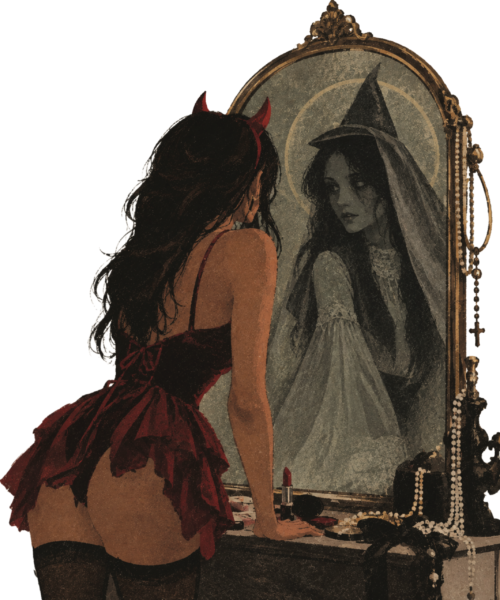
Corsets, glitter, and, of course, a sexy garter belt: all Halloween classics. Halloween, although often thought of as a spooky, scary holiday, has recently become more associated with going out and dressing provocatively. For college students, “Halloweekend” has become synonymous with partying for several days in a row while wearing sexualized costumes. And though no one should feel pressured to dress a particular way, Halloweekend participants unfortunately and inevitably face different expectations every year.
The role of Halloween costumes has certainly evolved since the holiday’s inception. Halloween originated over 2,000 years ago as Samhain, a pagan holiday the Celts celebrated to mark the beginning of winter. People believed the veil between the living and the dead was thinnest during the transition into the colder months, so celebrants disguised themselves to fend off spirits. In the 8th and 9th centuries, the Church moved All Saints’ Day to Nov. 1, making Oct. 31 All Hallows’ Eve. This Christian adoption gave rise to the name “Halloween.”
Costumes remained a key part of Halloween; in medieval England and Ireland, participants wore outfits alluding to the dead and spirits and went door to door requesting “soul cake” treats in a custom known as “souling.” Irish immigrants brought the tradition to North America in the 1840s, where it quickly became popular. Costumes were originally centered on spooky anonymity. Then, in the early 20th century, pop culture began influencing costumes as companies saw an opportunity to market fictional-character costumes to consumers. Halloween also evolved as a day to break social norms, leading people to dress up as anything from pirates to unhoused people.
Halloween pranks also became commonplace, and by the 1930s, property damage and vandalism had worsened. Officials reframed the holiday as directed towards younger children, further disconnecting it from its origins surrounding death.
World War II simultaneously began shaping Halloween traditions in another direction, as Hollywood and wartime media popularized pin-up photos of glamorous models and actresses, helping create the idea of the “sexy” costume. By the 1960s, adults were dressing up again, leaning towards costumes inspired by pop culture and media. Popular costumes of the era included the Addams Family and James Bond. In the 1970s and 1980s, LGBTQ+ communities across the United States used the holiday to wear creative, out-of-the-box outfits, host parades, and freely express their identities, helping lay the foundation for today’s Halloween parties and seductive costumes.
Halloween has always been a little beyond what society considers typical; it offers a chance to dress up as who you might secretly want to be perceived as, without judgment. Halloween’s role as a chance to subvert social norms has contributed to the rise of sexier, skimpier costumes, letting people dress in ways they find empowering absent criticism.
However, 29% of Americans say “sexy” costumes are the most overused. Revealing costumes are often criticized for setting a problematic standard for younger women, and TikTok creators also claim they want to stay in on Halloween to “honor their future husbands.” Risqué Halloween costumes have become a lens through which people can criticize those who partake, particularly women, shaming them and viewing them as less moral.
These critiques are an aspect of purity culture, a social and religious movement primarily emerging from white American evangelical Christianity in the 1990s. Purity culture ties an individual’s spiritual identity, morality, and personal worth to sexual abstinence before marriage, teaching that women and girls must dress modestly as they hold responsibility for the sexual thoughts and actions of men. Furthermore, purity culture often utilizes degrading metaphors to imply that engaging in premarital sex or being promiscuous permanently ruins a person’s value.
Purity culture has been on the rise, and some commentators have linked it to a broader conservative shift under the Trump administration. Trump has consistently pushed anti-wokeness, and it has bled into how we think about fashion and costumes. Anti-wokeness reflects a shift away from a sexually liberated future and a desire for a return to a more traditional past, particularly with respect to gender roles. These conservative ideas have spread on TikTok and other social media through prominent trad-wife creators such as Ballerina Farm, who create content about serving a traditional homemaker role and dressing modestly.
Criticism of women’s bodies and choices is not new, and though it has changed form over the years, its content remains the same. There are, of course, reasonable arguments against sexualized Halloween costumes: encouraging women to dress in revealing outfits can reinforce the idea that a woman’s worth is tied to her physical appearance and can perpetuate social or peer pressure. However, purity culture itself exists in parallel to sexualization—encouraging women to dress modestly and shaming those who do not still objectifies women and ties a woman’s value to what she wears.
Purity culture is continuing to gain traction, but we should not let it control us. From a onesie to micro shorts, people should be able to wear what they want without judgment. We must avoid forcing a problematic standard onto others: dress in what makes you feel comfortable, but do notn’t expect what works for you to work for everyone else.
Criticism of women’s bodies and choices is notn’t new, and though it has changed form over the years, its underlying messages have stayed the same. The pressure surrounding Halloween is multifaceted: mandatory sexualization can reinforce the idea that women must use their bodies to gain social capital, while purity culture shames and objectifies those who dress in revealing clothing. Any attempt to control what people wear strips individuals of their agency and limits their self-expression. Halloween’s history shows it was always meant to be a holiday of subversion and an opportunity to escape social norms, even if only for one night. Let us’s try to keep it that way.
Anika Gupta ’30 (anikagupta@college.harvard.edu) and Salma Gheith ’30 (salmagheith@college.harvard.edu) hope to see everyone wearing their favorite costumes at Indyween!