Artistic Anguish
Graphic by Neshama Ryman

In March 1945, Air Chief Marshal Sir Arthur Travers Harris, head of RAF Bomber Command, wrote a letter addressed to Sir Norman Howard Bottomley, Deputy Chief of the British Air Staff. In the letter, Harris sought to rebut Prime Minister Winston Churchill’s suggestion that the bombing of German cities should be reviewed because it risked appearing to be “simply for the sake of increasing the terror.”
Harris took the remark as an insult and bluntly countered it in his letter. “Actually, Dresden was a mass of munitions works, an intact government center, and a key transportation point to the East. It is now none of these things,” he argued. Yet, in becoming “none of these things,” it also lost what it had long been celebrated for.
Known as the “Florence on the Elbe,” Dresden was one of Europe’s major capitals of music, culture, and art; however, after the Feb. 13-15, 1945, bombing raids, the city was unrecognizable. Whether the decision to raze the city was justified remains fiercely debated; however, this article does not focus on that debate. My principal concern is what burned alongside the munitions factories and rail yards: the collections, the architecture, and the craftsmanship that connected Dresden, and Europe, to its past. It is important to note that in omitting engagement with this debate, I do not mean or want to forgo acknowledging the colossal loss of life that cannot be undone.
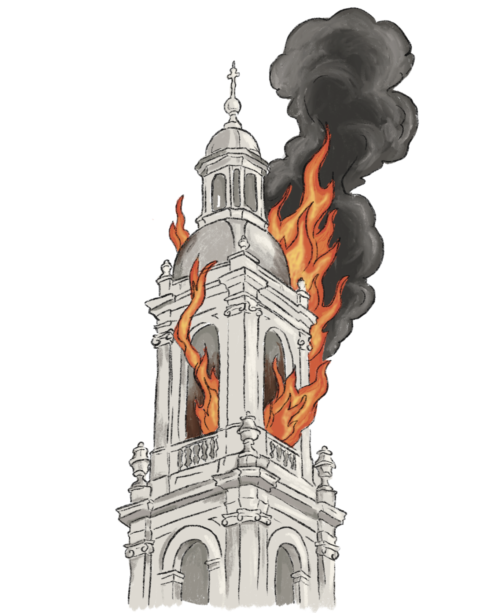
I mention Dresden because it is where my mind first went when I watched, in horror, what happened in Limoges on Oct. 17. During the current nationwide protests in France, which started as peaceful, student-led protests and have since become something else entirely, rioters forced their way into the city hall and set it alight. There was something almost poetic about watching the campanile (bell tower) resist the billowing flames for as long as it could before eventually growing weary of its fight and collapsing into the fire. History literally going up in flames.
It goes without saying that looting and the destruction of property is not only a crime before the law but a crime against community—against the cultural institutions which hold our society together. A town hall is not merely government property but a museum to the art it holds, a monument to the town it serves, and something that belongs to the people, for the people, built by the people who live under its shadow. Still, for all it gave its people, it burned. In a previous article, “A Commentary on Conservatism (Not the Nasty American Kind),” I wrote that it takes only a few to destroy what many have built, and what happened in Limoges made that idea manifest.
Art, and by extension culture, fundamentally shapes our individual identity and our understanding of our place in time and space. David Zwirner hit the nail on the head in his May 22, 2020 article in the “New York Times” titled “Art Is How We Justify Our Existence.” In the article, he writes, a sentiment I strongly agree with, “Works of art carry with them the wisdom of the world.” If this is true of paintings and sculptures, then I think this truth also extends to buildings and memorials—anything that carries cultural value, good or bad. We must recognize that history includes more than the parts we are proud of. The good and the bad live in the same history books, and we cannot understand how we arrived at where we are today without understanding the wrongs committed along the way.
Buildings hold history in a way a history book cannot. They let us breathe the air, feel the stone, and explore the spaces in which history actually happened. Burning them does not destroy the history they witnessed, but it robs future generations of the chance to experience them as evidence of the past, and potentially our chance to learn from what went wrong and move forward.
Before I go further, I want to digress and recognize that placing a relatively isolated act of arson next to a bombing raid that killed an estimated 22,700 to 25,000 people is not, at all, a suggestion of equivalence. However, in both cases, people believed a larger cause justified the destruction. For Harris, it was shortening the war; for the protesters, it is less clear, given the range of topics being protested at the moment, such as housing crises, economic inequality, and the cost of living, to name a few. My argument is not to diagnose either cause, but to point out that preserving heritage never seems to be anyone’s concern in the moment. It gets burnt, vandalized, and looted, and the pain of such actions lasts far longer than it takes to put out the flames.
This is not a uniquely modern issue. As is discussed in Professor Maya Jasanoff’s ’96 history class, HIST 58: the “British Empire,” the Old Summer Palace in Beijing, China, was ransacked and burned by British and French troops in 1860 during the Second Opium War. China’s treasures are now scattered across European museums, removed from the people and place that gave them meaning. Victor Hugo, in an 1861 letter, condemned the act, saying: “One day two bandits entered the Summer Palace. One plundered, the other burned. […] Before history, one of the two bandits will be called France; the other will be called England.”
Hugo condemned both France and England for what they did, and 165 years later, France watches its own heritage burn, not at the hands of a foreign army, but from within. The town hall may be rebuilt, and I hope it is. Dresden shows that it can be done. Whatever is rebuilt will be done out of memory, but memory, however well-intentioned, is not history itself. Hugo thought that what is looted can one day be returned, but what is burned is gone for good. This is the lesson that France is learning.
Noah Basden ’29 (nhbasden@college.harvard.edu) hopes not to get canceled for this piece.