What Makes a Good Halloween Tradition?
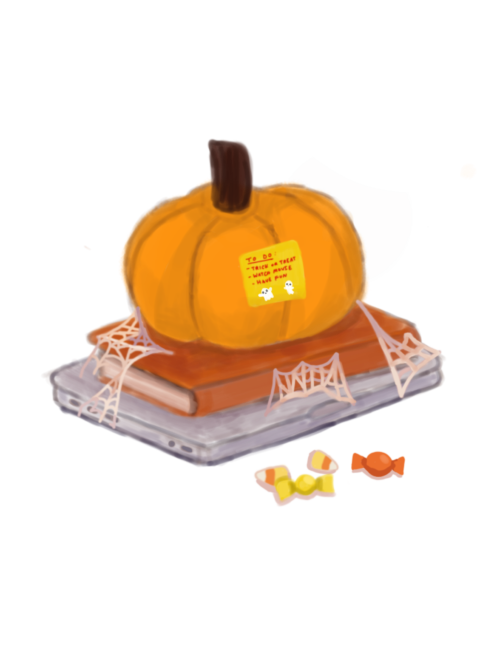
Graphic by Ella Cohen

The scariest time of year is here: midterm season. And I guess Halloween comes in at a close second.
By the last week of September, Trader Joe’s lines its entrance with pumpkins and Target turns the back-to-school section into a jumble of themed Oreos, plastic skeletons, and polyester costumes designed for the landfill. By Oct. 31, it can feel like the holiday has been building toward a single question: how much have you done to make it festive?
In my London neighborhood, the answer is “a lot.” Each year, my neighbors line their doorsteps with pumpkins, guard their doors with a skeleton, and hang up webs. But recently, their displays have grown far more ambitious. More pumpkins, fuller graveyards, even fog machines. One skeleton is no longer enough. Houses across the block battle to outdo one another with bigger decorations, better candy, and increasingly elaborate displays. And the numbers suggest it is not just my street—according to the National Retail Federation, consumers are projected to spend $13.5 billion on Halloween in 2026, about $115 per person.
I’ll give these fanatics this: decorating is fun, and there is nothing wrong with wanting to make your residence the spookiest among similarly spirited neighbors. But when the holiday starts to feel like a contest, the decorations can become more important than the people meant to enjoy them.
So what makes a Halloween tradition worth keeping? Halloween is best when it is easy to join, so the best traditions give people something to do together. If a tradition requires a big budget or massive production, it is not open to everyone. When traditions meet that standard, a few clear winners emerge.
First, trick-or-treating is the clearest and most classic example. It lets the whole neighborhood take part, which makes it the most shared of all. For children, the goal is to collect as much candy as possible. It also offers the pleasure of walking from house to house, seeing the costumes, and talking to neighbors. According to “Smithsonian Magazine,” trick-or-treating descends from earlier customs like “souling,” where people went door to door offering prayers for the dead in return for food, and “guising,” where children performed their talents for treats.
As the modern American custom spread in the 1920s and 1930s, common, disruptive Halloween pranks gave way to organized trick-or-treating, offering a safer alternative. It has lasted because it made the holiday friendlier by giving people something decoration alone cannot: a reason to knock on a neighbor’s door.
The same logic explains why a movie might be the best tradition for anyone with a packed week. The right film depends on the fear factor you want: “Hocus Pocus” or “It’s the Great Pumpkin, Charlie Brown” for a cozy night in, “The Shining” or “The Silence of the Lambs” for a proper scare, or “The Nightmare Before Christmas” if you are already ready to move on to the Christmas mindset. But the movie matters less than the ritual: when someone picks a good film, an ordinary night in your dorm with your roommates fills with Halloween spirit.
Pumpkin carving and haunted houses work as good traditions for the same reasons, but in their own ways. A perfectly carved pumpkin looks impressive on a doorstep, but the fun is in the process: scooping out slimy pumpkin guts and seeds, trying to draw a face on a curved surface, and loving your imperfect creation anyway. It is a decoration you can enjoy making rather than one you have to buy to show off, which is exactly why it beats the fog machine.
A haunted house is the more intense version of that, and even with a ticket price, it earns its place because of who you go with. There is the dark hallway, the sudden noise, someone leaping out from behind a curtain, and a friend grabbing your arm in fear. The attraction is partly the scare, but also the fact that everyone goes through it together, and the fear is temporary enough that you can laugh about it as soon as you reach the exit.
Costumes are where the competition is most likely to creep in. Adults are planning to spend an average of $60 this year on their costume alone. The more detailed the outfit and the more niche the reference, the better the costume, or so the thinking goes. But a costume can be funny and recognizable even if you make it from things already hanging in your closet. Last year my friend and I left our planning much too late, and we ended up going to a Halloween party dressed as each other. It cost us nothing, and no one could tell what we were, but we still had fun.
Halloween’s best traditions do not require elaborate planning, a big budget, or even much enthusiasm for being scared. The only ones that do not make the cut are the ones built just to be seen: the biggest display, the most dramatic costume, the most photogenic party. That is not to say that they are worthless, but the problem comes when the contest comes before the fun. Ultimately, the “best” Halloween tradition is subjective: it is whatever you feel like doing.
At Harvard, where Halloween lands in the middle of midterms, problem sets, and all the ordinary demands of the semester, it can feel like one more thing to get right. But this year it falls on a Saturday, so that work can wait until Sunday. A movie in the common room or a costume thrown together an hour before you head out takes almost no time or effort, and either one gives you a reason to look up from your laptop and spend an evening with people. The traditions are just an excuse to have fun.
Halloween’s customs have changed over time, and the goal is not to preserve one perfect version of it. For some people, that will still be a massive decorative skeleton. The rest of us can make memories with friends and family, pick a good movie, and enjoy the tricks and treats. The point of a tradition is not to have the best-looking Halloween, but to enjoy the spookiest season of the year.
Audrey Cheng ’30 (audreycheng1@college.harvard.edu) is planning to use Halloween as an excuse to wear pajamas to class.