A Case For American Nuclear Energy
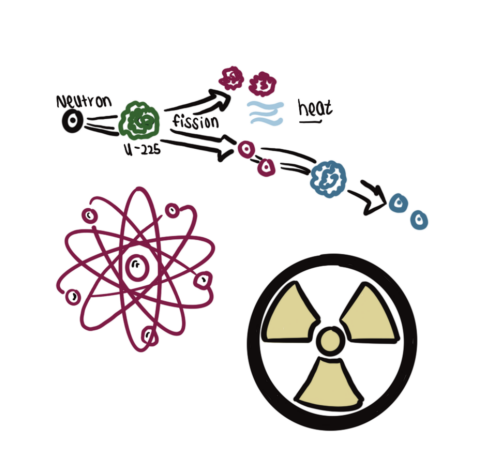
Graphic by Amelie Lima

Science, politics, and economics all say nuclear energy is the key to a clean future. The source currently accounts for just 18.6% of total electricity generation in the United States, despite capacity (the construction of new plants) remaining relatively steady since 1990. The semi-forgotten clean energy source has received minimal investments over the past 30 years, while wind and solar power have received billions of dollars—even though they account for a similar percentage of today’s total electricity output. By the end of this piece, I hope you will understand the power of nuclear energy and why I have decided to dedicate part of my future career to the field.
What even is nuclear energy? How does this atomic science produce this massive amount of power? When you consider that nuclear physicists dedicate their lives to understanding these questions, they become far more complex. In the most basic sense, nuclear fission works by splitting atomic nuclei (typically uranium), releasing a massive amount of heat that turns water into steam, which powers a turbine to produce electricity. In other words, nuclear energy harnesses the power of highly exothermic reactions.
Ok, now we know the process—next, the context. The history of nuclear energy is layered, which leads me to question what the world could have looked like if we considered the plain facts rather than jumping straight to fear rooted in past events. After the Manhattan Project, it became clear that the destructive powers of nuclear weapons could be leveraged for energy generation. Through military and civilian research, alongside initiatives such as Eisenhower’s “Atoms for Peace,” nuclear power was expanded into electricity production for naval vessels and domestic homes. Starting in the 1950s, countries around the world—mainly the United States and the Soviet Union—aligned, invested heavily in the source, and expanded its use across North America, Europe, and Asia.
After this rapid development of the energy resource, what changed? Why has the United States gone from a net increase of 109 nuclear reactors between 1960 and 1990 to a net decrease of 18 since then? Often called “the most serious accident in U.S. commercial nuclear power plant operating history,” Three Mile Island was a partial reactor meltdown on March 28, 1979, which released radiation affecting two million people.
The two other major accidents often associated with nuclear power are Chernobyl and Fukushima. The Chernobyl disaster occurred on April 26, 1986, due to a flawed Soviet reactor design and multiple operational errors, including the disabling of the automatic shutdown mechanism. The result of this terrible event was 30 total deaths—all operators and first responders—and the release of radiation affecting millions of people in surrounding areas.
The Fukushima disaster occurred on March 11, 2011, following an earthquake and tsunami that limited the plant’s cooling capacity, leading to a meltdown and the release of radiation into the Pacific Ocean. There were no direct radiation deaths, though thousands of deaths were associated with the evacuation. Notably, the reactor handled the earthquake well, as they are designed to withstand such events. The problem was that the reactor was not built high enough above sea level to withstand the tsunami. As a result, 11 of the 12 backup diesel generators were shut down due to water damage. All it would have taken to prevent this disaster was building the plant higher or placing the diesel generators in watertight bunkers.
All three of these accidents sound awful until you put them into context. For Three Mile Island, the radiation from the meltdown averaged one millirem above the usual background dose; for context, you receive six millirem on average from an X-ray and 3.5 millirem on a coast-to-coast flight. Chernobyl, by far the worst of the disasters, caused at least 30 deaths and 5,000 cases of cancer as a result of radiation. And in all three cases, industry regulations were overhauled to improve safety.
Despite these tragedies, this is a minuscule number compared to deaths caused by gas and oil. I do not have the space to account for the estimated 91,000 deaths in just the United States each year due to these industries, not to mention the ecological disasters they have unleashed.
Nuclear energy, yes, is powerful and can be dangerous when mismanaged. But with proper oversight, the numbers show it is significantly safer than our primary forms of energy generation.
Nuclear power is one of the most stable sources of energy. When a global crisis sends oil prices skyrocketing and unpredictable weather hinders solar and wind fields, nuclear power provides stable, constant power generation. It requires one three-hundred-sixtieth and one seventy-fifth of the land area used by wind and solar, respectively, to produce the same amount of kilowatt-hours—a unit equal to 1,000 watts sustained for one hour.
In terms of sustainability, nuclear energy is critical to a carbon-free future. On a lifecycle basis, nuclear power produces about 12 grams of carbon dioxide per kilowatt-hour, roughly equal to wind power, and one-quarter as much as utility-scale solar. France serves as a real-world example, with two-thirds of its electricity generated by nuclear power. Its carbon emissions per kilowatt-hour are 42 grams, compared to the global average of 472 grams. Even with these low emissions, France ranks among the cheapest countries per kilowatt-hour in Western Europe.
A common fallacy in the nuclear debate is that nuclear waste is unmanageable. The amount of waste produced by the United States over the last 60 years could fit within a football field stacked ten yards deep. So far in our production history, we have produced 400,000 tons of nuclear waste; each day, we consume 12 million tons of oil. This doesn’t even mention that waste could be recycled and reused for power generation with further research. The waste produced has its radioactivity reduced to one one-thousandth of its original level after 40 years. While still not safe, with proper investment in geologically stable storage sites, the issue of nuclear waste could be effectively addressed.
Beyond the waste issue, the main downside—cost—is being addressed by multiple initiatives. On May 23, 2025, President Trump issued four executive orders focused on reviewing nuclear regulations and their effectiveness. There has also been a push to construct small modular reactors, which, among their many benefits, enable mass production rather than the specialized construction required for large reactors.
Nuclear energy has spent years being Hollywood’s bogeyman. From “The Simpsons,” prominently featuring a satirized (and arguably fully misinforming) nuclear plant, to movies like “China Syndrome” that rest on misleading or exaggerated premises. Even the “ecological groups” pushing against nuclear conveniently take millions in donations from oil and gas. This era of deception must come to an end if we want a clean, bright, energy-dense future.
With billions of well-deserved dollars being pumped into the industry, a nuclear golden era appears to be on the horizon. And because of its amazing benefits, it is safe to say nuclear is the key to breaking oil and gas’s hold on the world.
Kalvin Frank ’28 (kfrank@college.harvard.edu) is excited to learn more about nuclear energy.