A Drag Path
Graphic by Clara Lake

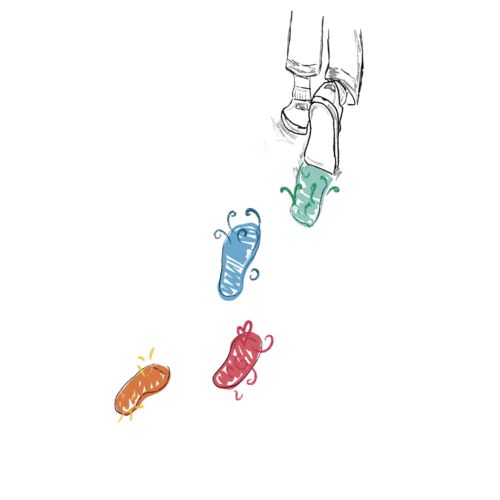
What does it mean to show one’s existence? What mark can one make as proof of their time on Earth? These are broad questions with no definitive answers. Nonetheless, we ponder these questions as we age, as every moment in life seems more important than the last. It is this tension between impermanence and the need to matter that the concept of a “drag path” finds its meaning.
A drag path is a mark left behind when an object is physically dragged across a surface. The term has been popularized—mainly through TikTok—as a metaphor representing trauma and the objects left behind as a reminder of all that was lost once someone has passed away. However, for the purposes of this article, I choose to define it more closely to its original meaning—as a depiction of the desire to be remembered through the trace we leave in the world simply by having existed in it.
With commencement around the corner, I imagine some seniors are totaling up their time at Harvard: wondering if they did enough, formed enough friends, or left any semblance of a mark on the University over the course of their four years of study. To be fair, considering the storied history of this institution, it can be easy to feel insignificant amongst the roster of past giants who have walked these halls. On a campus like Harvard’s, where every room, building, and cobblestone bears the names of those who came before you, building a legacy seems an impossible task. However, building a legacy has never been about statues or accolades, but about the drag paths—the small, often unnoticed things we leave for the people and places around us.
Rick Warren, the pastor and founder of the Saddleback Church, speaking at the 2024 Oral Roberts University Commencement, spoke to this message: “When people are dying, and they know their time is short, what they want in the room is not things or trophies or achievement. What they want is the people they love.”
There is something important in this message that, as Harvard students, especially now in the face of deflationary grading measures, we should be attentive to. When all is said and done, no one has ever wished, on their deathbed, that they had spent more nights in Lamont Library or skipped out on a friend’s birthday to grind out another problem set. Your grades are assigned to you, your legacy, on the other hand, is built and shaped by you and the people you meet along the way.
Thinking about legacy, my mind goes to the Old Burying Ground adjacent to First Parish Cambridge, right across from Johnston Gate. Many Harvard undergraduates have walked past this graveyard without giving it much thought, but few have ventured in to visit those who rest there permanently. Admittedly, I have a special connection with the burial ground, given that last semester, I was involved in a restoration project surrounding the site and spent a lot of time among the headstones. There are half a dozen former University presidents buried there, but you wouldn’t know it simply passing by—men who shaped the very institution you walk through every day, reduced to weathered stones that most people do not give a second glance.
Though the legacy of some, like Henry Dunster, Edward Holyoke ’1705, and John Leverett ’1680, live on in our residential housing system and street names around the Square, spare a thought for Charles Chauncy, Urian Oakes ’1649, and John Rogers ’1649. Their names don’t ring familiar bells, their drag paths worn smooth by the very thing that weathered their stones in the first place—time.
Though their names may have been forgotten, their marks remain intertwined with the fabric of this University. Invisible to the casual eye, they remain there nonetheless. So, as you walk through Johnston Gate, whether it’s on your first or last day, perhaps take a moment to cross the street, squeeze through the padlocked gate, and step inside the old burying ground. Stand amongst the stones, read the names that came before you, and make up the ones that have faded over time. And then ask oneself what mark one is leaving behind.
Your legacy isn’t left on your GPA, but in the lonely person you stopped to befriend in lecture when you didn’t have to, on the professor who remembered your name not because of your academic performance but because you showed up to office hours with genuine curiosity. In a community you were handed four years ago, you made it a little bit brighter just by being you. That’s all that matters in the end, being yourself and leaving a place better than you found it.
To the seniors, a final note. Be proud, not only of the degree, but of the drag path you have left behind. The friendships you chose to invest in when it may have been easier to stay silent and get through college on your own; those 2 a.m. conversations that turned into the most memorable experience of your life; that impromptu Joe’s run just because why not. All these things add up. Every moment you choose to be a person first and a student second adds up, and one day, when you are further from this place than you probably can currently imagine, it’ll be those moments—not the grades, not the accolades—that you return to. Harvard might have given you a degree, but through your friendships and actions, you gave each other something much more durable than that. Be proud of it and carry it with you. That’s your legacy; that’s your drag path.
Noah Basden ’29 (nhbasden@harvard.college.edu) hopes to be remembered for loving Hawaiian Rolls.