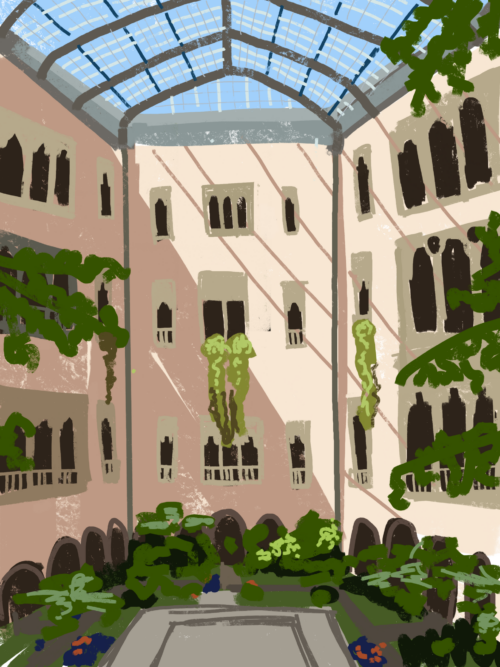
An Evening at the Isabella Stewart Gardner Museum
Graphic by Cameron Bernier

When I entered the Isabella Stewart Gardner Museum through a heavy glass revolving door, I could only think of one word to describe it: pristine. The large, elegant lobby narrows into a hallway that is flanked by a gift shop on the left and a coat check area to the right. At the end of the hallway, you are given two options: go to the second floor or embark down another long, glass hallway. I opted for the first.
Isabella Stewart Gardner first gained an appreciation for the arts while travelling through Europe and Asia with her husband, John “Jack” Gardner. Soon after, she began taking art history classes at the Harvard Annex, later known as the Harvard Radcliffe Institute, where acclaimed Renaissance art historian Bernard Berenson ’87 was her advisor. In the 1890s, Berenson aided the Gardners in curating an extensive art collection ranging from the Renaissance to art of the late 1800s. The two dreamed of opening their own art museum, so when her husband died in 1898, Gardner naturally set out to fulfill their dream.
After two years of construction (1899-1901) and two years of installation (1901-1903), Gardner’s museum, Fenway Court, was open to the public. When Isabella passed away in 1924, she left behind explicit instructions that the museum should be open to the public forever. The museum’s popularity skyrocketed in 1990 following a heist that stole 13 art pieces, valued $500 million at the time and making the robbery the largest property crime in U.S. history. Today, the museum displays the empty frames of the pieces to serve as a reminder of what was lost.
On Dec. 4, the Isabella Stuart Gardner Museum had its “First Free Thursday” event, in which the museum is open later than usual and offers free entry to all patrons on the first Thursday of every month. Throughout the year, the museum also offers discounts and free admission to students/faculty from nearby colleges using a school-specific promo code. Harvard students can gain free admission using their Harvard ID, but they may need to contact the Dean of Students’ office to access a promo code when booking tickets.
The museum has two main buildings. One, the “New Wing,” features limited-time, contemporary exhibitions; the other, called “the Palace,” was modelled on the Renaissance palaces of Venice and features a courtyard area flanked by galleries of art that Gardner curated during her lifetime.
When Gardner died in 1924, she left clear instructions that no permanent changes should be made to the museum displays. To keep her legacy alive, the museum’s board of trustees decided to construct an adjacent building, the “New Wing,” to use for special exhibitions, concerts, and other events. The “New Wing” is attached to “the Palace” by a glass corridor.
From Oct. 23, 2025, to Jan. 19, 2026, the second floor of the “New Wing” will feature various pieces by Boston artist Allan Rohan Crite (1910-2007). The exhibition brings life to the gritty urban landscape of Boston, using religious and political subjects. Crite also used a wide variety of mediums, from textiles to oil painting.
For me, the most striking feature of the museum was the wall of artists who were mentored by Crite or influenced by his work. The museum also offers an opportunity for guests also inspired by Crite to draw on a piece of paper and add it to an adjacent wall of artwork. By allowing museum-goers to not only view the art but participate in it, the exhibit encourages visitors to step out of their normal roles as audience members, and engage with and be moved by Crite’s art on a deeper level.
Upon returning to the main level, I moved down towards the long glass hallway to “the Palace.” Even in the night, the garden surrounding the hallway was enchanting—a work of art in itself. The hallway opened into a courtyard, with exhibitions flanking a main botanical garden. The garden changes its display every one to two months; currently, the museum houses a holiday-themed garden with amaryllis and flowering jade trees. Jazzy, ambient music floated through the courtyard, and it smelled of fresh rain and earthly bliss. The area felt regal, and I could almost feel Gardner’s presence—her soul and her devoted appreciation for the arts—in every curated piece.
The most unique aspect of “the Palace” is the way it is arranged. Rather than strictly being divided by time period or art movement, exhibits were curated based on subject or theme. One moment, you would be staring at some Ancient Greek or Roman structure; the next, a French Romantic oil painting.
One particularly striking exhibit was one based on images of the Madonna, or the Virgin Mary, which included a piece titled “Black Glass Madonna” from the 16th century. Right on the side featured an explanation on how the glass would have been blown, and it included oversized examples of the intricate glass rods and tubes to allow viewers to feel the textures.
Other rooms were less concrete in subject, such as the Yellow Room and Blue Room. The former heralds Isabella’s dedication to music, featuring paintings of ballet dancers, images of musicians, musical instruments, and paintings with musical titles, namely James Whistler’s “Harmony in Blue and Silver: Trouville” and “Nocturne, Blue and Silver: Battersea Reach.” The latter showcased Gardner’s dedication to the art of her lifetime, and it features anything from paintings, letters, and novels made by her friends and contemporaries.
A few rooms provided more insight into Gardner’s life. The Macknight Room, for example, was used by Isabella as an office, and the many trinkets covering her desk demonstrated her expansive tastes: an ivory magnifying glass from 19th-century Japan lying beside an Egyptian sarcophagus from 900-300 B.C.E. Similarly, Gardner used the Spanish Chapel as a space to mourn her son, Jackie, who died when he was one. The painting in the room, “The Virgin of Mary,” shows the baby Jesus sitting on his mother’s lap, showcasing her personal connection to the space as a way to express her grief. After she died, Isabella Gardner was laid in this room beside a statue of a deceased knight in accordance with her funeral instructions.
The Isabella Stewart Gardner Museum is not just a collection of history—it is a preservation of Isabella’s soul, her commitment to uplifting the arts in any way she could. The museum is not curated based on any one theme or aspect of art. Instead, it is specifically tailored to Isabella’s aesthetic tastes, allowing patrons to feel intimately connected to Isabella. Each piece, whether that be an expansive oil painting or small household object, was carefully chosen by Isabella for a reason only she could understand, allowing us to gain an understanding of the world through her eyes.
Although I am typically not one to revisit museums multiple times, the Isabella Stuart Gardner Museum is different. Visiting the museum is an immersive experience due to the uniquely enchanting atmosphere present in each exhibition, and I find myself already longing to return.
Eden Bridge-Hayes ’29 (edenbridgehayes@college.harvard.edu)writes Arts for the Harvard Independent.