Audiobooks on Our Minds
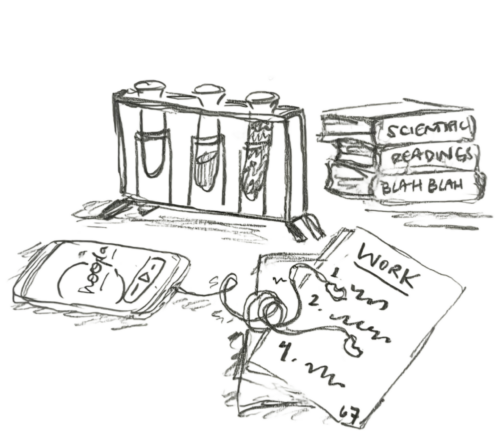
Graphic by Annabella Burton
Growing up, I proudly wore the title of “bookworm.” I completed every classroom reading challenge, spent my summer breaks combing through bookshelves, and my most prized possession was my public library card.
Every time my family moved, I made sure to get a replacement card (or two). I became such a prolific page-turner that my mother gave up on protesting my reading late into the night, giving me a bedside lamp that allowed me to become acquainted with Ally Carter, James Patterson, and John Green, who introduced me to Cammie Morgan, Max Ride, and Hazel Grace Lancaster.
Unfortunately, my reading habit began to wane when I entered high school. Reading for pleasure was often sacrificed for my coursework and annotating texts for my literature classes. Fortunately, I actually found many of the assigned classic and contemporary novels to be interesting. Instead of bemoaning required texts, I embraced all the life lessons I could learn from them. For example, I lost my ability to understand why people like to compare themselves to William Shakespeare’s “star-crossed lovers.”
But then came college. As a STEM concentrator, I longed for a return to reading for pleasure before bed. However, I would instead find myself up past midnight, slowly evolving into a Lamonster. As many of my peers would also come to realize, life is not just about scientific studies! But thankfully, my quantitative exploits have brought me back to audiobooks.
I was first drawn to this form of media after learning that it was included with the free online services offered by my hometown public library. With help from the app “Hoopla,” which allows users to borrow ebooks and audiobooks through partnerships with local public libraries, I could conveniently access audiobooks of great works through my phone or laptop. I still recall using it in middle school to listen to a class text at 2x speed to finish an assignment faster. Now, these narratives serve as my background noise while doing laundry, riding the shuttle, and pipetting. It’s the best way for me to return to my oldest hobby as a busy college student.
I’m not alone in this endeavor. For instance, Gabriela Rojas of Florida International University described in a “Her Campus” blog post how reading had similarly been a beloved childhood hobby that she had lost to the growing responsibilities of college life. Much like me, she turned to audiobooks to retain her adolescent passion—but now with an added convenient twist.
“What used to feel like ‘lost’ time—doing laundry, washing dishes, or cleaning my apartment—has turned into valuable reading time. I actually enjoy these chores now,” Rojas continued.
While audiobooks are a great option for collegiate bibliophiles, they are not without their critics. Some may worry that listening alone does not allow people to fully comprehend books the same way they could while reading. According to the University of Delaware, reading text requires us to decode the meanings and patterns of written symbols. Listening, however, relies on different parts of our brains, allowing us to interpret the meaning of words by examining tone and word choice in real time.
Though reading a physical text and listening exercise different parts of our brain, both are mentally invigorating, just in different ways. However, when going through more complex texts, a slower, close reading of a physical text may be helpful for comprehension. This is especially evident when compared to someone struggling to understand fast speech in real time with audiobooks. On the other hand, audiobooks make reading as a hobby more accessible to people with learning disabilities such as dyslexia, who may find themselves frustrated when grappling with written words. Multitasking (e.g., doing chores) while listening to audiobooks may reduce retention, but I still think it’s a great option for students who are short on time. Most audiobook platforms also allow users to adjust audio speed and volume to aid comfort and comprehension.
Harvard students have many convenient options for accessing audiobooks. Both the Cambridge Public Library and the Boston Public Library have partnerships with Libby, a free ebook and audiobook service. Using one’s student ID, a Harvard undergraduate can obtain a library card from either or both libraries, granting them access to up to 20 audiobooks per month. Cambridge Public Library also partners with a similar app, Hoopla. Other public libraries across the nation have similar partnerships, so even postgrads can take advantage of this.
The next time scrolling through YouTube fails to give you the perfect background video for folding laundry or eating dinner, try an audiobook. You know you’ve missed it. After all, your next friends may just be Agatha Christie, Freida McFadden, or even former Mather House resident, Julia Quinn ’92. I’m sure they’d be more than happy to connect you with the fascinating Hercule Poirot, Blake Porter, and Lady Whistledown.
Adedoyin Adebayo ’26 (aadebayo@college.harvard.edu) has placed a hold on “Going to Meet the Man” by James Baldwin through Libby.