Befriending “Paradise”
Graphic by Clara Lake

“Paradise is not easy to reach,” said Nonna Manu.
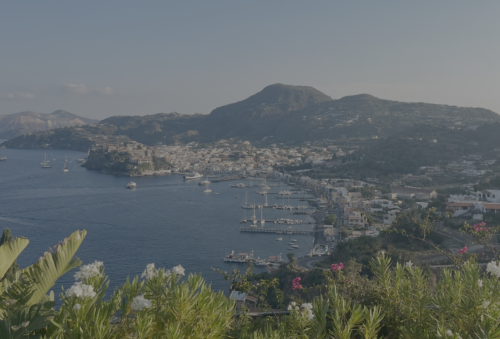
From the ridge upon which her house sat, I could see the white rooftops of Lipari spilling down the island’s green hills and into the sea, where the port and the “Laurana,” the ship that my travel companions and I had just arrived on, were nestled.
“Nonna Manu” is a nickname given by her two grandsons, aged six and two-and-a-half. These were my adopted family members, as I would spend July as their au pair, teaching them English. I was following in the footsteps of my mother, who decades earlier had gone to Italy as an au pair for the boys’ father when he was their age. As a college student from the suburbs of Massachusetts, I was stepping into a life very different from the one I knew—onto an unknown island where I knew no one beyond my pseudo-family and did not speak the native tongue.
The first night, I told Manu I hoped to run while I was there (as a skier for Harvard’s varsity Nordic team, this would be my summer training). She suggested I begin right then and gave me instructions for a route up the nearest hill. As dusk fell, I set out down a street whose slope made my knees ache. The asphalt through rows of stucco houses soon gave way to a dirt path. I ran until I reached a small church high above the coastline. Peering over a cliff, I could see the lights of Canneto below, bright against the dimming orange light of the sun and the navy blue of the Tyrrhenian Sea.
Standing there, I was overwhelmed by the unfamiliar beauty of my surroundings, filled with excitement and curiosity. I had a feeling that I would find my place that summer, in the only way I knew how as an endurance athlete—through motion.
Life on the island settled quickly into a routine. My mornings began early. I would awaken before the rest of the family and slip out onto the porch in time to glimpse the sunrise, which cast a soft pink glow on the sea, illuminating the Stromboli volcano in the distance. In these quiet hours, I ran on paths that barely existed, leaving only traces on the satellite map on my phone. At one point, it led me through a patch of thorns and to the top of Monte Guardia, overlooking the town. From my perch, I could also see two large rocks in the sea that Manu told me are landmarks in Odysseus’ journey home from Troy.
The Isole Aeolie (Aeolian Islands) are named after the Greek ruler of the winds, Aeolus. They were born from volcanic eruptions; evidence of this surrounded us. After breakfast each morning, Manu and I prepared the boys for the beach. There, we swam together and watched the older boy jump from the pier with friends while his younger brother cooked pails of “pasta pesto” and cake from pebbles, singing “tanti auguri a te,” or “happy birthday to you.”
These days were marked with memories—and candidly, lessons. One morning, I saw what I thought was plastic floating in the calm water. I assumed that pollution had reached the edges of our Earth until the eldest son told me it was a rock: pomice, he said. Manu pointed out that its white and light structure demonstrated its volcanic origins. A few weeks later, Manu drove us around the island to see the now-closed pomice (pumice) mines. The cliffs were entirely white, sloughing into shallow water tinted turquoise by the pale rock below and ivory fragments that dotted the surface.
Tuckered out from the beach, the boys usually napped after lunch, along with most of the island. Their siesta was strange to me at first; while the island slept, I stayed awake, braving the heat in the quiet streets. One day, I jogged two kilometers downhill to the sea along the road we usually took, swam laps, and climbed back up the switchbacks. Midway through July, I rented a trekking bike from a man named Bruno and pedaled my way around the brutally hilly circumference of the island. Each afternoon, under my sweating brow, I began to feel closer to the island; it was becoming my friend, especially since I could not understand the Italian everyone else spoke.
In the late afternoons, Manu, the boys, and I went back out exploring. Manu took us to the far corners of the island, sharing her intimate knowledge and appreciation for the land, having first visited at age nine. The children’s curiosity and energy fueled my own and gave me a unique lens through which to experience the environment we were learning about together.
One day, we drove to the other side, to Acquacalda. Between the cliffs and the sea was a single row of houses, separated from the water only by the street and a rocky beach that clattered noisily as the waves washed over it. Manu said that during the winter, the waves were so large and violent that no one could live there. There were large manmade rocks that the older boy scampered over. I was close behind, flinching with anxiety each time a wave sprayed us, then helping the younger one follow his brave older brother. I could feel the intensity of that town, but let myself see it through their eyes, as an incredible adventure. “I am the king of the world!”
Another afternoon, we went to the Caolino Caves. Colorful red and white hues of volcanic earth rose around us, remnants of past excavations, a hint at how humans once tried to extract from this place. The older boy and I hiked down a trail to see where sulfuric gas leaked from a seam in the earth. The dirt was loose and slick, and we slipped a few times, but he was determined to show me.
Back on the porch, the island of Vulcano was visible, with a large crater from past volcanic eruptions. On my day off, I took an aliscafi (a ferry that rides above the water) to this island and hiked all the way up the crater. I peered down into the crater, feeling that I was at the mouth of a sleeping beast. Later, again renting a bike for my journey around this new island, I begged the owner to let me rent a normal bike, rather than an electric one. He finally relented, sending me off on a bright green ride called “Starfighter.” I was soon reminded of how harsh volcanic-formed hills are, particularly under the relentless sun. On Vulcano, I found beaches where the sand was completely black and burned the soles of my feet.
The Aeolian Islands have been a UNESCO World Heritage Site since 2000, protected for their unique volcanic environment. I am beyond grateful for my time there, to the boys for showing me how to explore like a child again, and to Manu for sharing this special place with us. Paradise may not be easy to reach, nor is it easy to know. But learning Lipari through motion created a grounding connection.
Back home, where nature feels more contained, I miss that intimacy. Surrounded by college students, I almost forget what it feels like to view the world with childlike wonder. But the lesson remains: to know a place is to experience it with your whole body. Run through the cherry blossoms and see the beauty of Boston in spring, look for new ways to understand where you are, and move through it, with it, rather than simply past it.
Clara Lake ‘27 (claralake@college.harvard.edu) claimed the Strava QOM up Vulcano’s crater.