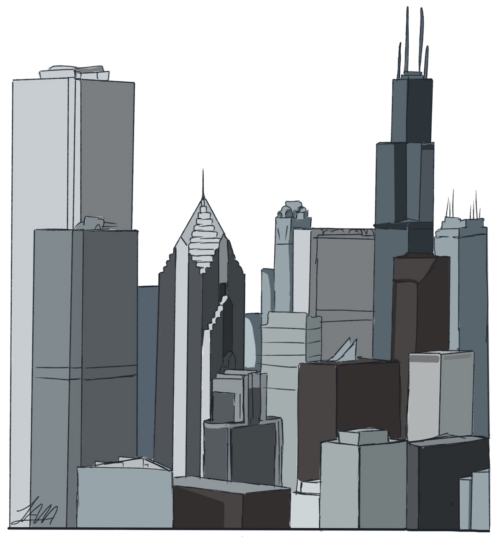
Exploring American Hometowns: Dear Chicago
Graphic by Linden McCarl

A SoundCloud remix of Frank Sinatra’s “My Kind of Town” bellows out of the car’s stereo as we barrel down Lake Shore Drive. We speed south, maneuvering through congested city lanes. Time feels briefly arrested. Across the windshield, I can only see fuzzy streams of red car lights, apartment stoops, and skyscraper windows. The headlights crunch the streetlight colors together, making them sting. I sway my arms back and forth out the car window.
Later that early-April Chicago night, we pull into the gas station at the corner of LaSalle and Clark. Chicago’s Windy City air sings Chance the Rapper with us. My front passenger seat window is half-open.
A man strides up to our car. In the few seconds I see him, he’s about 20 years old, and he’s sporting a black hooded Nike zip-up. I turn my head, and the man has extended his arm through the window. I look closer. He has a gun in his hand.
Life and death get reduced to seconds. I can hear my parents telling me that everything but my life is replaceable. I imagine them in front of the TV, shaking their heads, arms crossed: This city’s problem is only getting worse. What will it take for something to be done? You read the stories, you get the alerts, and you assume it will never happen to you.
Back in the moment, I instinctively wrestle my purse from my seatbelt as my friends throw their wallets, purses, and phones at me from the back seat. It feels impossible to muster the force to shove our belongings through the window, but I do anyway. He grabs our stuff and runs off into an alley. We sit there slowly drowning in our silence. While our shock is pervasive, our fear quietly lurks—we do not speak or cry.
Time stands still, and Chance echoes quietly on the radio.
I winnow my focus back to the simple memories of Chicago: biking to Kanye West’s “Homecoming” with my friends along the Ledge; pressing my nose against the glass of the John Hancock Observatory; eating ice cream on the steps outside “Bucktown Market,” Wabansia’s convenience store. If I listen closely enough, I can hear Uncle speak to me in Hindi, and then maybe everything can fit back into its place. Shukriya.
The fluorescent depths of my swollen city backyard lure me back. And just as abruptly, it returns, gorgeously and impossibly—the same city, the same streetlights. Nothing looks different.
***
In the days, months, and years that followed, I tried to remind myself that this was not who Chicago is. I know that. The quiet rituals—Italian food at Club Lucky, Bucky the Bucktown bunny, hours spent in line at Annette’s Italian Ice, screaming “Go, Cubs, Go” from the bleachers of Wrigley—they’re an enduring, internal compass that allows me to return to the same streets, the same skyline, the same home. But cities cannot divide so easily into two parts: the one I love and the one I fear. These two sides, the sweet and the flawed, are part of the same story, not separate ones.
People say that during accidents, moments are magnified. Wasn’t I supposed to want to run away from this city? How could I still call this place home? What I hold onto most from that late night in April is my unexpected composure, as though some version of myself was already prepared to meet the darker side of this city I love so dearly. One without a river dyed green, Lollapalooza, summers at North Pond, and a silver bean.
I’ve lived in Chicago for 21 years now, on the same street in Bucktown. And it has been one of the greatest loves of my life—the hard, extraordinary kind. It’s the foundation of who I am, most of all for what it has taken and what it has given me—thick skin, pride, even a certain hardness. Maybe this is what it means to grow up in a place like this—you learn to live with its contradictions. To see the same city as both beautiful and complicated, flawed and wonderful.
***
Four years later, I can finally take the driver’s seat, instead of the passenger’s. Trips down Lake Shore Drive remain a kind of catharsis, with the water by my side and the skyline in my front windshield, but this time I’m at the wheel. Certain things have changed: my ZIP code now belongs to Cambridge, Massachusetts; home feels less tied to a place and more to people; the car windows are kept locked; and the gas tank remains full. But I am still a city kid, and this is just what it asks of us: to persist.
I am now learning what it means to fall back in love with a place after it has shown its true self, for all its beauty and its flaws. Not to forget what I saw and continue to see, but to let it exist alongside everything else. To love Chicago, incredibly, painfully, and mythically, is to allow it to be complicated, as it always has been, and choose it anyway.
Rania Jones ’27 (rjones@college.harvard.edu) has fallen back in love with Chicago.