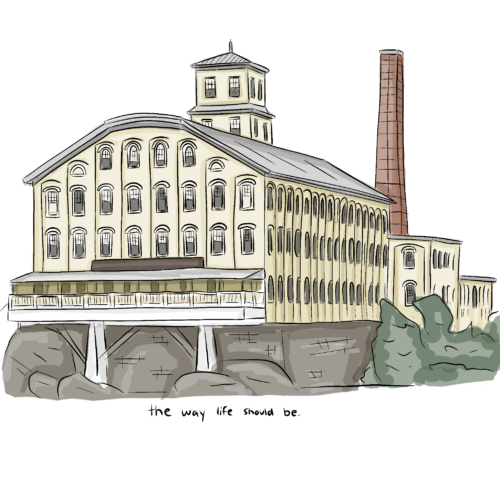
Exploring American Hometowns: Topsham, Maine
Graphic by Miranda Chao Hwang

First of all, it’s not “Top-sham,” it’s pronounced “Tops-um.”
I am what you call a true Mainer, born and raised—we are very proud of our status, and transplants are almost eternally outsiders. If you’ve ever met someone from Maine, they’ll make it a key part of their personality; I’m no exception. I suppose it’s a certain rugged charm: that the cold, long winters, the constant presence of more trees than people, and having the best of all worlds—mountains, lakes, forests, and rocky shores—that endows us with our pride.
But it took leaving my town of 10,000 residents and coming to Harvard to fully appreciate the privilege of having spent my childhood among the creaking pines and the whooshing sea breeze.
We are not to be confused with those who have vacation homes and are fleeting visitors. Don’t get me wrong, we need our tourists. They fuel our economy even as they clog our predominantly two-lane roads, and never know how to pronounce the town they’re in. Speaking of roads, Topsham lies at the gateway to two of the state’s busiest routes: I-295—which connects our capital, Augusta, to the rest of the country—and Coastal Route 1, the scenic way to Acadia National Park. Because of this, we have some of the best pit-stop shopping and dining in the surrounding area.
If I only wrote about Topsham, this article would be too short to make it to print. However, the town is deeply connected to its surrounding areas. For example, my high school served four communities: Topsham, Harpswell, Bowdoin, and Bowdoinham, meaning you could drive across 40 square miles—well over an hour—and still be in the same school district. Given this size, getting your driver’s license at 16 is a basic necessity.
The Midcoast area is known for its long shoreline dotted with harbors, hundreds of islands, charming towns, and forests filled with winding rivers. Topsham is known for being overshadowed by our neighbor across the bridge, Brunswick, home of Bowdoin College. Literally 90% of photos that show up when you Google “Topsham, Maine” are actually Brunswick, sans the old and retired yellow paper mill—that’s ours.
Like many Mainers, I claim to have salt (and a little ice) in my veins. As a baby, my mother used to walk the sandy shores of Popham Beach State Park with me slung in a shawl, scouring for sand dollars. Once I could walk, we’d visit Acadia every summer and munch on wild blueberries as we hiked. As I found my balance on skis, I took to the Maine mountains and quickly mastered the art of faceplanting at uncontrollable speed into powdery snow.
Each season has its extremes: autumn burns through the treetops; a good winter brings mountains of snow; spring delivers the flowers, but mostly mud; and summer is what makes it all worthwhile. Having a bit of everything means understanding that we are at the mercy of Mother Nature, but also learning to tough things out.
There is no waiting for the perfect day—it’s never promised. Even in elementary school, we would go snowshoeing through the wooded trails, snow or shine. In my Advanced Placement Environmental Science class, we would don our waders and trek through the bog at the Cathance River Nature Preserve—one time, the mud took hold of my boot, and I was claimed by the pungent marsh. As soon as the sun arrived in early May, my friends and I would head to the beach, often having to cover our bikinis with sweaters and shorts to protect against the cool coastal winds.
“There’s no such thing as bad weather, only bad clothing,” we say—or at least I say.
Though not a part of my town or school district, the sandy shore of Popham Beach holds a special place in my heart, and it feels impossible to describe my home without it.
I could drive the bends and curves through my neighboring town, Phippsburg, with my eyes closed. I’m convinced that the sand there is eternally tangled in my hair. However constant my love for the long golden beach is, every summer it is unrecognizable.
It faces the Atlantic head-on; each winter it is ravaged by storms and pounded by waves. Accompanied by the shifting of the Morse River, it is the fastest-eroding beach in Maine, losing 91 feet of waterfront land per year.
When I was a child, beyond the gnarled pines were vast dunes of seagrass, home to the small endangered bird, the piping plover. Back then, I used to walk as close to these dunes as possible, afraid the waves would rise and drag me away. Now, the waves have risen and carried off much of the long coarse grass, leaving an elevated bank where, at high tide, the water now kisses the pine roots, which desperately try to hold onto the sand. The dwindling plovers are also now forced to change their nesting habits or face extinction.
I suppose this is the unrelenting nature of the Maine coast. However, the few pockets of sand we have are the most vulnerable to the rapidly changing natural environment. Efforts have been made to protect Popham, such as using donated Christmas trees to help trap and compact sand and replanting dune grass, yet these are temporary fixes with no long-term solution in sight.
The winters are now about 2 weeks shorter, less harsh and less magical, the storms are more powerful and unpredictable, and the sea levels continue to rise, all of which threaten both the coastline and the traditional way of life.
When I run into the waves at Popham, it is cold, but nowhere near the polar plunge it used to be, even in the summer. The waters are so warm that sharks have now become a regular sight, something that never crossed my mind in my youth. The warming Gulf threatens the staple of Maine and our biggest food export: the lobster.
These factors don’t just affect the coastline but also threaten the local way of life. The seaside areas are getting more expensive, and it’s harder and harder for the young people who call it home to stay. It has the largest elderly population in the nation. Add this pressure to our sustaining industries like lobstering and lumber, and the Maine I know starts to feel like it’s fading.
“The Way Life Should Be” is the state’s official slogan, and I wholeheartedly agree. I am also heartbroken that the next generation of Mainers could experience a very different childhood from the woodland wonder of my own.
The “Maine aesthetic” is romanticized as all harbor towns, fresh lobster, and wild blueberries, and we do have that. Topsham is overlooked because it lies adjacent: it is small and wooded, and its coast lies along the Androscoggin River—not quite postcard material. Still, it is my home, my community.
Rural fun is not given; it needs to be sought out, no matter the weather, location, or how mundane things may seem. I have endless stories of backyard bonfires and late-night drives after football games, eyes peeled for deer. I could never decide on one representative Maine day, but last summer came close.
We were at my friend’s camp in the lake-dotted region. It was a picturesque day, with music playing from our phones and cards in hand as we played cribbage on the dock. One of us noticed thick, gray clouds rolling in, but the game had to go on. It wasn’t long before the sun disappeared and the pouring rain began. Instead of seeking shelter, we launched ourselves off the dock into the rippling lake, giggling and splashing. Only when the lightning lit up the sky did we climb out and take shelter inside.
That is the Maine I know and love. There’s no waiting for the weather to clear; just making the most of what we have. The difference now is that the tides and winds are changing.
Sophia Gonzalez ’28 (sophiagonzalez@college.harvard.edu) can’t wait for a true Maine summer.