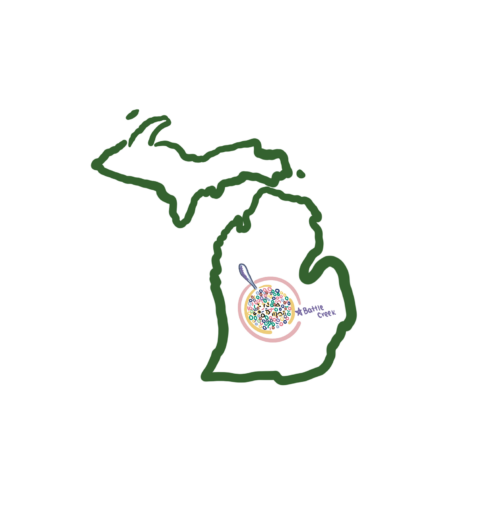
Exploring Worldwide Hometowns: Battle Creek, Michigan
Graphic by Amelie Lima

It feels like most at Harvard have a claim to a well-known city. Whether they’re from urban centers, the suburbs, or somewhere within city limits, people usually hail from places like New York City, Los Angeles, Chicago, and Washington D.C. But when someone asks me the quintessential getting-to-know-you question, I never have a simple answer. I’m two hours west of Detroit; three hours east of Chicago; an hour south of Grand Rapids, Michigan; three hours north of Indianapolis. To most, my hometown is the definition of the middle of nowhere.
But Battle Creek, Michigan, is somewhere.
To me, it’s home. You might have heard of our claim to fame. Battle Creek is also called “Cereal City USA.” The story goes that in the 1870s, Dr. John Harvey Kellogg had hired his brother, William Keith Kellogg, to work in his world-famous health spa, the Battle Creek Sanitarium. In 1898, when working in the kitchen, W.K. Kellogg had left a batch of wheat cereal dough out overnight. Despite this mistake, he decided to roll and cook the dough anyway. What came out was a delicious wheat flake that was later adapted into a corn-based cereal.
After W.K. invented flake cereal in the late 19th century, the national cereal movement began, culminating in over 80 cereal companies opening in my town at our peak. The most recognizable are Kellogg’s and Post. Today, Americans are the fourth-largest consumers of breakfast cereal in the world, with the average resident consuming 160 bowls a year. This statistic is a testament to how my town has shaped the morning routines of people all over the country—and the world—even if they have never heard of the hamlet.
And do not fret; Battle Creek has a few other lesser-known claims to fame. Civil rights activist and feminist Sojourner Truth called Battle Creek home; modern floor hockey was invented here; the Seventh-day Adventist Church, with 22 million followers, was founded in Battle Creek. I could go on, but you get the point: my town of 53,000 people has quite an interesting history.
Battle Creek’s heyday was well before I was born. If I talk to anyone over the age of 50, they know my hometown (likely because they read the cereal box in the morning rather than playing on their phone like us). But like much of the Rust Belt, my town declined after the 1970s. Jobs left, and so did the people.
Even though many described my city as a dead town and national news sites dubbed it “the second-worst place to raise kids,” I found my childhood amazing. As a kid, I remember going to “The World’s Longest Breakfast Table” downtown and meeting Tony the Tiger and Toucan Sam. On the Fourth of July, I recall watching the booming Thunderbirds fly over crowds of thousands, followed by the majestic hot-air balloons at the Battle Creek Field of Flight, which is consistently ranked among the best air shows in the country.
Summers with Grandma and Grandpa consisted of trips to Binder Park Zoo to feed the giraffes. Or visits to Kingman Museum—imagine the Field Museum of Natural History in Chicago, but 180 times smaller. Sometimes we’d take a weekend trip to “the big city”—Detroit or Chicago—or “up north” to our cottage in Harrison, Michigan. But most of my summer was spent enjoying the amenities that my hometown had to offer.
Elementary and middle school brought watching Lakeview High School football games and playing cops and robbers into the night with friends. As nature prepared for the harsh Michigan winter, the yard featured a rainbow of leaves in the fall, which Dad raked up for us to play in before we helped bag and place them at the curb. One benefit of the cold was snow days; winters were full of days skating on the ice of Goguac Lake or skiing at the hill in the neighboring town (I say hill because we don’t have mountains in Michigan).
Despite the people who criticize my “dying rust belt town,” I had the quintessential American childhood, and I wouldn’t replace it for the world. For me, I thought Battle Creek was the perfect size. It was big enough that I didn’t know the vast majority of people who called it home, but small enough that a run to Meijer (think Walmart, but better) usually meant bumping into two or three people I knew. It had the amenities of a larger city, but the friendliness of a small Midwestern town.
Now, the college application process was definitely something Battle Creek could not really help me with. Most of my peers from my high school went to an in-state public university—Michigan State, the University of Michigan, and Western Michigan—or to the local Kellogg Community College. All great options, and ones I applied to. But I wanted something different; to experience something far away, foreign. I threw in applications to schools all over the Midwest and the South, and a few Ivies just for fun. It ended up working out, despite my doubts; here I am today, writing for the “Harvard Independent.”
As I started my college journey, many of my friends saw leaving Battle Creek as moving out and never coming back. I was a different case; I felt indebted to the childhood it had given me, the people I had met, and the education that had brought me this far—Battle Creek was, and forever will be, my hometown. Even if I never return to live, because of college, career, or life, it holds a special place in my heart. I “Believe in Battle Creek” and its future growth, whether it’s home to my future family or I have to root it on from afar.
Kalvin Frank ’28 (kfrank@college.harvard.edu) just enjoyed a nice day on Goguac Lake.