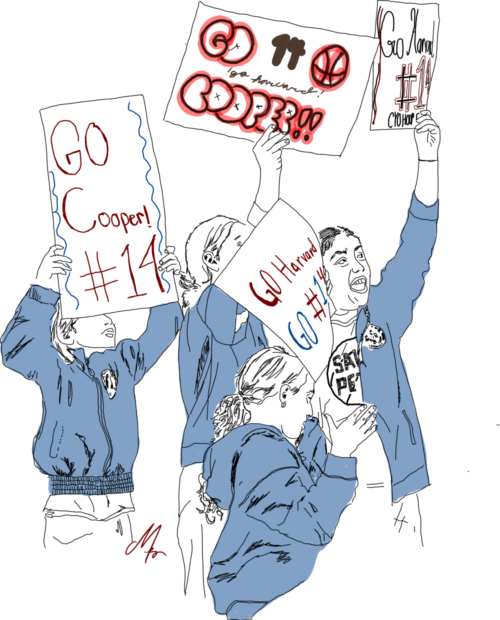
Greg (H)ooper of Cambridge, Massachusetts
Graphic by Megan Legault

All college athletes eventually come to face one of the biggest dilemmas in modern publicity—the retirement post.
How does one sum up four years of hard work and camaraderie into a singular post without suggesting that they tie all life’s meaning to their athletic career or have “peaked?” Even the Oscar-winning short film that marked Kobe Bryant’s retirement has been clipped online, becoming the punch line of a running joke as “Dear Basketball” bellows melodramatically over the dreary instrumentals of a Daniel Caesar single.
Harvard Men’s Basketball’s very own Greg Cooper ’26 arguably got as close as it gets to this sought-after balance. Choosing Drake’s “Weston Road Flows” to set the tone for a curated combination of college and pre-Harvard photos, Cooper showcased how basketball was woven into the trajectory of his life. Most notably, he included a screenshot from a 2019 Snapchat story taken at Lavietes Pavilion, where Cooper wrote “Gonna be playing here one day trust me”… and so he did.
Cooper grew up in Cambridge—Cambridgeport, or “the Coast,” to be specific—a place where basketball was an integral part of the social scene. “On summer nights, the courts at Hoyt Field and Dana Park would fill up with teenagers trying to prove their talent,” Alèx Leith, Cooper’s personal rebounder and childhood best friend, told the “Harvard Independent.”
“As kids, Greg and I would excitedly watch the older boys play from behind the fence,” he recalled. “It would only be a few years before Greg was doing slam dunks on those very courts as hundreds of people watched and cheered.”
Leith and Cooper met playing soccer at Mayor Field when they were nine years old. Since then, Leith has had a front-row seat to Cooper’s journey as a local basketball talent. He watched as Cooper went from competing in informal dunk contests at local parks to winning an undefeated high school state championship, to playing on “the biggest stage in Cambridge basketball”: Lavietes Pavilion. Accomplishments, Leith says, were no measure of luck, but the result of years of sacrifice and determination.
Brandon Wooten, Cooper’s trainer since high school, agreed with Leith’s opinion. Wooten, who also played collegiately, first met Cooper through “Old Man Jim” at the Quincy YMCA during his junior year of high school. “Greg was at the gym almost every day, training at 5 a.m. This got my attention because I only trained athletes who were willing to prove their dedication by waking up early,” Wooten said.
Wooten’s training sessions would begin to push not only Cooper’s physical limits but his mental fortitude with early wake-ups and running suicides to the point of vomiting—uh, no thanks! But, it was in these challenging moments, when he had pushed Cooper to a point of total exhaustion, that Wooten says he “got to see Greg’s true character.”
“Though he was close, he never quit,” Wooten admired. “He always found a way to push through the pain, the negative thoughts, emotions, and self-doubt. He never gave in and never made excuses.” Extreme as it may have been, this training proved pivotal for navigating the trials of his collegiate career and developed a mentality that has served him well beyond basketball.
Growing up local, Cooper had a unique perspective on Harvard when he arrived on campus. While attending St. Peter School, located just a few minutes from the Quad, he had a friend whose mother was a professor and lived in Quincy House. Unlike the rest of us, his earliest memories of campus aren’t from a campus tour or Visitas. Instead, they consist of walking to Felipe’s in eighth grade, riding hoverboards through Quincy’s dining hall, and doing flips on a fitness trampoline to impress college girls who walked by on the lawn.
When it came time to make his college decision, Cooper recognized that his acceptance to Harvard was an offer to a world-class education. So, despite having offers to play basketball elsewhere and a desire to explore the world beyond Cambridge, he decided on Harvard, gambling his athletic career in the process since a walk-on offer was far from guaranteed.
His senior summer, having gained some attention from Harvard’s coaching staff, Cooper was invited to a scrimmage with current players. Not only did he play well, but he also capitalized on this opportunity to connect with members of the team’s roster. “I got their numbers, and they would text me whenever they were in the gym, and they’d open up the side door for me,” Cooper said to the “Harvard Independent.” He spent that summer sneaking in through side doors, putting himself in the eyeline of Harvard’s coaches who watched on as he demonstrated that same no-quit mentality. By the first day of his freshman year, Cooper’s stubbornness earned him a spot in Harvard’s locker room.
Despite all the work he put in to get there, Cooper would not register much court time playing for the Crimson. He could have quit. Without athletic scholarships, even Cooper admires the equalizing dynamics for student-athletes at Harvard. “Athletes are not given a one-up in terms of housing, social status, kind of, everybody’s in the same boat,” he said.
But, remaining true to character, he stayed on the team. “He figured out that there are ways to affect the game without being on the court,” Wooten said.
Cooper welcomed friends and teammates to Cambridge, introducing them to culturally diverse neighborhoods beyond Harvard Square and showing them his favorite local restaurants like The Coast Cafe. His family opened their home for weekly home-cooked meals by his sister and offered a place to go when the team stayed on campus during holidays.
For the Cambridge community outside the Harvard bubble, Cooper has emerged as a role model for young athletes. Playing at local Boys & Girls Clubs’ courts and bringing nearly 150 students, families, and alumni of St. Peter School to attend a Harvard game as “Coop’s Troop” each year.
“What makes Greg special isn’t just what he does on the court, but how he shows up afterward—taking time to meet our students, sign jerseys, and connect with them in a genuine way,” Wendy Burns, Director of Admissions at St. Peter School, said to the “Harvard Independent.”
“Our students see themselves in Greg—a Cambridge kid, shaped by local schools, who has worked hard, succeeded at the highest level, and continues to give back to the community that raised him,” she added. “His kindness, humility, and commitment to others have left a lasting impression on our students. He’s not just someone they cheer for—he’s someone they aspire to be like.”
When a player with significant court time is a fan favorite, that’s one thing; when a player who totaled 44 minutes of court time over four years packs the stands, it speaks to something greater about what they represent. As for Cooper, it is the way he embraced his role, stepping up as Cambridge’s “hometown hero.”
“Basketball is such a powerful sport in that it’s very accessible. Anybody can play it, and it’s such a good connector of anybody, no matter where you come from, your height, your weight, your abilities, your lack thereof,” Cooper said. “It’s so easy to look up to great basketball players in the NBA, in college, and really have that fuel your desire to do what you want to do.”
Walking away from his Harvard basketball career without an accumulation of accolades, the role Cooper has played in the program, and the renewed perspective it gave him on the sport and community he grew up with had an impact far beyond what any award could capture.
“I knew that I was connected with communities, and if I could inspire one kid, that would be enough for me,” Cooper said … and so he did.
Megan Legault ’28 (mlegault@college.harvard.edu)once told Cooper he needed “air traffic control” after watching him compete in a formal dunk contest at Lavietes Pavilion.