Jazz Joints
Graphic by James Foss

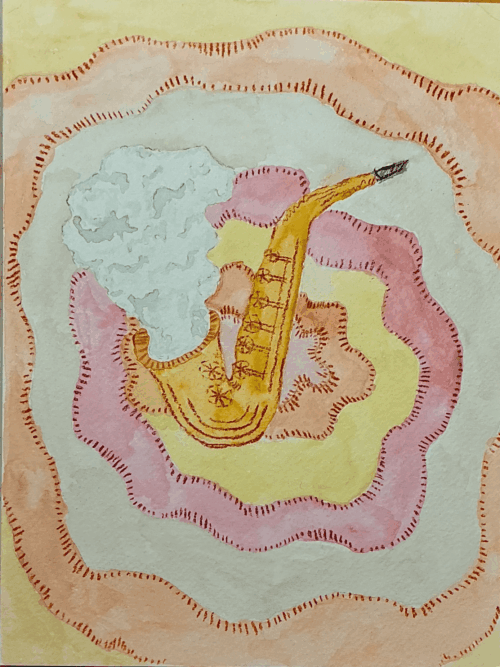
On Feb. 10, 1938, Sidney Bechet walked into a Decca Records studio in New York and cut a track called “Viper Mad.” The song, which Bechet composed with musician Rousseau Simmons, was an ode to smoking marijuana. O’Neill Spencer sang the lyrics over Bechet’s clarinet: “wrap your chops round this stick of tea / blow this gage and get high with me.” Just one year earlier, the U.S. federal government had banned the very substance the song was about.
The relationship between cannabis and jazz wasn’t initially one of social opposition. The jazz music scene began in New Orleans, in the brothels and dance halls of Storyville, a red-light district that hosted performances on a daily basis. The district’s liberal attitudes gave musicians space to experiment and refine new styles, helping popularize jazz in the area by the early 1900s. Marijuana was introduced to the New Orleans jazz scene in the 1920s primarily through Caribbean sailors and immigrants entering the port city, where it was adopted by jazz musicians as a “medicinal” alternative to alcohol. Working long shifts late into the night, marijuana sustained their energy in a way alcohol couldn’t, and provoked a kind of imaginative, experimental improvisation that captivated audiences. Weed and jazz spread together up the Mississippi through the Great Migration, landing in Chicago and then Harlem, where both took on an entirely new feel.
Jazz players who used cannabis were called “vipers,” named for the hissing sound produced when taking a big draw. By 1930, there were around 500 tolerated “tea pads,” or marijuana bars, in New York alone, offering joints for around 20 cents. These social institutions helped legitimize marijuana use. In the jazz world, the viper was not a criminal; he was simply a musician who used marijuana.
The most famous viper was Louis Armstrong. Armstrong first tried cannabis in the 1920s and used the substance throughout his career, before performances and recordings. He called it “the gage” and spoke about it openly near the end of his life, telling biographer Max Jones that marijuana was “a cheap drunk and with much better thoughts than one that’s full of liquor.” Armstrong was so associated with the substance that his 1928 song was simply titled “Muggles”—a common slang word for weed. The title required no further explanation for the musicians and fans who bought it.
Supplying Armstrong, and much of Harlem, was a Jewish clarinetist from Chicago named Milton Mezzrow. Mezzrow became the principal supplier of Mexican marijuana to Harlem in the 1930s. His 1946 autobiography, “Really the Blues,” chronicles his life as a musician, marijuana smoker, and dealer. Mezzrow established himself at the corner of 131st Street and Seventh Avenue and claimed that overnight, he became the most popular man in Harlem. Whether or not that was hyperbole, his name entered the local vernacular. “Mezz” became a synonym for marijuana, and “mezzrole” described the type of joint he rolled. Fats Waller immortalized the man in the 1933 song “If You’re a Viper,” with lyrics referencing a joint five feet long—a “mighty Mezz.”
For the vipers, the effects of marijuana also mattered musically. Dr. James Munch, a pharmacologist associated with federal narcotics enforcement in the 1930s and 1940s, captured the effect years later. He stated that “for musicians, marijuana lengthens the sense of time, and therefore they could get more grace beats into their music than they could if they simply followed the written copy.” The aesthetic project of jazz, its willingness to slip around the beat, its improvisational interplay between players, was shaped in part by a shared perceptual state. Billie Holiday and Lester Young, both experienced vipers, were known for their “telepathic” performances at Café Society. Holiday used to take taxi rides between sets to smoke, because marijuana wasn’t permitted inside the club.
In the 1930s, viper songs celebrating the use of marijuana became hugely popular within the jazz world, including “Muggles” by Louis Armstrong, “Sweet Marijuana Brown” by Benny Goodman, “Viper Mad” by Sidney Bechet, “That Funny Reefer Man” by Cab Calloway, “Viper’s Drag” by Fats Waller, and “Gimme a Pigfoot” by Bessie Smith. These songs were recorded by Columbia, Victor, and Brunswick, the major commercial labels of the era. The music industry knew exactly what these songs were about and pressed them onto vinyl by the thousands.
However, discussions of marijuana in the mainstream did not last long after the arrival of Harry Anslinger. Appointed in 1930 as the first commissioner of the Federal Bureau of Narcotics, Anslinger built his career on a campaign that weaponized cannabis to target Black and immigrant communities. He went so far as to argue that jazz musicians were creating “Satanic” music under the influence of pot. His obsession eventually led to a prolonged witch hunt against Billie Holiday, causing her to lose her license to perform in New York cabarets and leaving her dogged by law enforcement until her death. Anslinger’s actual recorded statements are staggering in their candor. In documents collected under his name, he wrote that jazz and swing were the product of marijuana use and that the drug was dangerous primarily because of its supposed effect on the social order. His attitude was most plainly expressed when he remarked, “Reefer makes darkies think they’re as good as white men.”
Legislatively, Anslinger succeeded. His propaganda campaigns culminated in the passage of the Marihuana Tax Act in 1937, which effectively criminalized cannabis at the federal level. The Viper Songs kept getting pressed for a few more years. “Viper Mad” came out in February 1938, weeks after the Act took effect, but the open reefer culture of the jazz age was over. In 1940, Mezzrow was arrested while trying to enter a club at the New York World’s Fair with sixty joints and the intent to distribute.
What Anslinger was never able to do, though, was separate jazz from its roots. The improvisation, the polyrhythm, all of it had already been shaped by a decade of communal smoking in tea pads and backstage dressing rooms. You can criminalize a plant, but you cannot unpress a shellac record, and by 1938, the vipers had already given the world everything it needed.
Rohan Tyagi ’29 (rohantyagi@college.harvard.edu)will be listening to “Viper Mad” by Sidney “Pops” Bechet this 4/20.