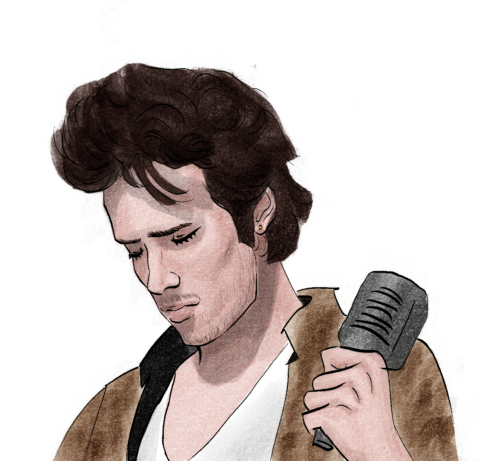
Jeff Buckley and the Art of Yearning
Graphic by Madison Krug

Listening to Jeff Buckley feels like being trapped in purgatory, suspended between heaven and hell. Waiting defines his album “Grace,” lingering in the space after love ends but before the ache fades.
More than 30 years after its 1994 release, “Lover, You Should’ve Come Over” has surpassed 440 million Spotify streams. In 2026, it entered the Billboard Hot 100 for the first time, climbing the charts decades after Buckley’s death.
Written in his mid-20s, “Lover, You Should’ve Come Over” speaks to a stage of life that isn’t romanticized like the puppy-love summer romances of youth or the quiet, coffee-filled mornings of midlife. Instead, Buckley lingers on the raw ache of early adulthood, the wistful longing of “what ifs,” and the self-condemnation following youthful arrogance.
“Oh, but maybe I’m just too young to keep good love from going wrong,” Buckley sings.
The emotional confusion of youth intensifies today’s dating limbo. While modern terms like “simp” and “talking stage” were not present in the 90s, the uncertainty of young adulthood has always lingered. Heartbreak clings to Buckley’s music and continues to resonate with his audience long after love’s elation fades.
In the minute-long harmonium opening, Buckley forces the listener to be patient—something our culture resists. It recalls a time before iPhones, Wi-Fi, and social media reshaped how we communicate, desire, and connect. Its restraint feels almost defiant in a world that rewards immediacy over intimacy.
“So I’ll wait for you, love
And I’ll burn
Will I ever see your sweet return?
Oh, will I ever learn?”
Now there are hundreds of potential sweethearts just a swipe away. With an ocean of options at your fingertips, finding the right catch can feel strangely impossible—and increasingly impersonal. The promise of storybook romance begins to lose its shine.
Handwritten letters have been replaced with fleeting texts, meet-cutes with hookups, and intentional courtship with indefinite situationships. While flings are nothing new, they once grew from tangible chemistry, not from someone you stumbled upon on an app. Connection now feels impersonal and far too convenient.
Buckley’s resurgence speaks not only to individual heartbreak but to a shared language of longing that binds listeners through romantic grief. That nostalgia often surfaces in revisiting old romances, from films like “The Notebook” to classics such as “Pride and Prejudice.” Yet when Noah feels too good to be true and Mr. Darcy feels like a relic, unrequited love, without tidy resolution, can feel like a mirror, catching the parts of ourselves left obscure.
“Lover, You Should’ve Come Over” creates a quiet sense of communion; though many may listen alone, they don’t feel alone. The verses and chords carry with them a quiet assurance that the soft throbbing of your heart has been felt and recognized by another.
Buckley repeats “It’s never over,” relentlessly returning to the same ache over and over:
“It’s never over
My kingdom for a kiss upon her shoulder
It’s never over.”
“Poetry, beauty, romance, love, these are what we stay alive for,” John Keating famously said in “Dead Poets Society.” These forms sustain us when we feel like Atlas bearing the weight of the world. Sometimes they aren’t just what we stay alive for, but why we stay alive, easing the burden as if it were shared.
Buckley escalates longing into sacrifice, a reach for the irretrievable:
“My body turns
And yearns for a sleep that won’t ever come
It’s never over
All my riches for her smiles
When I’ve slept so soft against her
It’s never over
All my blood for the sweetness of her laughter
It’s never over
She is the tear that hangs inside my soul forever.”
It’s impossible to capture the intensity of Buckley’s melancholy through print alone. It’s his voice that completes the ballad.
In 1997, while working on what would have been his second album, Buckley drowned in an accident, cutting his career short. The unfinished quality of his music mirrors the ache it captures: what we once had is all we will ever have. The past stays frozen.
While the past in itself may be unreachable, the feelings remain. Songs like “Lover, You Should’ve Come Over” stir buried emotions and bring them to the surface, which can feel confrontational. Yet, there’s something to be said for lingering in the discomfort. Just as the body adjusts to temperature, the soul adjusts to its own depths. To feel deeply is to yearn deeply.
Love isn’t just the fairy tale ending we grew up with as kids or what we hope to find at the end of the day. Reality is harsher, but it’s shared. With Buckley’s resurgence, people are finding comfort, or at least community, in the art of yearning. So, dear reader, make that playlist of songs full of heartache, watch the classics starring pining leads, and let yourself sit with the emotions they stir.
Finally, put some headphones on and listen to “Lover, You Should’ve Come Over” in all its glory.
Sophia Gonzalez ’28 (sophiagonzalez@college.harvard.edu) is a contributor to “Lover, You Should’ve Come Over’s” rise in the charts.