Kitchen Sink No. 11
Graphic by Kerrie Zhu

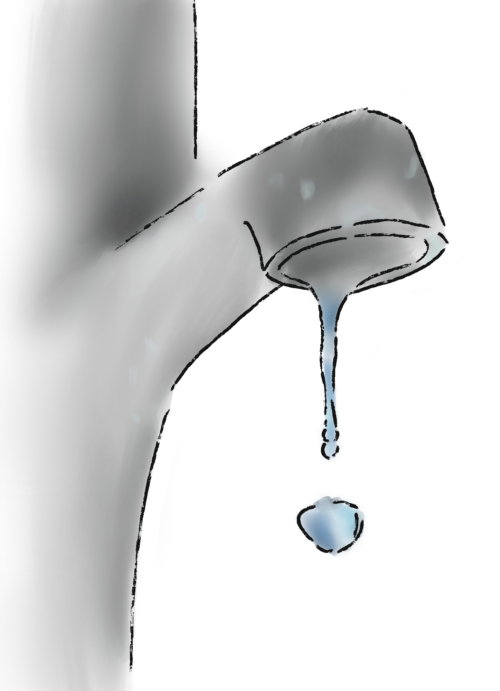
The sink in the ward was not like the sink in room fourteen. It was larger, institutional, the porcelain yellowed at the drain where decades of hands had passed over the same spot, the iron taps stiff and slightly out of plumb. There was only cold water. The hot tap was a decoration, a concession to some earlier version of the building when dignity had still been among its concerns. You turned the cold tap and counted—not because the hot was coming but because the counting was all that remained of the ritual. The ritual had outlived its reason. It was a thing my hands performed because they had forgotten how not to.
I stood at it now in the grey hour before the orderlies came, and I counted, and the water ran clear from the first moment because the cold has no theatre to it, no preliminaries, no small rehearsal of rust before it delivers itself. One. Two. Three. I held my hands under it until my knuckles whitened. I thought of Thomas, who was elsewhere, and the girl from the library, who was elsewhere in a different sense, and of the oak tree in the quad that I would never stand beneath again, and the three absences arranged themselves around the sink the way mourners arrange themselves around a coffin, quiet, patient, each attending to its own grief.
Ruddock came on at six. He was the largest of the attendants and the least cruel, which is to say that his cruelty had not yet curdled into pleasure, that he did what he did because it was his work and he went home at the end of the day and slept without interruption. He wore a leather strap on his belt and carried a ring of keys that announced him down every corridor, and when he looked at you, he looked at the shape of you, the outline, without bothering with the interior.
He stopped at the end of my bunk. Up, he said. Whitmore wants you again.
I said I had been yesterday. He said yesterday was yesterday. I said this was unusual. He said nothing to that, which was his answer to most things, the shrug of a man who has decided that no questions were addressed to him.
I got up. I had not been sleeping. I had been lying with my eyes closed in the manner that the ward permitted, a kind of vigilance dressed as rest. I put on the soft ashy coat they gave us and followed him into the corridor.
…
The room Ruddock brought me to was not Whitmore’s office. It was one of the consulting rooms on the lower floor, smaller, colder, the fire not yet lit, the walled garden replaced by a narrow window that gave onto the airing yard. There was a sink against the far wall. A cold tap only again. I noticed it the way a man about to fall notices the floor—not as a feature of the room but as its governing fact, the thing around which the rest of the room arranges itself without knowing it.
A man I did not know was sitting in Whitmore’s chair. He introduced himself as Dr. Pell. He said Whitmore had been called away and that he would be conducting the morning’s session. His voice had the false softness of a man performing kindness, which is the particular register I have learned to distrust most. Ruddock stood by the door with his hands behind his back and his eyes on the window, bored in the way that men are when they are also alert.
Pell asked me to sit. I sat.
He had a file on the desk in front of him, and the file was mine, and I could see my name at the top of it and beside my name a second name in brackets, as though the clerk who had prepared the file had not been certain which to use and had decided, with bureaucratic diplomacy, to use both. Pell opened the file and read for a time without speaking. Then he looked up.
You are the one who calls himself Edward.
I did not answer. The question had the shape of a trap, and I had seen the trap and was deciding whether to walk into it anyway, because sometimes walking in is the faster way out.
Dr. Whitmore has shared his notes with me. He opened the file but did not look at it. I am not here to continue his treatment. I am here to assess you for the board. Do you understand what assessment means?
I said I did.
He said the board is considering a procedure. He said it without inflection, and I watched his face for any sign that he knew what the word meant in the room between us, and I found none. He said the word again—procedure—and then he said the other word, the one with the Latin in it, and Ruddock at the door shifted his weight, and the shift was very small, and I noticed it because my attention had become the attention of a man noticing everything at once.
The procedure, Pell said, is intended to resolve the condition. It has produced, in similar cases, a marked improvement in compliance. The patient becomes calmer. More tractable. Capable of routine. He recited these words the way a man describes the weather in a country he has never visited.
I asked what happened to the other one. The one who was not calm.
Pell looked at me then for the first time with something like interest. He said, The other one, in the cases he had reviewed, tended not to present again.
I understood him. The understanding arrived whole, devoid of the mind’s usual loitering. He was telling me that the procedure would cut Thomas out of the body I was sharing with him, and that when the cutting was over, one of us would remain, and that he was not certain which one and did not especially care, because the board was not asking him to care—the board was asking him to produce a man who could be left alone in a room without incident.
And it was possible, I saw this too, that the one who remained would be neither of us. That the knife would reach past both names and find a third thing underneath, something smaller, something both Thomas and I had been, once, before the house with the wall around it, before the upstairs room, before the woman who had looked at me and said the name that was not mine.
Pell closed the file. Do you have any questions, Edward?
I asked if the assessment was today. He only nodded. I said I understood.
He asked me to stand and to come to the sink, where he would conduct the first part of the examination, which was physical. It would be brief. Ruddock would assist. He stood and moved around the desk with a slight limp that I had not noticed before, a small stiffness in the right knee that made him grip the desk edge as he passed it.
I stood. I went to the sink.
…
Here is the part I do not know how to tell. Not because the memory is absent—the memory is the most tangible thing I have ever owned—but because the retelling of it requires a sequence, and the memory is not a sequence. It is a single gesture performed in many places at once.
Pell was behind me. His hand was on my shoulder, guiding, professional, impersonal, like a man who has laid such hands on many shoulders and received from none of them any complication. Bend forward. Place your hands on the rim. This will be only a moment.
I bent forward. I placed my hands on the rim. The porcelain was very cold. Below my face, the basin was dry and pale, and at the drain, there was a dark collar where the years had pressed themselves into the surface. I counted. I did not mean to count. I counted because my hands were at a sink and my hands had been taught what to do at a sink, and the teaching came before the thinking.
One.
Pell’s hand moved on my shoulder. I did not hear Ruddock move, which was how I knew he had moved, because Ruddock was loud when he was at rest and became quiet when his body was being asked to do a thing.
Two.
The second rhythm I had lived with for weeks—the breath that was not my breath, the patience I had learned to feel behind my eyes—was not behind my eyes any longer. It was in my hands. It had come forward into the porcelain, into the cold rim, into the muscles of the forearm that I had always considered mine, and I felt it arrive the way you feel a door open behind you in an empty house. A settling.
Three.
I do not know which of us turned. Whichever of us had been sleeping woke up, and whichever of us had been awake lay down, and in the interval between those two movements a third thing happened which was not sleep and not waking, and in that interval my elbow came up and struck Pell beneath the chin.
He made a sound I will not describe. Not because it was terrible—it was not terrible, it was only small and surprising, a little cough of air, the kind of sound a man makes when he misses a step on a stair. He fell against me. His weight came forward onto my back, and my hands, still on the rim, bore it. The rim took the weight. The sink took the weight. The whole porcelain ugliness of it held him up for the length of a breath while I pivoted beneath him and got my hand on the back of his neck.
I slammed Pell’s face down into the basin, right beside the rim of the drain. The porcelain rang—a dull, flat note—and his body went slack all at once, like a sack of grain when you cut the string. I turned the cold tap. I do not know why. The counting, perhaps. The ritual demands its completion. The water came on clear from the first moment and filled the basin and ran over his face, and I held him there, my hand at the base of his skull, and I counted past three, and I did not stop at three, because the three had been for Thomas and Thomas was not here.
Ruddock’s hands were on me before I had finished turning. He pulled me back from the sink and put me against the wall, and his forearm came across my chest, and I let it. I did not resist. I stood with my back to the plaster and my hands open at my sides, and Ruddock held me there and looked past me at Pell in the basin, and I watched his face change—not into horror, which would have required imagination, but into the blankness of a man who has encountered a thing outside his training.
Get Whitmore, I said.
He said, Whitmore is not—
Get Whitmore. I will not move. I said it without raising my voice, and Ruddock looked at me, and then at the door, and then at Pell, and I could see him calculating—the patient pinned and unresisting, the doctor past help, the corridor empty. He released me. He did not turn his back. He stepped to the door and shouted down the corridor, and then he came back and stood between me and the sink, and we waited.
The basin was behind him. I could hear the water still running. And I knew that Pell had been dead since the second blow, perhaps since the first. That the water had been a ritual performed on a body that had already left. That I had been washing a hand that was not the hand I had believed myself to be washing.
…
Whitmore came. I did not turn. I heard his footsteps in the doorway and then his breath, a single indrawn breath held for a long time and then released. He did not speak immediately. He let the silence do what silence does in a room where something has happened, which is to make the happening final.
Then he said, very quietly, Let him go.
Ruddock stepped aside. Pell’s face had slid sideways in the basin, and the water was still running over his fingers where they hung across the rim. I looked at Whitmore and saw on his face an expression I had not seen there before, which was neither horror nor pity but something like the attention a man gives a page he has been reading for a long time and has just now understood.
Which of you did this, he asked.
I opened my mouth to answer, and I did not know the answer. I had been present for all of it. I had counted. But the hand at the back of Pell’s neck had been mine and not mine, and the decision—if it had been a decision—had been made in the interval where the two of us exchanged places, and neither of us had been the whole of the one who chose.
Both of us, I said.
Whitmore looked at me for a long time. Then he looked at the sink. Then he looked back at me. I think that may be the first true sentence either of you has given me, he said.
He sat down in the chair Pell had been in. He did not call for Ruddock. He did not call for anyone. He set his hands on the desk and looked at them, and I could see him thinking, and the thinking was the patient, careful thinking of a man who had been given an impossible piece of evidence and was trying to determine what, if anything, it could be used to prove.
Whitmore said, The board meets on Thursday.
I know I said.
After today, the procedure will not be the question they ask.
I know.
He said, I am going to tell them what I saw in this room. I am going to tell them that a man died here and that I do not know which of you killed him.
He came to the sink. He reached past Pell and silenced the tap—not hurriedly, but also not gently, just in the way a man who has been in a room with the dying turns off a lamp. The water stopped, and in the silence that followed, I heard, for the first time in weeks, only one breath in the room, and it was mine, and I could not tell whose.
Whitmore said, very quietly, You can both come with me now.
Written by Luke Wagner ’26 (lukewagner@college.harvard.edu)and Jonah Karafiol ’26 (jonahkarafiol@college.harvard.edu).