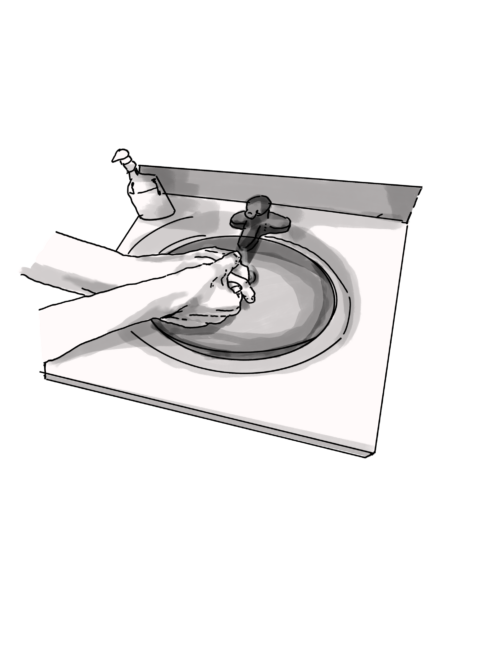
Kitchen Sink No. 9
Graphic by Sage Willey

The paper was in my pocket when I woke. I had not put it there—or I had put it there and forgotten, which amounts to the same confession. I unfolded it at the desk in the grey light and read it again: a name, an address, the handwriting almost mine but tilted slightly and with letters pressed harder into the page as though the hand that wrote them had more certainty to spare. The ink had bled into crinkled waves at the edges where the paper had been damp. I turned my right hand over. A faint smear along the side of my smallest finger, the inklings of a sentence I did not remember composing.
I went to the sink. The hot water—one, two, three—came through in its usual thin stream, reddish and then clear. I washed the ink away. It went easily, which felt wrong; things that matter should be harder to remove. I dried my hands on my trousers and looked at the paper on the desk.
The address was south of the river. I knew the area only by reputation—lodging houses, public houses with no signs, the kind of streets that didn’t appear on the maps the university distributed to new students. The kind of streets a person like me would have no reason to visit, which was precisely why I was going to visit them, because the person who had written the address was not entirely me, and following him was the closest thing I had to a plan.
I put on my coat. I checked the mirror. The face in it looked like mine, though slightly thinner than I remembered, the eyes carrying a tiredness that had moved past fatigue into something more structural. I held my own gaze for a moment, testing it for signs of the other, and found nothing conclusive. He did not announce himself in mirrors. He announced himself in bootlaces, in marginal notes, in addresses written on scraps of paper during hours I could not account for.
…
The walk took the better part of an hour. The morning was cold and damp, the kind of English cold that does not assault you but simply waits, settling into the coat, the collar, the space between the scarf and the neck, until you realise you have been shivering for some time without noticing. The streets narrowed as I went south. The buildings darkened by decades of coal smoke, the gutters running with something that was not entirely rain.
I found the street. It was short and did not connect to anything obvious—it began at a coal merchant’s yard and ended at a wall, as though the city had started a thought then abandoned it. The number on the paper corresponded to a building at the far end, three stories tall, the windows dark. At the ground level, an oak door at the bottom of three stone steps, and no handle on the outside.
I stood across the street and looked at it. A cart passed behind me, the horse’s hooves stomping on the wet stone. I counted the windows. I counted the steps. I was stalling, and I knew I was stalling, and knowing it did not make me stop.
The door opened. A woman came out, pulling her shawl around her shoulders against the cold. She moved with the heaviness of someone who had been awake for a long time, and she did not look at me as she turned up the street and walked away. The door remained open behind her—not an invitation, exactly, but the absence of a refusal, which was close enough.
I crossed the street, went down the steps, and through the door.
Inside, the air was warm and close, carrying a smell I could not name but that my nose recognised before my mind did—something resinous, close, almost sweet—a tightening in the stomach, a quickening that had no obvious cause. The room was dim. Candles on the bar, candles on the tables, candles in wall sconces—the flames leaned in a draft that came from a vent I could not locate. Behind the bar was a row of bottles with no labels, and above them a sign in Cyrillic, the letters angular and crowded against one another. The barman was wiping a glass. He looked at me, said nothing, set the glass down, and picked up another.
I sat at the bar because sitting gave me a chance to think about what to do next, if anything. The stool was wooden, scarred, the surface worn smooth by use. The barman set a glass in front of me without being asked. I looked at it. Vodka, clear, the surface trembling slightly from some vibration in the building’s structure. I drank it because not drinking it would have required an explanation I did not have.
The room behind me was mostly empty. Two men at a table in the far corner, speaking in a language I did not understand. A woman was sleeping or pretending to sleep in a chair by the cold fireplace. The orange hue of the candles tinted everything the color of old brandy, and the shadows they threw were unsteady, shifting when the draft shifted, so that the walls seemed to breathe.
I set the glass down and reached for my coat.
Then the door at the back of the room opened, and she came through it.
…
She was carrying a cup of tea in one hand and a cigarette in the other. She moved through the room as a trail of tobacco smoke spiraled from her mouth to her back and lingered on the ends of her hair—I had ceased to notice the furniture. Her hair was dark and cut until it lay resting on her shoulders. On the inside of her left wrist, at the place where the pulse sits closest to the surface, a tattoo in the same script as the sign above the bar. She sat two stools from me and set her tea down and drew on her cigarette and looked at the wall behind the bar with an expression of settled, unhurried boredom.
Then she looked at me. Her eyes were the color of river water, grey-green, and they moved across my face with a slowness that felt practiced, the look of someone who had learned to read faces the way other people read newsprint.
You are back, she said.
I said I had not been here before. She studied me for a moment. Then something in her expression changed—not surprise, not confusion, but a slight recalibration.
She said, No. You are the other one.
The room was very quiet. The two men in the corner had stopped talking. The barman wiped the same glass. I heard my own breathing, which sounded too loud, and beneath it the low hiss of the candle nearest to me, a pressure in my ears like the room had sealed itself shut.
I said, What do you mean, the other one.
She tapped her cigarette against the edge of an ashtray and did not answer immediately. She was deciding something. I could see it in the way her attention withdrew and then returned, the brief internal conference of a person choosing how much to say.
You came two nights ago, she said. Late. You sat where you are sitting and drank three glasses and did not speak. Then you left, and then you came back, and you were different. She paused. The second time, you spoke. The second time, you laughed. The second time, you told me your name.
I asked what name I had given her. She looked at me with an expression I could not read—not pity, not amusement, something closer to the careful attention of a person handling a thing that might break. She said, Edward.
The name landed in the room like a stone dropped into a well. I waited for the echo, and there was none, only the silence that follows a sound that has been completely absorbed, and my own knuckles wrapped around the bar, which I was gripping because my hands needed something to grip.
My name is Thomas.
She nodded. Yes, she said. She drew on her cigarette and exhaled slowly, the smoke drifting toward the ceiling in a thin, purposeful line. You hold yourself differently, she said. Your shoulders. Your hands. He is—she searched for the word—loser. She said it with a slight accent that turned the word into something more precise than it usually was.
I wanted to leave. I wanted to stand up and walk out of the door and back across the river and up the stairs to room fourteen and sit at the desk and wash my hands and pretend that the address on the paper led nowhere, that the woman with the grey-green eyes was mistaken or mad or lying. But she was not lying. I knew she was not lying because she had described him perfectly—the looseness, the laughter, the ease that I did not possess and that arrived only when I was not present to prevent it.
I asked her what he had done—what Edward had done, on the night he came.
She crushed the cigarette in the ashtray. The room waited. I waited. The candles bent and straightened. She said, He talked. She stopped. She put down her tea but still held the glass, and I understood that she was deciding what to leave out, and that what she left out would be the thing that mattered most.
He talked about many things, she said. The university. A professor. She waved her hand, dismissing these. Then she said, He talked about the Greeks. A play. A man who killed his mother and was not sorry, or was sorry but would do it again. She paused. He said this as though he was proud of it, and then he said it again as though he was afraid of it. I could not tell which was true. Perhaps both.
My stomach turned. Not from disgust. From recognition. The argument was the one in the essay, the one Hendricks had laid on his desk beside mine, the one written in handwriting that was almost my handwriting but pressed harder into the page. The argument that lucidity and horror are not opposites. It was his argument—Edward’s argument—and he had been sitting on this stool, in this room, delivering it to a woman with a dragon tattooed across her shoulder, while I slept in room fourteen with no memory of having left.
What else, I said.
She looked at me for a long time. Then she said, He asked me about a girl. A girl at the university, in the library. He did not say her name. He said she was the only person who could see him, and he was not sure whether this was a comfort or a danger.
The room tightened around me. I could feel my pulse in my throat, in my wrists, in the place behind my eyes where headaches begin. The candle nearest to me guttered and recovered. The barman set down his glass and picked up another.
She said, He also asked about a field. Whether I knew of a field, outside the city, where something had burned. He said he could smell it on his hands. He said the smell would not come off.
I looked down at my hands. They were clean. The cleanliness meant nothing because the smell she was describing was the same smell I had been trying to wash away for weeks—not on the skin, deeper, in the memory of the skin, in whatever place the body stores the things the mind refuses to hold.
Did he tell you what burned I said.
She shook her head. But he was afraid of it, she said. Not of the fire; Of the fact that he was not sorry.
…
I walked back across the river in the late morning light. The fog had lifted enough to show the city in its ordinary shape—the spires, the rooftops, the slow brown water below the bridge, a barge moving east without urgency. Students passed me on the path, gowns over their shoulders, books under their arms, and I watched them and could not remember whether I had ever moved through a morning like that, with that kind of ordinary direction, or whether I was only remembering someone else’s memory of having done so.
The facts, as I understood them, were these. There was a man who used my body when I was not using it. He called himself Edward. He had been to a field where something burned, and he was not sorry, and the not-being-sorry was the thing that frightened me most, because I had been to that field too—or my body had—and the soot was under my nails to prove it, and I did not know whether the absence of guilt I felt when I looked at it was mine or his.
I wanted to walk faster, and I walked faster, and the river did not care. I was living in the interval.
I crossed the quad. The oak tree stood where it always stood. I stopped beneath it. The bark was rough under my hand—I had not decided to touch it; the hand had moved on its own, reaching for the trunk the way it reaches for the hot tap in the morning, out of habit, out of a routine I did not remember establishing. My hand. His hand. Same hand.
A student crossed the quad behind me and called out, good morning. I turned and nodded. He paused, tilting his head, and said, Were you out here again last night? I saw someone under the tree quite late. I said I had not been. He shrugged and went on.
I climbed the stairs to room fourteen. The door was closed, as I had left it. Inside, the Oresteia was on the desk, open to a page I had not opened it to. In the margin, in the handwriting that was almost mine, two words had been underlined and then underlined again, the pen pressed so hard it had nearly cut the page. Beside them, a small drawing—not a word, not a sentence, something closer to a mark, the kind a person makes when they are thinking about something they cannot say. I stood there looking at it for a long time.
I read it twice. Then I went to the sink and turned on the hot water—one, two, three—and held my hands under it and scrubbed until the skin reddened and tightened, and the pain gave me something to hold. I scrubbed until my knuckles ached. The water ran clear. It always ran clear. There was nothing on my hands except the memory of things my hands had done without me, and no amount of water was going to reach that deep.
I turned off the tap and stood there, dripping, listening to the pipes settle in the wall, and somewhere beneath the sound of the pipes I heard it again—the second rhythm, faint, misaligned, the breath of someone who was not me and was not elsewhere, who was here, in the room, in the body, waiting with the kind of patience that does not need to announce itself because it already knows what is going to happen next.
I dried my hands, sat at the desk, and picked up the pen. I do not know what I intended to write. What came out was this: I went to the bar. I met the woman. She knows you. And the handwriting was mine, but the words were addressed to someone I had never met who lived behind my eyes, and I did not know whether writing to him was an act of war or an act of surrender, and I sat there looking at the sentence until the chapel bell struck and I lost count of the strokes, the way I always lose count now, as though that part of my mind had been given over to someone who had a different use for it.
Written by Luke Wagner ’26 (lukewagner@college.harvard.edu) and Jonah Karafiol ’26 (jonahkarafiol@college.harvard.edu).