
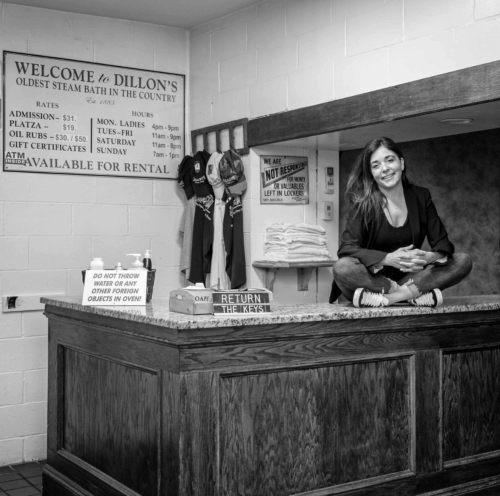
Portrait by photographer ©Darlene DeVita, supported by the Chelsea Heritage Grant.
Last spring in Chelsea, Lisa D. Guglielmi Rizzo—the magnetic owner of Dillon’s—opened a new window of America for me. Week after week, I returned to enjoy the traditional shvitzing (sweating in Yiddish), oil rubs, and platza (shoulder whacking with an oak leaf) at her establishment, a hidden gem 30 minutes from campus that has been operating since 1885. Talking with her at the counter also taught me a tremendous amount about love—for, as Harvard philosopher Elaine Scarry put it, “the beautiful things have a forward momentum, the way they incite the desire to bring new things into the world.”
Dillon’s belongs to my dream garland of personable old businesses on the East Coast, all with unique, cinematic stories. Here too, Lisa is extremely passionate about her establishment, which welcomes a diverse but inclusive clientele. For that reason, she insists on keeping prices affordable ($36 for two hours, about $60 with a massage), with bathing being an integral part of the fabric of Chelsea, Massachusetts’s smallest town. Our last conversation in May remains memorable to me as Lisa radiated kindness, glamour, and the immense power of solace through action.

Regulars of the Ladies’ nights on Mondays. Lisa stands on the right. ©Dillon’s.
Lisa’s story is quintessentially Bostonian. Born into a large Italian-Argentinian family with 14 aunts and uncles on her mom’s side, she served coffee at Dunkin’ in high school, where she met her husband—the young Anthony Rizzo Jr. (unrelated to the famous baseball player). He asked her to his prom, she recalls with a smile, and the two were together for thirteen years before marrying. During that time, she worked as a customer representative for airlines, maintaining her independence.
“I thought I would later get married and have a big family,” she confided in an interview. “My husband wanted to have six kids!”
This vision first took form when Anthony Jr. purchased Dillon’s in 1992, pursuing real estate and emboldened by their relationship, as Chelsea was recovering from financial collapse. He felt a special attachment and committed “a hundred percent” to the bathhouse—the oldest in the country—long before the domestic showers’ revolution—in an immigrant neighborhood that was a major destination for waves of Russian and Eastern Europeans back in the 1870s. At that time, the community was made up largely of Russian Jews, including Israel and Tillie, the original founders of Dillon’s—affectionately known as the Shvitz (Yiddish for “sweat”).
Due to the Great Chelsea Fire of 1973 ravaging the town’s archive, we are only left wondering about the bath’s first hundred years. But 250 miles south, in New York City, a New York Times photo essay pictured the last banyas (Russian for steam baths) at the turn of the century, with their historic lores of deaf masseurs for businessmen, vodkas in the lockers, and closures during the terrible AIDS epidemic. This gives us an imagined background of the beginnings of the Russian banya as a diasporic phenomenon.
Many tensions certainly seem to have characterized it. According to Olga Petri, who reviewed Brown professor Ethan Pollock’s book, “Without the Banya We Would Perish,” the steam room has indeed functioned for one-thousand years as a “camera obscura [that] refracts the complex spectrum of society, culture and politics” in Russian territories. The conflicts it crystallizes between what she has called the “sanitary” and the “grit, intimacy and chaos” could only take similar and new forms with the transfer to American land.
As for Dillon’s, settled in a town long plagued by corruption, a Boston Globe journalist described men convivially playing poker and getting oil scrubs by the steam room in 1997—a more clement period for the city following the institution of a new council—manager government system in 1995. This was Rizzo Jr.’s heyday, dearly remembered by his clients, many of whom have been coming since Eisenhower.

Anthony Jr. Rizzo on the front cover of the Sunday Times, January 1993.
Alas, life and the bathhouse took a devastating turn when Anthony Jr. died at 30 from complications of dermatomyositis in 1999, leaving Lisa a widow with a one-year-old child, Anthony III. Grief and responsibility intertwined, as she mourned a partner of heart and honor to her, while inheriting an institution that functioned like a men’s club six days a week.
“Some men said the repairs and constant upkeep was heavy,” she explained; others tried to take advantage of her.
But 27-year-old Lisa had learned to build nerves of steel when she turned down unsolicited offers for acquisition during her husband’s illness. She could also count on her beloved friends Madelyn and Linda, a therapist and a customer who jumped right behind the counter to help.
Moved by their support, Lisa decided to prolong her great love with Rizzo Jr. by keeping Dillon’s—with the help of her mother, who moved in with her to care for her baby.
“I had no time for depression,” she affirmed. And in many ways, her decision further embodies Scarry’s interpretation of beauty as “the active state of creating,” or “[in] the site of stewardship in which one acts to protect or perpetuate a fragment of beauty already in the world.”
“Every time there was a hiccup or an issue I would always just take a deep breath and ask to myself ‘What would Anthony do?’ And it all came together,” Lisa added.
“Over the years, I gained a lot of support and respect from my male clientele, especially after I undertook a renovation phase, with the help of Platza specialist Patsy. The biggest part of this was the rebuilding of the oven, which required a lot of time and preparation, as well as the right people to get it done.”
Many locals indeed praised her courage. In a letter that she keeps framed next to the entrance and that “still moves her to tears,” one of the regulars expressed how proud he was of her “making Dillon’s the best Shivtz in the whole wide world.”

Letter to Lisa enframed in Dillon’s ©LisaRizzo.
That thus made for a reborn Russian bath. Certainly because, for Scarry again, “a beautiful thing seems—[and in fact] is—unprecedented: and that sense of being without precedent conveys a sense of the ‘newness’ or ‘newbornness’ of the world.”
One of Lisa’s reinventions, in particular, was the Ladies’ Nights on Mondays, which she had suggested to her husband and started implementing before his illness. He was proud of these special nights, which she manages herself to this day. “Many women open up to me; they talk about their sex lives and menopause. Some even celebrate their divorces!” she exclaimed.
The bathhouse’s demographics have also changed in accordance with the state. Chelsea was once called “Little Jerusalem” in 1885, but today, the town is more than 60% Latino following a migration wave in the early 1990s. Many citizens from Ukraine or the Arab world also frequent the bathhouse, which makes for countless variations on the same bathing ritual—and possible tensions in online reviews. Politics are never too far away either, and especially among men, Lisa and her late manager for men’s days, Patsy, have had to neutralize some boisterous rows.
“I try to keep the lounge television neutral,” she told me, keen to preserve the friendliness that can make the United States so charming and conventional.
After all, beauty, Scarry writes, is pacific: “its reciprocal salute to continued existence, its pact, is indistinguishable from the word for peace.”

Lisa and a client, posing in front of a Ukrainian flag. ©Dillon’s.
In fact, the communal bath is an ultimate maker of beauty, architecture, and sociability worldwide. At the Hammom Kunjak of Bukhara, Uzbekistan, a 15th-century stone jewel lit by candles, Russian women savor tourism or a new life away from Moscow—which many have fled since the escalation of the war against Ukraine. At Istanbul’s Cagaloglu Hamami, calls to prayer resonate from the skylight, in between the Blue Mosque and Hagia Sophia, where the archaeology of sounds would reveal the confessions of Florence Nightingale and Kate Moss.
Dillon’s, by contrast, is a local institution—you might instead meet Harvard house deans here in disguise. I heard longings for Czechoslovakia in the late Soviet Union, or desires to visit Paris in the fall. There were chatters about sons joining the military, as well as younger girls playing sports. All this came to represent an American society in the making, right down to the news broadcast about airplanes in the living room, with a warmth and intimacy that lasted longer than the steam.
As for herself, Lisa wants women to enjoy themselves and embrace life to the fullest by their own standards, manifesting the spirit of second-wave feminism that reclaimed equity from the 1960s to the 1990s. It is clear that her principal role in managing Dillon’s epitomizes this movement, which revolutionized family, sexuality, domesticity, the workplace, and reproductive rights.
“The resistances of the world, far from oppressing me, served as support and material for my projects,” Simone de Beauvoir wrote of herself in “The Prime of Life,” while occupying the forefront of such a turn.
For “ultimately,” Francis Jeanson claimed in 1966, “a happy existence is [for Beauvoir] one that makes a wager on being so: happiness is given for that very purpose.” In other words, happiness is a gamble that generations of feminists can take forward.
In Lisa’s case, full participation in society involved the American ideal of individuality, resilience, and ownership. But it also came through motherhood, and with a sense of duty to fulfill—a word that often comes up to her—she passed on her success story to her son, who opened a second bath location in Quincy in 2024 and designed a line of Dillon’s bath gifts and hats for their regulars.
“I feel like a bartender,” Lisa remarked of her job on Mondays. “I compare it to that—which means I am a good secret keeper. But the best part, which I had been waiting for years and was always hoping for, is that Rizzo III loves Dillon’s and wants to keep old traditions alive like his father did!”
Unfortunately, “clients sometimes stop coming when they become mothers,” she laments, which I too overheard, in a lobby filled with musings about both the joys and anguish of having a baby in one’s turn.“I know, I haven’t been here in years — I have had one, then another…” I overheard a woman say.
But many of them still come around, and through conversations, they together keep on generating life out of life. “I can’t tell you how many times I have seen women exchanging phone numbers,” Lisa laughed.
As for men, “during COVID, they were in bath withdrawal,” Lisa recalls, using this occasion to greet managers Gene, Alex and Steven, as well as Tom, the new platza specialist. “Regulars called me on the phone just to talk about Dillon’s.”
Thinking back to her struggles, she now feels at peace with the state of the bathhouse. “Knowing how much my late husband loved it made me stronger—it was all worth it when I hear people say: ‘Thank you for giving us a place to leave all our worries at the door’ or ‘Dillon’s is so special it’s like going to church.’”

Lisa posing with Patsy, who was already a figure of Dillon’s before Anthony Jr. purchased it in 1992. “He became my voice of reason and helped me rebuild the sauna every season. Patsy was a special man,” Lisa said ©Dillon’s.
Among the tradition of bathers and the old telephone ringing for massage appointments, Lisa still feels Rizzo Jr.’s presence around her in Dillon’s. She succeeded despite the crushing loss of the man she loved, and her bathhouse only continues to grow. In this regard, her story illustrates the power of cherishing memories through action, of embodying within ourselves the qualities of those who have left us in the most tragic way.
When discussing her brutally interrupted marriage, she always associates it with Dillon’s very existence—with boldness, creativity, and self-fulfillment—as well as the legacy she can gift to their son.
There is no doubt that such a relationship was based on faithfulness and independence. Through all the pain, this is enough for Lisa and her enlarged family, which just welcomed a grandson, to be born and reborn in beauty.
Marie Prunières (marieprunieres@g.harvard.edu) is a Ph.D. Candidate in Romance Languages and Literature at Harvard Griffin Graduate School of Arts and Sciences.