Politics Doesn’t Stop on the Sideline
Graphic by Emma Crago

Sports are often idealized as a great unifier, existing in a vacuum away from the noise of politics and the stressors of everyday life. To an extent, I agree. There is something sacred about turning on the television or going outside with a ball in hand to escape the seemingly collapsing world around us. That is why many find politics in sports an uncomfortable pill to swallow; it brings the outside in and makes one of the last frontiers of uncomplicated human enjoyment feel very complicated all of a sudden.
That being said, the sanctuary that people have constructed around sport has always been an illusion. Wanting politics to wait outside of the stadium’s gates is, in itself, a political choice that asks the most affected to leave their realities at the door so that ours remain undisturbed.
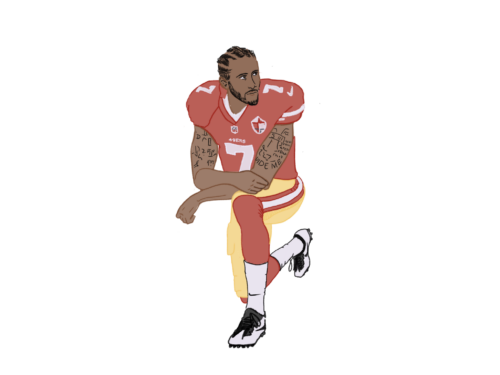
Why have many of us accepted this as our new norm? How is it that Colin Kaepernick’s decision to kneel during the national anthem caused more debate than the actual issues that caused him to kneel in the first place? To say that politics needs to be removed from sport is the same as saying, “I don’t get involved in politics.” I’m sorry, but everything is political. Sport isn’t exempt just because we want it to be.
As much as we may want to believe that sports became more equitable to all over time, the fact that at the most recent World Cup, the Fédération Internationale de Football Association threatened seven European teams with sanctions for wearing the ‘One Love’ LGBTQ Rights armband, shows that it simply isn’t true. The diversity we see in professional sports now, across all metrics, is the result of someone fighting for a group that wasn’t allowed a seat at the table. What’s more political than that?
Jackie Robinson didn’t don the pinstripes of the Brooklyn Dodgers on April 15, 1947, because his talent was simply so extraordinary that Major League Baseball was prepared to abandon its deeply entrenched color line. His first start was the result of more than a decade of media and labor union pressure against baseball teams to desegregate and allow ‘colored players’ to play in the MLB. He didn’t do it by himself, nor did many of his trailblazing peers.
Robinson is just one example—there are too many to name—but it is clear that the sports we know and have come to love in their modern iterations were born of politics. There would be no Women’s National Basketball Association, National Women’s Soccer League, or Professional Women’s Hockey League without Title IX, nor would there be the robust, multi-layered U.S. Paralympic program that we know today without the Amateur Sports Act of 1978 and the ADA of 1990.
Sports were built on political foundations, and yet, we are asking the people who play them to stay quiet about the world outside of the game. Athletes have always had a voice that they are able to exercise in support of the political causes they hold near. So why is it that when athletes speak on these issues, all of a sudden, we want to take the politics out of sports?
We’ve developed a selective amnesia when it comes to all of this. We forget that our heroes of today were, in their time, ostracized and threatened for expressing their political viewpoints. Due to his opposition to the Vietnam War, Muhammad Ali lost his Heavyweight Championship title, faced death threats, and was sentenced to five years in jail. Billie Jean King—a tennis icon and champion of the rights of LGBTQ+ people and women—lost “every single endorsement” she had following her forced outing in 1981, she said in a 2013 interview with Makers. Like Robinson, they were not rogue activists making statements from the fringes of society, but were some of the most famous, visible athletes of their time.
You may think to yourself, ‘I would have never booed Robinson off the field.’ Perhaps you wouldn’t have. But consider, for a moment, the thousands of sports fans who did nothing at all. Fans watched in silence as the hostility unfolded, waiting and hoping the controversy would pass. Silence has often been the preferable position of the many against the few, and history has, and will continue to show, that silence has never been as innocent as it seems. Not saying something is saying something.
It is easy for me to condemn in retrospect and say that I would have done differently, but truly, I don’t know what I would have done. One must note that it takes incredible courage and sacrifice to speak up for the rights of the oppressed. Colin Kaepernick took a knee, and for his stand, he sacrificed his career.
When the public responds to athlete activism with ‘I just watch to watch the game’ or, as Laura Ingraham notoriously stated in 2018 to LeBron James, to “shut up and dribble,” that is in itself a political choice. Demanding athletes to stay silent is not the removal of sport; it is an endorsement of the political status quo just by another name.
Where was Laura Ingraham when Nick Bosa wore a MAGA hat on live television following the 49ers’ win over the Cowboys in October 2024? She wasn’t there to comment because Bosa conformed to her politics, and James didn’t. Was Bosa just a citizen expressing his political right of expression, and James’s take on BLM a distraction? I think not; you can’t have it both ways. If we’re going to keep politics out of sport, then let it be a blanket statement, not a position you take only when it doesn’t fit your agenda.
It is the athlete’s right, as it is the right of us all, to be an active political participant; these are citizens first, performers second. Sport did not suddenly become political in 1947 with Robinson nor in 2016 with Kaepernick; it has always been moulded, advanced, and dictated by politics and enriched by those who sought to use their voices for something larger than just the game. Our sporting heroes of today stand, in a myriad of ways, on the shoulders of sportsmen and women who fought for their right to be your hero. There is no version of sports that exists outside of politics; there never was, and the legendary athletes who made our games great knew it better than anyone else.
Noah Basden ’29 (nhbasden@college.harvard.edu)is mad for March Madness.