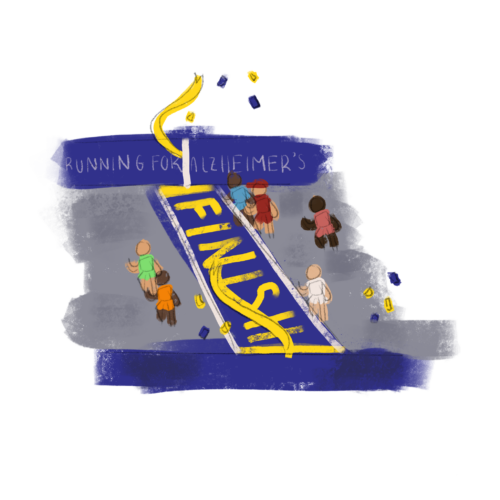
Running For Alzheimer’s Disease
Graphic by Cameron Bernier

Do you ever get the feeling that Harvard students live double lives? Well, you wouldn’t be far off—most of them do.
Kirkland senior, Maggie Chiapetta-Uberti ’26, is no exception. When she isn’t rehearsing with the Harvard Opportunes, Chiapetta-Uberti advocates for Alzheimer’s awareness by sharing her mother’s journey on social media. As part of her advocacy, Chiapetta-Uberti is running this year’s Boston Marathon for Team End ALZ to raise money and awareness for the disease.
“My mom, Lainee, is the coolest person I know,” Chiapetta-Uberti said in an interview with the “Independent.” “She is incredibly witty, the life of the party, and is always creating the fun in every space she enters. She has this rare ability to make people feel seen and like they belong, no matter who they are.”
While most of us struggled with what felt like the catastrophes of hormonal acne or a messy Snapchat situationship, a 14-year-old Chiapetta-Uberti navigated her mother’s life-altering diagnosis with early-onset Alzheimer’s at the age of 58.
Understandably, Chiapetta-Uberti remembers feeling as if her mother’s unexpected diagnosis was not real: “I had such a fixed idea of Alzheimer’s as something that only older people get, so it just didn’t make sense to me that it could be happening to my mom.” Still, the diagnosis reshaped her family’s reality in ways they could not escape.
To give a very simple definition, Alzheimer’s is a terminal neurodegenerative disease that progressively destroys a person’s memory and cognition. Its impact is devastating. Even on the smallest scale, Alzheimer’s hinders the daily life of those affected—and their loved ones, especially when it affects someone’s mother at such a young age.
“It’s funny because at the time I felt so grown and mature, but looking back, I really had no idea what that diagnosis actually meant,” Chiapetta-Uberti explained. “I was trying to understand a disease I had never really thought about, while also watching someone I knew so well begin to change … it was hard to process because it’s not something temporary or something that gets better. And so that permanence made it feel even more overwhelming.”
As only a freshman in high school, Chiapetta-Uberti didn’t know anyone whose parents had been diagnosed with Alzheimer’s disease. In addition to coming to terms with what seemed like an impossible diagnosis, Chiapetta-Uberti said, “I remember really yearning for a sense of community and for someone who understood what this felt like.”
As a result, she began attending classes, support groups, and community events with her sister, gaining that desired sense of community and strengthening her own advocacy. “I was also frustrated by how little I felt I could actually do. I wanted to understand the disease better, and I wanted to be part of the fight against it,” she said. Seeing others who were impacted by the disease come together, Chiapetta-Uberti felt motivated to start speaking out about her own experiences.
The beginning of her advocacy journey also exposed her to the stigma surrounding Alzheimer’s disease. The stigma has wide-ranging effects, including delayed diagnoses, social isolation, and a reduced quality of life. Because the disease fundamentally alters aspects of a person, it also makes conversations between families and caregivers especially emotionally charged. Even Chiapetta-Uberti did not tell anyone about her mom’s diagnosis until the end of her senior year of high school, a choice she regrets in retrospect, since it only further contributed to the negative perception around her mom’s disease.
Now, having learned from her personal experiences how this stigma prevents discussion about Alzheimer’s, Chiapetta-Uberti prioritizes breaking down the isolation she felt after her mother’s diagnosis. “A big part of my advocacy is about making sure others don’t feel alone and also being honest about the reality of the disease and the moments of love and connection that still exist within it,” she explained.
Since coming to Harvard, Chiapetta-Uberti has expanded her connections with the Alzheimer’s community while deepening her engagement through research. She joined an Alzheimer’s research lab at the Genetics and Aging Research Unit, learning from leading researchers like Dr. Rudolph Tanzi. And, recently, she finalized her senior thesis in Neuroscience, where she looked at tau protein and its role in the disease progression of Alzheimer’s.
Outside of developing her advocacy and knowledge of Alzheimer’s disease, her mother’s diagnosis forced Chiapetta-Uberti to mature in ways that she wasn’t prepared for. For one, she believes that it has given her a more insightful outlook on life and the value of being present.
“I don’t take time for granted in the same way anymore. I’ve learned to appreciate moments as they are, without always comparing them to how things used to be or worrying about what’s coming next,” Chiapetta-Uberti said. “I’ve become more patient, more empathetic, and through meeting different people affected by this disease, I think I’ve become more aware of how much people can be carrying that you might not see.”
With the Boston Marathon on the horizon, Chiapetta-Uberti says her shared love for running with her mom motivated her to run for Team End ALZ.
“Running has always been something that connects me to my mom,” Chiapetta-Uberti said. She described her mom, Lainee, as “a beast in track and field” and that she inherited her love for running. “When I was thinking about how I wanted to show up for her and for this disease, the Boston Marathon felt like the most meaningful way to do that.”
Chiapetta-Uberti has taken to social media, posting informational videos and documenting her training for the marathon. Her videos capture moments of daily life with Alzheimer’s, including small moments like running laps around her mom, exchanging high fives as she takes her daily, 2.5-mile walk so that she does not get lost, or hosting a spelling bee during their morning coffee and laughing at her inability to spell words like “salad.” It is moments like these that help people realize that Alzheimer’s is a disease that affects real families and real people.
“This journey has been difficult but also incredibly beautiful and has helped me find a lot of meaning in being there for my mom fully and unconditionally,” Chiapetta-Uberti said. “I’m so so grateful to have had this unique opportunity to run for my mom and to carry her with me every step of the way.”
Megan Legault ’28 (mlegault@college.harvard.edu)urges everyone to donate to Chiapetta-Uberti’s fundraiser HERE!