We Were the First
Graphic by Amelie Lima

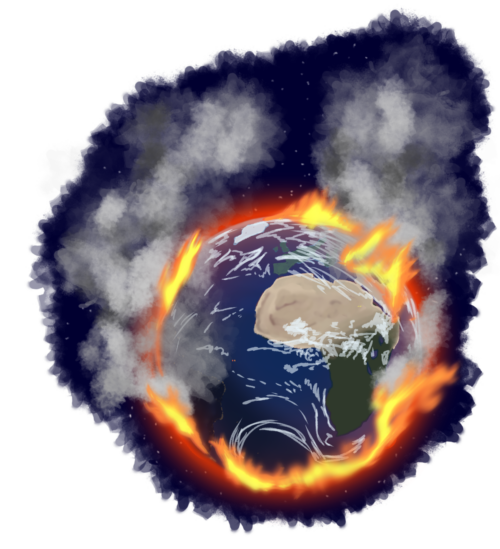
Man was not made to inherit the stars but to be stewards of the Earth.
“We choose to go to the moon. We choose to go to the moon in this decade and do other things, not because they are easy, but because they are hard.” These words, spoken by President John F. Kennedy in his address at Rice University in 1962, set the course for the Apollo missions in pursuit of the unknown, in defiance of the perceived impossible. Though Kennedy did not live to see the fruits of his ambition, the first human to do so, American Neil Armstrong, touched down on the moon’s surface seven years after his address.
Sixty-four years later, I cannot be the only one who was thinking back on Kennedy’s speech as the crew of the Artemis II was preparing to take off on their journey around the moon. By the time this is published, they will be well on their way to exploring space further than anyone else has ever gone before, embarking on the first human lunar flight in over half a century.
However, amidst all the excitement surrounding the launch, I ask you to rest your craned necks and focus instead on what’s been under our noses the entire time.
The world is suffering immensely, and our solution is not found in the stars. Our sustained desire to venture beyond our prescribed bounds is not, in my view, a representation of exploration but rather emblematic of a gross dereliction of duty towards the planet and the future of humanity. For decades, the unanimous opinion of the world’s leading climate change experts has pointed to the need for large-scale and immediate change if we are to survive as a species. For decades, their calls have been ignored.
Our world is literally dying, growing sicker and sicker every year. Instead of offering it the palliative it needs, we have continued to poison our oceans, destroy our rainforests, and pollute our skies all in the name of profits over people. Peter Thiel, the infamous co-founder of PayPal and Palantir, was asked in an interview if he believed humanity should endure. He paused, for far too long, before finally answering, “Yes.” The world was in uproar, and some went as far as to label him a sociopath; yet, for completely different reasons, I have found myself pausing to reflect on the same question. The question is not whether humanity should endure—obviously, I would want it to—but whether humanity deserves to. That is a harder question to grapple with.
The concept of deserving on a species level is, in and of itself, complicated to dissect, primarily due to the complexity and sheer scale of a group of over 8 billion people. How can we condemn the future generations to a fate completely out of their control? A fate brought upon by people in positions of actionable power who have systematically ignored all the warning signs pointing towards a day of reckoning that they will never see. It doesn’t seem fair, and it isn’t, but through our actions today, we have shown little regard for the fate of the future.
Though I project an air of complete doom and despair, humans have a funny habit of getting out of a bind when we really need to. Take the ozone layer crisis, for example: large-scale atmospheric damage threatened to disrupt entire ecosystems and, by extension, our fundamental way of life. The world rallied and signed the Montreal Protocol in 1987 to protect the ozone layer, and 20 years later, the effort paid off. Evidence suggests that the damage is repairing itself in what can only be viewed as a win for science and the world more broadly. Despite always seeming to come out on top, the question remains: Do we deserve to keep on winning and endure?
The power of Kennedy’s words is not lost on me. His speech at Rice is so often cited as a testimony to human ambition, and it so easily could be reframed as our call to action on the climate. Kennedy spoke of going to the moon “not because [it was] easy, but because [it would be] hard.” What is harder than an unprecedented coordinated global response in pursuit of survival? Kennedy described the task of space exploration as a challenge “that we are willing to accept, one we are unwilling to postpone,” but, in the case of climate change, I think willingness is not enough. There are scores of people working towards carbon neutrality and improving the climate, but it isn’t enough. This cannot merely be a cause we are “willing to accept” but one we must be “unwilling to postpone.” Climate change has been the next generation’s issue for far too long, and if we draw our line in the sand today, the choices we make will determine the destiny of generations to come.
If we cannot meet this task with the gravity it deserves, if we cannot find the so-called indomitable spirit, then the answer to the deserving question becomes clear. Squandering our opportunity to persevere and the consequences that come with it is not only an injustice to the future but is a punishment we will have earned.
If one views the Earth as a ship, perhaps the analogy is easier to understand. Like any great vessel, it has borne the full weight of our evolutionary journey to the present moment. All the while we’ve been poking holes into its hull, and we’ve poked one too many—the ship is taking on water. Soon it will be listing and, in the not-too-distant future, it may sink. We are the captains of this ship, and when a ship sinks, the captain goes down with it.
All is not lost.
There is still time, but the window is closing. As the crew of Artemis II goes further than any human has ever gone, I hope they look back at the Earth and see it in all its beauty. The Earth is not just another inconsequential speck in an otherwise endless abyss of darkness. It is our home, and there isn’t, for all we know, another planet like it. The chapter on humanity in the hypothetical book of everything there ever was and will be is not yet finished, and the final lines should not, and I believe won’t, be ones of passive acceptance.
Noah Basden ’29 (nhbasden@college.harvard.edu)does believe humanity should endure—just so we’re clear.