Weed Cell Blocks
Graphic by Annabella Burton

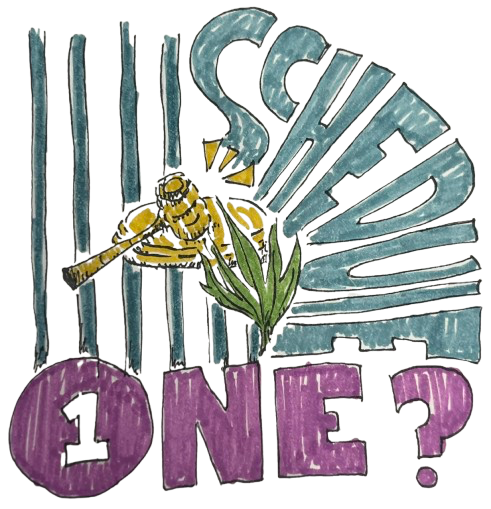
On Dec. 18, 2025, Donald Trump signed an executive order entitled “Increasing Medical Marijuana and Cannabidiol Research.”
“The Attorney General shall take all necessary steps to complete the rulemaking process related to rescheduling marijuana to Schedule III of the Controlled Substances Act (CSA) in the most expeditious manner in accordance with Federal law,” Trump wrote.
While this is a step in the right direction, it does not magically repair the communities gutted by mass incarceration, or free the people still sitting in prison for something that is now legal in half the country. The deeply rooted racist history of the criminalization of marijuana has forever scarred the minority communities that these policies were created to target. While there have been a fair number of strides made regarding decriminalization, further reform cannot come soon enough. The echoes of “War on Drugs” era policies are still felt by the thousands of men and women who continue to live behind bars because of this substance, and the injustice will persist as long as our government allows it.
The aforementioned order aims to expedite the process of rescheduling marijuana from a Schedule I drug to a Schedule III drug. This transition was initiated by Joe Biden’s administration in October 2022, following executive requests to Attorney General Merrick Garland and Secretary of Health and Human Services Xavier Becerra to “launch a scientific review of how marijuana is scheduled under federal law.” HHS’ findings prompted Garland to begin the process of redetermining cannabis.
The CSA created five classifications, or “schedules,” for distinguishing the danger and potential for abuse of certain substances as well as the criminal penalty attached to each. The DEA defines Schedule I substances as those that have “no currently accepted medical use and a high potential for abuse”—substances such as ecstasy, LSD, and marijuana. Schedule III is characterized by “drugs with a moderate to low potential for physical and psychological dependence,” such as ketamine or anabolic steroids. Prison term length and fine amounts for offenses related to Schedule III drugs are about half that of Schedule I.
Rescheduling measures come in response to years of pleas from individuals and advocacy groups alike. However, under this rescheduling, marijuana would still be illegal under federal law. People found possessing, distributing, or manufacturing the substance would still face federal prosecution, just with lighter penalties and formal recognition of its medical use. While it remains to be seen whether action will be taken at a federal level, ample progress has been made in state jurisdictions. As of 2026, 40 states have legalized the use of cannabis in some way. While these reforms may appear to simply reflect modern science and public opinion—which they do—they also represent the first baby steps toward righting past wrongs.
The federal government’s first instance of regulating the substance came with the Marihuana Tax Act of 1937, a policy placing high tariffs on the substance in response to droves of Mexican immigrants arriving in the United States in the preceding decades—immigrants who had brought their recreational practices with them. However, the actual criminalization of marijuana didn’t come until decades later with the aforementioned CSA.
The CSA was passed in 1970, and with it came marijuana’s classification as a Schedule I substance. The following year, Nixon declared drug abuse “public enemy number one,” and so began the “War on Drugs.” Federal drug control budgets ballooned, the Drug Enforcement Administration was created in 1973, and local police departments across the country were incentivized through federal funding to prioritize drug arrests above all else.
The effects on Black and brown communities were immediate and devastating. Studies have consistently shown that Black and white Americans use marijuana at roughly the same rates, yet Black Americans are arrested at nearly four times the rate for possession. Stop-and-frisk policing and mandatory minimum sentencing became policy, and minor infractions were often blown up into years-long prison sentences. Families were broken apart, and an entire generation of mostly Black and Latino men was funneled into a criminal justice system that offered little path out.
The Watergate Scandal and Nixon’s resignation may have technically ended this ‘war,’ but the seeds had already been planted. Future presidential administrations, namely Ronald Reagan’s, and subsequent Congresses would uphold and even expand upon these policies. Drugs were ravaging so many disadvantaged communities during this age, but the aim of policy was never to actually address those issues. The Nixon administration had an enemy, and former Nixon Domestic Policy Chief John Ehrlichman laid out the true purpose of these laws in his interview with Harper’s magazine:
“We knew we couldn’t make it illegal to be either against the war or black, but by getting the public to associate the hippies with marijuana and blacks with heroin. And then criminalizing both heavily, we could disrupt those communities,” Ehrlichman said. “We could arrest their leaders, raid their homes, break up their meetings, and vilify them night after night on the evening news. Did we know we were lying about the drugs? Of course we did.”
The truth shall set you free.
According to the CDC, excessive alcohol consumption kills around 178,000 Americans per year. For cigarettes, that number is 480,000. But cannabis, the drug that is classified alongside heroin on the federal level, has killed a total of zero people. Every year, there are more people killed by being crushed by vending machines than there are linked to marijuana use. There is no reasonable scientific or moral argument for maintaining marijuana’s Schedule I status—only a political one.
If it were cannabis plants that grazed Europe’s fertile lands centuries ago instead of honey for mead or barley for beer, it is hard to believe it would have ever been criminalized the way it has been. But because this vice came from “outsiders” and was enjoyed by those not allowed to participate in society, it was dangerous.
Now, generations of Black and brown communities continue to bear the weight of a policy designed to break them. Just like the systems of slavery and Jim Crow before it, mass incarceration has become this nation’s ubiquitous system of racial control. The American Civil Liberties Union found that in 2018 alone, law enforcement made nearly 700,000 marijuana-related arrests—more than for all violent crimes combined. While the arrest data is public, the number of those actually serving time for cannabis is unclear.
The Last Prisoner Project cross-referenced two Bureau of Justice Statistics reports using data from 2004 and 2018 and arrived at an estimate of around 32,000 people currently held in state and federal facilities for marijuana offenses. That figure, however, is almost certainly imprecise, as the underlying data excludes countless categories of people, such as those held in county jails, juvenile facilities, immigration detention, jurisdictions that don’t report to national organizations, and a host of other scenarios. What that means in practice is that the true scale of marijuana incarceration is larger than what the numbers show, and the people hidden in those gaps are disproportionately Black and brown.
While it’s easy to get caught up in the data, we can’t forget that each statistic is a person. People like Vincent Winslow, who will die behind bars because he sold an undercover officer $10 worth of marijuana, or Parker Coleman Jr., who is serving a 60-year sentence for charges related to conspiracy to distribute marijuana. There is simply no scientific or medical justification for a substance that has never killed anyone to carry penalties that are destroying people’s lives.
The only way justice will be served is if cannabis is completely decriminalized under the law and everyone currently serving time for cannabis related charges is pardoned. The rescheduling of marijuana is a step in the right direction, but the scars running through minority communities from the cycle of mass incarceration won’t go away in one generation. Not one more person should sit in a cage for a plant that has never killed a single soul.
Philipos Alebachew ’29 (philiposalebachew@college.harvard.edu)doesn’t think people should go to jail for weed.