Ruminations on “Wild Geese”
Graphic by Sarahluna Sassine

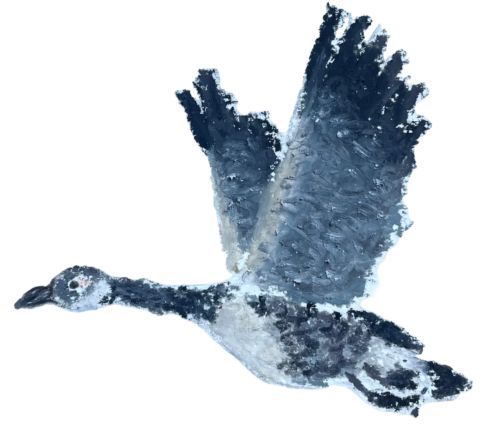
“You do not have to be good.
You do not have to walk on your knees
For a hundred miles through the desert, repenting.
You only have to let the soft animal of your body
love what it loves.
Tell me about despair, yours, and I will tell you mine.
Meanwhile the world goes on.
Meanwhile the sun and the clear pebbles of the rain
are moving across the landscapes,
over the prairies and the deep trees,
the mountains and the rivers.
Meanwhile the wild geese, high in the clean blue air,
are heading home again.
Whoever you are, no matter how lonely,
the world offers itself to your imagination,
calls to you like the wild geese, harsh and exciting —
over and over announcing your place
in the family of things.”
— Mary Oliver
Though this week has been marked by clear skies and glorious sunshine, this Earth Day, I find myself holed up in Lamont Library—specifically, level 1 row 41—reading and re-reading the late Mary Oliver’s 1986 poetry collection “Dream Work.” This collection includes “Wild Geese,” arguably Oliver’s most loved and famous poem. The piece is not only an ode to nature but an essential commentary on the need for a different perspective that every college student should adopt at some point in their lives.
In a sentiment I initially found hard to swallow, Oliver opens her poem with, “You do not have to be good” (line 1). Notice how she didn’t say perfect nor great—just good. In other words, it is okay not to be good. That sounds like quite an obvious statement, yet how often do we actually allow ourselves to internalize these words? I would wager that, in actuality, we give ourselves grace less than we might imagine. When in reality, to feel is to be your true, authentic self—to be human.
On the flip side, perfection is a myth that many of us have conned ourselves into believing is attainable. I have found that, especially at places of elite higher education, there is a sort of herd mentality surrounding perfection. There is a sense of obligation to do more, be more, and achieve more because we are in a privileged academic space. That our presence here is proof of some exceptional ability or potential. Of course, we should want to do great things with the education we’ve received. But when the pursuit of perfection becomes the only goal, we risk failing to apply what we’ve learned over the past four years to building a life that is simply “good enough”—whether as an end in itself or a step toward something more refined.
To live is, in my opinion, to be vulnerable: in a sense, it’s “let[ting] the soft animal of your body/love what it loves” (lines 4-5) and being unapologetically yourself. As Oliver puts it, “the world goes on”(line 7), so my question is: Why waste what precious time you have pursuing something unattainable, instead of living on your own terms?
The logical explanation for what I mean by that starts with an essential question: what is living for me, and by extension, you? I’ve already touched on feeling as an essential part of living a good life, but there is something more foundational to it. Living is, in part, rejecting the pressure society places on you to sacrifice your free time in pursuit of building a career or increasing productivity that never feels like enough.
It’s “over and over announcing your place/in the family of things” (line 17-18), saying to the world that you exist beyond your output. There is a you that exists outside of Harvard that laughs way too loudly at stupid jokes or finds comfort in the dulcet tones of Adrianne Lenker’s music—despite all your friends calling you performative. There is a you that deserves to flourish, and that version deserves just as much, or even more, attention than the version that gets overly excited at the prospect of lunch, as the only break you get during the day. It’s this iteration of you, not the competitive athlete in the case of some, nor the people striving to maintain their 4.0 GPA, in the case of others, that Oliver is speaking to.
On that note, I find it ironic that I am currently writing this hunkered down in the darkest corner of Lamont’s basement. Perhaps I’ll take my own advice and practice what I preach. Until next time…
Originally, as you can see, this article was going to end on a positive note. In light of recent news and reflection, I realise I didn’t address what we are supposed to do for those whose lives are taken before they can announce their place “in the family of things” (line 18).
My mind turns to Shreveport, Louisiana, and to the eight children senselessly murdered last week in what was the deadliest mass shooting in the U.S. in the past two years. Seven of those eight children were gunned down in what local police have described as “execution-style” killings at the hands of their own father.
Children.
Gabby Giffords, the former Representative from Arizona who survived an assassination attempt in 2011 and subsequently founded Giffords, a nonprofit organization dedicated to ending gun violence in America, put it best: “All of us should be outraged that we live in a country that routinely subjects our kids to such unimaginable violence.”
Maybe Oliver was wrong. Maybe we do need to “walk on [our] knees/For a hundred miles through the desert, repenting” (lines 2-3) because we ought to feel ashamed. It is shameful that firearms are the leading cause of death for children and teens in this country, and the politicians’ thoughts and prayers aren’t doing anything to stop it.
It is shameful that, in Louisiana, where this tragedy happened, you do not need a license to own a firearm, nor, in the case of private sales, do you need to go through a background check to purchase one. It is because of laws like these that I reject the frequently said phrase “Guns don’t kill people, people kill people.” Actually, guns do kill people—and we’ve made it far too easy for the wrong people to get their hands on them.
Reading the line “Meanwhile the world goes on,” (line 7) in this context almost seems like an insult. It is a fact of life that the world will move on from this tragedy—but should it? Every time a horrific event like this occurs, which in America is far too often, we mourn in the moment, yet the vast majority of the population moves on. The survivors and affected communities, alongside the activists who have devoted their lives to preventing these atrocities from happening, don’t get to move on. They are confronted every day by reminders of what was, waking up to quiet houses no longer filled with the laughter of youth, tables set for one instead of for many. They don’t get to move on.
Noah Basden ’29 (nhbasden@college.harvard.edu)writes Forum for the “Harvard Independent.”