Kitchen Sink No. 12
Graphic by James Foss

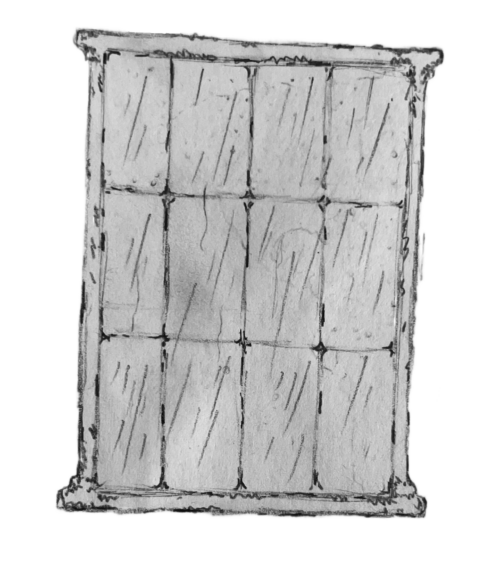
The ward is quiet this morning. Rain on the window and the sound of it has the same sound it had that week, and I am writing this at the desk by the window, and my wrists are light against the wood where the ties have been loosened for the hour they are loosened.
I will tell it as it was. Monday first.
…
It has been raining since Sunday. A patient patter off the fens that has soaked into the gravel until the gravel has gone to mud at the edges, and into the stone of the buildings until the granite has darkened two shades, and is still coming down this morning as it came down last night, without hurry, the persistence of weather that has settled in and does not intend to be moved.
My boots have not been dry since Sunday. I have a second pair, which were my father’s, also not dry. I have been rotating them on the fender in front of a fire, and the leather has begun to take the shape of my feet. My feet are cold. They have been cold since Sunday. I look at them sometimes to confirm that they are still with me.
The sashes of the large window do not seat. Clusters of water droplets line the sill. Along the inner edge of the peeling plaster, where the west wall meets the ceiling, a patch the size of a man’s hand has darkened since Sunday.
I go to the sink each morning and count to three as my hands have been taught to count, and I come back into the main room with wet hands, and the room is not empty in the usual way. I do not see anything. The air along the west wall, under the dark patch, has the quality it has when it has been breathed by someone else and given back.
I say, aloud, into the room, Good morning. The room does not answer. I had not intended to speak. The words come out and stand in the middle of the room, and I look at them where they are standing, and after a while, they dissipate.
I dress. A button on my shirt is missing, but I do not remember it missing last night. The shirt’s collar sits wrong because of it—I go to the hall with the top seams ajar.
…
Hendricks reads the messenger’s speech from the Libation Bearers aloud in Greek. His voice has the tremor it gets when he is moved and does not wish to be seen being moved, and the rain on the long windows is loud enough that the men at the back have tilted their heads to catch him. I am not tilting my head. I am watching his mouth and hearing, through the Greek and through the rain, the second breath behind my own, and I understand at some point during the speech that the breath is following the Greek.
Afterwards, Hendricks catches my eye in the crowd, leaving the hall. He does not nod this time. He stops. He says, Are you well. I do not answer. He waits, and I do not answer, and the men around us go on out into the rain, and after a moment, he reaches into his coat and takes out a book and puts it into my hand and says, quietly, You might look at this. I had meant to lend it to you. Then he turns and is gone in the crowd, and I am left with the book, and I walk out into the rain holding it flat against my chest under my coat, and the water that comes in at the collar runs down and pools on the cover, and I do not feel it until it has begun to soak through to my shirt.
Back in my room, I set it on the desk. I do not open it at once. I light no fire. I sit on the bed and look at the book, where it is on the desk, and it is a small green cloth volume of the Libation Bearers, Hendricks’s own copy, judging by the wear at the spine, and after some time, I rise and open it and see that he has marked a passage. The mark is a thin pencil line in the margin, down one column of the verse. I read the marked passage. I read it again. The second time I read it more slowly than the first. I close the book.
I sit with my hand on the cover for some time, and the room is cold, and the air along the west wall is close again, and whatever is there has not read the passage, because it does not read with me, but it knows that I have read it, and it waits for me to say what I will say, and I do not say anything. I put the book on the shelf above the desk. I do not put it with my other books. I put it alone, and it stands there, green, slender, patient, with Hendricks’ mark still inside, and I think about what Hendricks must have seen in my face, that he put this book in my hand rather than speak.
…
Tuesday, my pen is not on the desk.
I stand looking at the place where it is not. I check the drawer. I check the pocket of the coat I had been wearing on Sunday, and the pocket of the coat I am wearing now, and the pen is in neither. I sit down on the bed. I get up and check the drawer again. I sit down on the bed.
I find it at half past four in the grate. Lying across the topmost sticks of the fire I have not lit, horizontal, set down carefully, as a man arranging the pieces of a fire would set down a pen he had carried in for some other reason and put aside. The nib is not damaged. The barrel is not damaged. It is only where it is.
I take the pen out of the grate. My fingers come away sooty. I put the pen back on the desk. I stand looking at the grate, and I say to the grate, Why. The grate does not answer. I go and wash my hands at the sink and come back, and the pen is where I left it, and the grate is where it was, and I do not light the fire that evening, because I cannot bring myself to light a fire in a grate that has held a pen that was not put there by me.
That night I hear, from the bed, a small sound in the closet. Not the tap. Something smaller. A knocking, perhaps. I do not get up. I lie in the bed and listen, and after a while the sound stops, and I do not know whether it stopped because it had finished or because it had noticed me listening.
…
Wednesday, I cannot be in the room.
The trees bare to their last twigs, and the grass gone dark and slick under a week of wetness, and the river running fast and high. I walk with my hands in my sleeves, and my collar turned up, and the rain dripping off the brim of my hat and trickling down the back of my neck. Puddles seep through the futile rubber soles of my boots within the first hundred yards, and each step takes on a small wet sound at the heel that accompanies my walking so precisely that I cannot tell whether I am making the noise or the noise is making me walk.
I stop at a wooden rail. The wood is wet and colder than the air. I look at the water. I slide my finger across the rail, and the string of droplets it has gathered falls onto the mud. I stand looking at the mud where they have fallen. I take my hand off the rail. I walk on.
The second breath is closer now. It had been a few paces behind. It is on my shoulder now. It has not spoken, because it does not speak, but it has come up, and the attention that is not mine rests on the water where my attention had been, and whatever is attending is patient.
On the lane back, I pass a woman with a child. The woman nods at me, civil, the way a woman nods at a gentleman in a lane, and I open my mouth to respond to the gesture, and what comes out is a laugh. Short. One syllable. The woman does not stop. She walks on with the child and does not look back, and I walk on, and I do not know what the noise was for.
…
The library is on the far side of the second court. I take a desk on the upper gallery, by the north window, and I open a book I am not reading, and I sit.
She is at the desk three down from mine. Young—twenty, or not yet twenty—with dark hair twisted up with a French pin and a grey wool dress that is dry and a book open in front of her that she is actually reading. She makes a small pencil mark in the margin and does not stop reading.
I watch her for I do not know how long. And while I am watching her, the second breath is not behind mine. This is the thing I notice. It has been with me all day, on the Backs, at the rail, on the walk home, and here it is not. I sit in a room with her, and we are the only two people in it, and I breathe my own breath and my own breath only, and I do not move.
She looks up once. Not at me—not at him either. At the window, where the rain is running down the glass in long, slow sheets and the lamp-yellow from the cloister walk is coming through the rain and breaking on the panes into slow vertical light. The light is on her face for a moment. She looks down.
I leave before she leaves. I cross the cloister. I come out into the rain, and the second breath is behind mine again before I have reached my staircase, and I understand that I have found a room it cannot enter, and that I will have to go back to the room, and that going back is a thing I will not be able to stop myself from doing.
…
Thursday, I go back to the library.
I cross the second court. I come to the cloister. I come to the stone stairs. I put my hand on the rope. The rope is coarse, and my palm is tender in a place I cannot account for, and I close my hand on the rope anyway, and I begin to climb.
The second breath is beside me on the stairs.
On Wednesday, it had stopped at the foot of them. Today it does not stop. It climbs with me, tread by tread, and the gathering in it begins on the stairs, and I understand that the room is not the thing that keeps it out.
I stop halfway up. Stone worn in the middle by six centuries, rope damp under my hand. I take my hand off the rope. I turn. I go back down. I cross the cloister. I come out into the rain.
I do not remember the rest of Thursday. I have tried, on the bed afterwards, and in this ward afterwards, and Thursday from the hour of the stairs is a grey that has no shape in it. Between the stairs and the Friday morning, there is a span of perhaps fourteen hours that belongs to neither of us, or to only one of us, and that one is not me.
I know this. When I wake on Friday, the shirt I had put on Thursday morning has been taken off, folded, and placed on the chair by the grate, and I have never folded a shirt that way in my life.
…
Friday, I see her in the high street.
I am coming down from the booksellers, and I step out into rain that is heavier than it has been all week. Rain that has no angle, only falling, and the pavement is running with water, and the men on the street are under the eaves or under their umbrellas or running, and she is on the pavement ahead of me with neither umbrella nor eave, walking as though she had made the decision a street ago that she would keep at her own pace and let the rain do what the rain would do.
She is soaked. Her trench coat is dark along the shoulders. Her hair has fallen on the left side, and strands stick to her neck. Her basket has a thin film of water along the weave. She walks evenly. She does not hurry.
Edward is with me. It is the first time I have said the word in some days, even in my own head, and the word does not help.
He lifts. I use the word lift because it is the only word I have. He has been at my shoulder at the pace of my pace, and when she comes into view, a change goes through him that is a narrowing, a gathering, and I take a step after her without meaning to. I stop. I take another. I stop.
I put my hand on a lamppost and hold. The iron is cold and wet, and my hand takes the wet from it and holds. She is walking on the pavement. Edward is pulling forward in me as the rain pulls down from the roofline, and I hold the lamppost, and a man going past asks if I am all right, and I say, out loud, to the man, I will not. The man does not stop. He walks on. And I stand with my hand on the iron and watch her walk to Magdalene Bridge, and across it, and away.
I stand at the lamppost a while longer. My breath is quick. Edward is settled at my shoulder again, put away, kept for later.
I go back to the college by the lane.
…
It is late. The staircase is quiet. I am standing at the window of my room, and the rain is running down the glass in the same long, slow sheets it had been running down the library window on Wednesday. The court below is empty. Behind me, in the room, Edward is at the shelving along the west wall, where the damp patch has gone darker still through the day.
I press my forehead to the window glass. The glass is cold. I look down into the empty court, and I say to the glass, quietly, I will not. And the glass receives it, and behind me, Edward receives it, and does not answer, because we both already know.
Written by Luke Wagner ’26 (lukewagner@college.harvard.edu)and Jonah Karafiol ’26 (jonahkarafiol@college.harvard.edu).