Sports! Sports! Sports!
Graphic by Sam Park

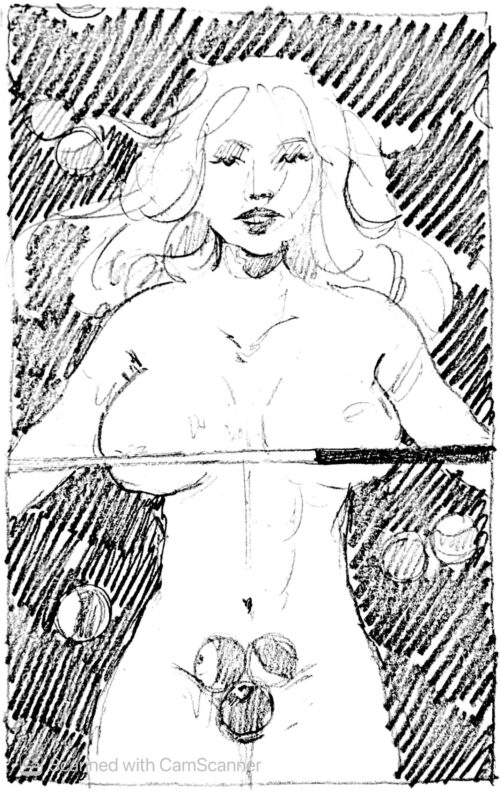
Lately, it seems like we’ve been seeing a lot of Sydney Sweeney. The blonde, blue-eyed actress has been all over everyone’s feed in controversial advertisements, from Dr. Squatch to American Eagle and, most recently, Novig, a sports-betting company. Sweeney seems to lose more and more clothing as the advertisements continue, and backlash to such risqué work has increased in tandem.
For those unfamiliar, the Novig ad features Sweeney wearing little to no clothing while posing with sporting equipment including footballs, a tennis racket, a golf club, hockey sticks, and a basketball net. Sweeney describes Novig’s sports gambling platform using the tagline “just sports,” including a sequence where she says the word “sports” in various (suggestive) tones.
I find myself disappointed, but not surprised, by Sweeney’s conduct. Many female athletes view the way that Sweeney leans into being sexualized as demeaning towards women in sports—a conclusion I certainly find to be true as she sprawls across a table, nude, saying, “I just look good here.”
By acting as if the only role for women in sports is to be sexualized accessories to it, Sweeney devalues years of work that female athletes have put in to fight for equal representation, pay, and opportunity.
Female athletes already face objectification when actually playing sports—during the European Beach Handball Championships in 2021, Norwegian female athletes had to pay a fine of $175 each just for wearing shorts instead of bikini bottoms. Sweeney’s choice to appear in extremely revealing uniforms and gear makes women’s presence in sports seem like a joke. Defenders of Sweeney’s choices note that female athletes have released similar campaigns, such as the nude cover Serena Williams did for ESPN’s Body Issue in 2009. But this is willful ignorance: Williams posing nude as a celebration of her athleticism and the way her athletic career has shaped her body should not be equated to Sweeney being styled as a decorative prop for a sports-related product.
Ultimately, though, Sweeney isn’t pretending to be a female athlete—she’s just being herself. Although she wears and holds various sporting equipment, she does not act like she’s actually trying to play the sports, and her lines in the advertisement are about Novig’s sports-betting platform, not sports themselves. In fact, I’m not entirely sure that the advertisement is particularly bad for women in sports; I think it’s just bad for women in general.
Sweeney’s performance in the advertisement ultimately reinforces the idea that women’s bodies exist only to be looked at. The advertisement uses her body to get attention, and it worked: Novig’s brand mentions jumped by 1,200% in the first four days after the advertisement, and 73.4% of surveyed male gamblers were more inclined to choose Novig. Still, it’s harmful to all women when women with access to power and exposure act as if it is acceptable to turn one’s body into a marketing tool.
What Sweeney says in the advertisement matters too. In a sultry tone, Sweeney says Novig is “just sports,” with “No wars and no politics.” Her apolitical stance isn’t new: when her American Eagle advertisement, which claimed she had great “genes/jeans,” was criticized for its references to eugenics, she defended herself by merely saying, “I did a jean ad.”
Sweeney has a pattern of believing she can detach herself from the context surrounding her. However, there’s no such thing as “just sports.” Sports and sports betting are continuously informed by politics, from debates about transgender athletes to disputes over women’s pay to legislative arguments about betting—which is to say, everything is political. Yet Sweeney’s consistent choice of projects that distance themselves from politics reflects an ignorance of systemic injustice.
Sweeney has said she’s “not a political person. [She’s] in the arts.” But the arts are political, too. What we choose to represent in our shows and movies reflects the stories we think are worth listening to. Sweeney’s position as a conventionally attractive, white, blonde woman gives her privilege—privilege that often allows her to ignore the consequences of her actions.
As Sweeney repeats “Sports! Sports! Sports!” for Novig, I find myself wondering: Why would any woman choose to portray herself this way? Sweeney’s supporters argue that it doesn’t matter why—Sweeney can do what she wants, and people are just jealous. But Sweeney isn’t the first beautiful actress in the world, and her critics aren’t just envious.
Even though she chooses to sexualize herself, that doesn’t legitimize her actions. Not all choices a woman makes are feminist, and Sweeney certainly proves that: when she leans into sexualization, she leans into the patriarchal assumption that a woman’s body can be objectified and monetized, encouraging the idea that women exist as sexy decorations to help sell things, rather than as human beings in their own right. And when Sweeney makes these choices on a national scale, it spills over—people use her to put down other women, calling women who disagree with her “crazy” and “ugly.”
At the end of the day, I stand by what I said: I am disappointed, but unsurprised. Sweeney’s conduct, and her defense of it, have definitely led more people to feel validated in their own sexualization of women and female athletes, but she has never really been a feminist icon. Sweeney’s goal was probably to make the campaign go viral, which she did. Still, even if she isn’t at the forefront of the feminist movement, that doesn’t mean we can’t critique her choices. The actions of rich, famous women trickle down to the perceptions of women everywhere, and it is critical that we point out she didn’t just “do a jean ad” and that it’s not “just sports.”
Anika Gupta ’30 (anikagupta@college.harvard.edu) is comping the “Harvard Independent.”