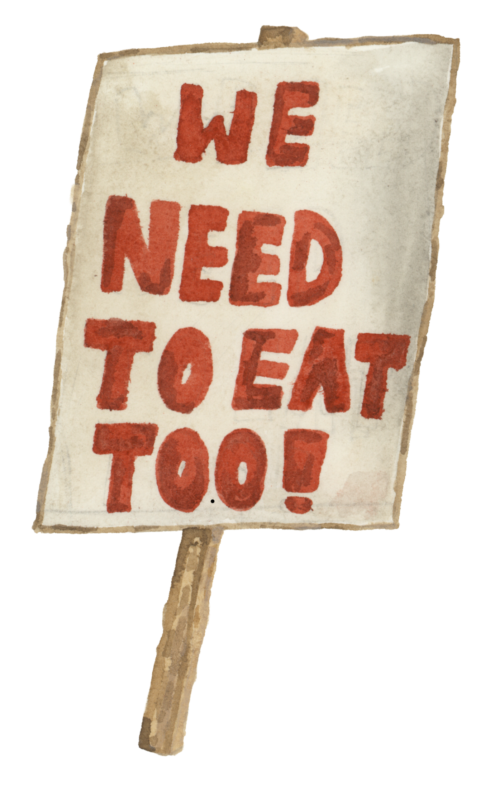
HUDS Workers Warn of Impending Strike
Graphic by Lola Selberg

Since June 19, 2026, Harvard University Dining Services employees have been working without a contract. Their contracts with Harvard are negotiated through UNITE HERE Local 26 and set terms for wages, benefits, working conditions, and grievance procedures for HUDS staff. Represented by their union, HUDS workers are now considering striking if Harvard does not propose a new contract that meets their demands—higher, inflation-adjusted wages, lower health insurance premiums, and greater job security.
This is not the first time HUDS workers have had trouble with contract negotiations. In October 2016, HUDS workers went on strike for 22 days after failed negotiations with Harvard over health insurance and a minimum annual income. Students and locals supported the strike, and Harvard eventually reached an agreement with the union.
The previous HUDS contract, negotiated in 2021, expired June 19. Given the contract’s expiration, rising rents in the Cambridge area, and other rising expenses, HUDS workers are seeking a new contract that reflects these costs. Employees report working seven days a week, taking overtime shifts, or working second jobs to make ends meet.
“The cost of living’s high. Food is high, and rent is high. People are afraid to go on strike, because how are we gonna pay our bills?” Nancy Maduro, a HUDS worker in Winthrop House, told the “Harvard Independent.”
HUDS workers hope to negotiate for wages that match those at neighboring institutions, such as the Massachusetts Institute of Technology and Northeastern. HUDS workers earn about $16.80 an hour, compared with $30 or more at MIT and Northeastern.
In addition to petitioning for higher wages, union members are also seeking a more affordable health care plan, as rising insurance costs have made it harder for some to support their families. “If you have another kid, they’re gonna try and make us pay more,” said Billy Zhu, a HUDS worker in Winthrop House. Zhu struggles to pay for his children’s dentist appointments because of high insurance premiums.
“$171 a week for family, and now they’re trying to make us pay 3 percent more,” he said. “It’s too high.”
On Sept. 16, UNITE HERE organized two rallies outside Harvard’s Smith Campus Center, each following a teach-in in the First Parish Church. “They were just HUDS workers telling us their stories about what their experiences are like right now, struggling to make ends meet under the conditions that Harvard is providing for them,” said Ariadne Georgiou ’30, who attended both teach-ins that day.
The teach-ins gave students and other union allies a chance to understand the financial difficulties HUDS workers face. At one point, union members were asked to raise their hands if they were currently relying on overtime to make ends meet.
“More than half of the people in the room raised their hands,” Georgiou continued. “It was just good to see everybody in solidarity together, undergrads and HUDS workers, union members and organizers, and everything.”
Georgiou described the stories employees told of struggling to support family members, relying on overtime hours to make ends meet, and letting go of long-term career goals. “Those were just incredibly heartfelt, a lot of sincerity and pain in their stories, and it was just really palpable—the feeling in there that something wasn’t right.”
Another student in attendance, Catie Espiricueta ’30, spoke about the importance of showing solidarity with the workers: “As students, we directly and immensely benefit from the hard work of our dining hall staff. As such, we have an immense responsibility to support them because they should not have to sacrifice any aspect of their life to stay economically afloat.” Students did this in 2016 by showing up to rallies, walking with the workers on the street, and bringing food to workers in the dining halls.
Maduro and Zhu, both employed at Harvard during the 2016 HUDS strike, recalled the value of student support. “The students helped us a lot last time, in 2016. If not for the students, we wouldn’t make it,” Maduro said.
In response, Harvard’s Student Labor Action Movement has organized in solidarity with UNITE HERE. “We just kind of take instructions from the union on how we can amplify their voice right now,” Georgiou, who is involved with SLAM, said. “They are super organized and super vocal,” she added.
Amplifying the voices of undergraduate allies might increase pressure on Harvard to negotiate. “Our voice is powerful in this situation in particular,” Georgiou noted. “Ideally, they would be able to get a fair contract without having to strike, but if it does come to that, there should be enough support from the undergrads.”
Maduro said she did not want to strike, but it seemed increasingly likely. “We can’t afford it. Cost of living is high. It’s not looking good for us,” she said. Maduro is unsure whether a strike will even make a difference.
So far in the negotiation process, Harvard has not agreed to the union’s demands. Earlier in the bargaining cycle, union leadership reported that the university had rejected 37 of 40 wage-increase proposals.
During the 2016 HUDS strike, Harvard argued that it couldn’t easily draw on its multibillion-dollar endowment to fund higher salaries for HUDS workers, because donations are often directed toward specific purposes, such as professorships, libraries, and scientific research.
As a strike becomes increasingly likely, one student remains optimistic. “While at the rally, I also felt hopeful because it was clear that Harvard students support our staff,” Espiricueta said. “By supporting them and standing alongside them as they fight for fair wages, Harvard will have to listen, and I am positive that student support will remain strong.”
Sadie Tribe ’30 (sadietribe@college.harvard.edu) and Abigail Mckoy ’30 (abimckoy@college.harvard.edu) are comping the “Harvard Independent.”