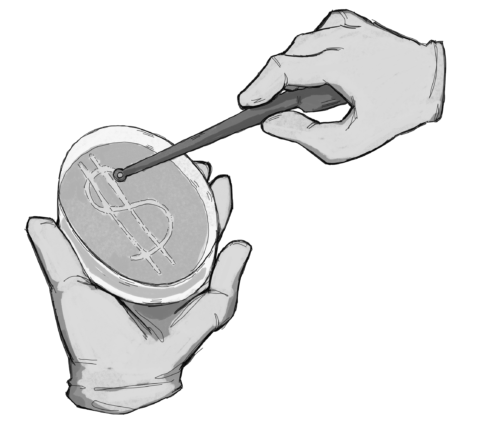
Will Harvard Labs Become a Political Petri Dish?
Graphic by Taylor Bierwerth

On Sept. 18, President Donald Trump asked the National Institutes of Health to cut Harvard University’s research funding. Dr. Jay Bhattacharya, the NIH director, refused. He defended his agency’s current grantmaking process, driven by standard scientific peer review. Trump then asked his Director of the Office of Management and Budget, Russell Vought, to draft an executive order placing a political board in charge of NIH grants.
The executive order was shelved on Sept. 23 amid bipartisan pushback. However, the White House has not formally withdrawn the order, so it could return after this November’s midterm elections. The standoff between Trump and Bhattacharya could affect labs, institutes, researchers, and students across Harvard’s campus.
“Coming to Harvard, I recognized that it was often in the public eye, but I didn’t really appreciate how much of a political target it was,” Nathaniel Rathbone ’30, a student concentrating in integrative biology, explained in a written statement to the “Harvard Independent.”
The amount of federal funding Harvard and Massachusetts receive may help explain why Harvard is a target for the Trump administration. Massachusetts received about $3.41 billion from the NIH in 2025, or roughly $478 per resident. This was the highest per-capita funding in the country, eight times the median state’s per-capita funding. The administration has argued that NIH funding should be distributed more widely across the country. “Dr. Bhattacharya’s vision to disperse NIH funding more widely across the country ensures the agency funds rigorous, unbiased, evidence-based science, regardless of location,” a U.S. Department of Health and Human Services spokesperson said.
Dr. Charles Nelson, a Harvard Medical School professor, has a different explanation for this funding concentration. “I don’t think that’s an issue of equity. I think it’s an issue of where the intellectual powerhouse and scientists are residing,” he said in an interview with the “Harvard Independent.” “If you do a head count of which schools have the most Nobel Prize winners, it’s going to be those very schools [that Trump has targeted], and that’s where the big discoveries have been made.”
The effects of these funding pressures are evident in Harvard’s labs, particularly in studies on topics the administration opposes. “The vocabulary that we’re using to try to get grants has changed drastically with the Trump administration, particularly [with] them targeting DEI,” a Harvard PhD student explained anonymously to protect their lab’s ongoing research. “[The lab] is very interested in how skin tone affects your ability to get [clinical] measurements through skin, and we can no longer talk about that at all.”
This conflict is playing out nationwide. Researchers across the country filed a class-action lawsuit, alleging that the NIH’s screening process has censored research based on political ideology. According to court disclosures, the agency uses keywords such as “equity” or “gender” to flag and terminate grants. The NIH acknowledged using a search tool to flag University of California grants with terms like “health equity” and “structural racism.” The list of flagged terms also includes “climate change” and “vaccine hesitancy” according to the disclosures.
Rathbone worries that the funding cuts will also have long-term effects on research. “My thinking is that if researchers start choosing questions based on their political acceptability rather than their scientific value, then the kinds of unconventional or uncertain research that have produced some of science’s greatest discoveries might be discouraged,” Rathbone added.
While research funding can be cut in a matter of weeks, training and recruiting the next generation of scientists can take years. Nelson has witnessed this strain in his own lab. “Very talented undergraduates here are going to work for Google and Meta and the like because it pays more than academia does,” he explained. For reference, research assistants at Harvard earn an average annual salary of around $62,000, whereas entry-level roles at large tech companies can pay $150,000 and often more. “I do worry about the gutting of academics and the gutting of people, really talented people, who are going into science.”
Students are also affected by faculty reactions to funding cuts. “If students look to faculty and the faculty look depressed and are stressed, and they look hopeless, they’re thinking, ‘I don’t want to be like that,’” Nelson said.
The PhD student has personally seen their mentor’s energy shift. “My [principal investigator] is definitely someone who always wanted to be in academia, always wanted to be a professor. That was their dream,” the student said. “My PI has been distracted way more than ever before because we’re just pushing out grant after grant after grant after grant to try to get basically any money for our lab.”
The funding restrictions on research have left many undergraduate students reconsidering their career options. “It makes me actually more inclined to pursue a stabler career, such as going to med school,” Kelly Zheng ’30, a student on the pre-med track, shared. At the same time, she views the current uncertainty as an opening. “We are at such a turning point that it would be a shame almost to pass up on the opportunity of doing something more unorthodox.”
Rathbone is reconsidering his options, too. “I’m still interested in research, but I think this has made me less certain about the prospects of pursuing employment in academia,” he said. “If anything, it’s forced me to look around at other ways of doing research (like industry research or startups).”
Some Harvard faculty have already built companies from their research. Leading Harvard faculty such as Gerald and Darlene Jordan Professor of Medicine Dr. David Scadden and Associate Professor of Stem Cell and Regenerative Biology Dr. Chad Cowan have successfully launched major biotech companies like Fate Therapeutics and CRISPR Therapeutics from their university research.
Still, private companies may not necessarily be a safety net for prospective researchers, the PhD student noted. “I have friends in companies, particularly in biotech companies, and they’re all getting laid off in huge numbers,” they said. “People are a lot more scared to make mistakes in industry right now. Unless something’s working 100%, they won’t continue to pursue it.”
Many scientists are also looking for research opportunities outside of the United States. A “Nature” poll of roughly 1,600 researchers from 2025 found that more than 75 percent of scientists were considering leaving the country. China has since launched a new “K visa” aimed at young science and technology talent. “Other countries are very much taking this as an opportunity to take our brainpower,” the PhD student said. “There’s not much hope in the science world right now, and I think the hope is in other countries.”
Despite the bleak outlook, two undergraduates on campus remain among the most hopeful voices. “I do feel like the fact that Harvard has been around for so long … signifies that historically, we have been able to overcome challenges,” Zheng explained. “I just think that this ambition is not going to be tempered by budget cuts. I think it’s not something that you can take away with a couple executive orders.”
Aadit Shrivastava ’30 (aaditshrivastava@college.harvard.edu) wants to research the freshman flu epidemic.