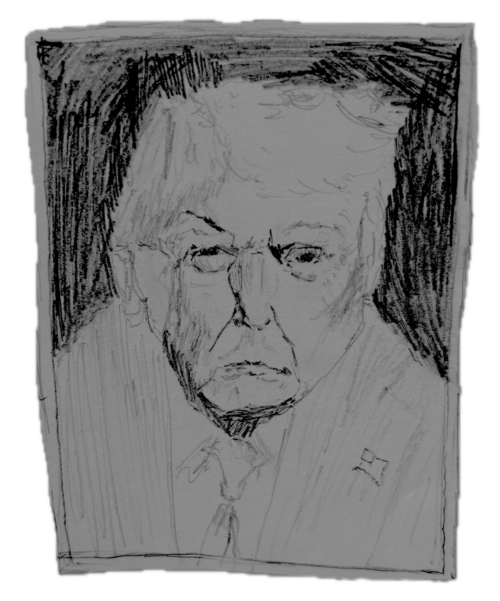
Hung Up on PowerWhat does a presidential portrait say?
Graphic by Tess Harris

Step into the Smithsonian’s National Portrait Gallery’s “America’s Presidents” hall and you will notice that all the faces look strangely alike. They sit or stand with a flag, desk, or column nearby, and they all wear the expression of someone who knows history is watching. They are meant to feel timeless. But are they really art, or are they just branding in a frame?
For most of American history, the answer was supposed to be “neither”—the portraits were a ritual, only unveiled after a president’s final term. The National Portrait Gallery likewise traditionally hangs a presidential portrait only after that leader has permanently left office. The logic is that a portrait is a final verdict, not something to deliver during an ongoing trial. The president is supposed to be safely in the past tense.
Even in an otherwise changing world, that convention endured. In 2018, Barack and Michelle Obama unveiled portraits by Kehinde Wiley and Amy Sherald that diverged from the genre’s precedent. In his portrait, Obama is seated, leaning forward against a wall of living foliage instead of the traditional mahogany desk. Michelle Obama is rendered in grayscale, in Sherald’s signature style. Visitors lined up for hours: the portraits broke from the ones that came before, and people could tell. It turns out that a portrait can be a statement about who gets to be a subject of American history at all.
Which brings us to the present, where the portrait no longer waits for history but tries to write it.
In 2025, the White House released a new official portrait of President Donald Trump by chief White House photographer Daniel Torok. With a dark background, no American flag, and a stern, unsmiling expression, Trump’s piece reads less like a civic portrait and more like a movie poster. Supporters loved the intensity, while critics found it too theatrical. Either way, the photo was a choice: an image meant to project strength, not reassure.
This tension did not stay inside the White House. In January 2026, the National Portrait Gallery removed wall text mentioning Trump’s impeachments from the display of his portrait. Meanwhile, Trump has also altered how other presidents appear in his redesigned presidential portrait gallery in the West Wing Colonnade, hanging a photo of an autopen to represent Joe Biden.
We could argue forever about whether any of this is fair. A caption, a frame, and a hanging location used to be only background details. Recently, though, they have started to create arguments themselves. When a museum edits a wall label, it revises a portrait’s meaning without ever touching the picture itself.
Even beyond Washington, we can see this fight in the states. After Trump complained about how he looked in his portrait at the Colorado State Capitol, the building’s advisory committee voted to take down all the presidential portraits in the rotunda, at least temporarily. They replaced them with an exhibit celebrating the state’s 150th anniversary. As of this spring, officials remained undecided about whether to put the portraits back up. An entire history of presidents, Democrats and Republicans alike, ended up in storage over one man’s reaction to a painting.
You do not need to be in Washington to feel this. Look up the next time you eat in Annenberg. The walls of Harvard’s rooms are lined with oil portraits of the people who ran the place, funded it, or taught in it. For most of the University’s history, those people looked a lot alike. Portraits tell you who the institution thinks is worth remembering. Anyone who has ever wondered why the people on the walls do not look like the people at the tables has already asked the question that the National Portrait Gallery faces: who gets remembered, who does not, and who decides? At Harvard, the answer to the last part has always been the university itself.
Harvard also has a stake in the presidential canon. John Adams, Class of 1755, and John Quincy Adams, Class of 1787, both studied at the College, as did Theodore Roosevelt, Class of 1880; Franklin D. Roosevelt, Class of 1903; and John F. Kennedy ’40. Barack Obama became the first Black president of the “Harvard Law Review” before anyone had hung his portrait anywhere. George W. Bush is a Harvard Business School alumnus. When you walk around the Yard, you brush past the same buildings as those whose careers shaped the nation—and the gallery wall.
Fittingly, one of these alumni has become a portrait artist himself. George W. Bush’s new book, “The Call of Freedom: Portraits of Political Prisoners and Dissidents,” will be released March 9 and coincides with an exhibition of his art at the George W. Bush Presidential Center in Dallas. Here is a former president who spent decades as a subject and now chooses to be the painter, putting the focus on people who were imprisoned for speaking up. It reverses the genre: power looking at the powerless, rather than the other way around.
Maybe we are more qualified to judge this than we might think. Our generation spends its life managing portraits—from the Harvard ID photo, snapped in 30 seconds and carried for four years, to the LinkedIn headshot, the club website bio, the Instagram slides filled with candids. We edit, crop, choose the dark background or the warm one. We know what a portrait is meant to do, because we do exactly what the White House does, just at a smaller scale.
So when the White House picks a stern portrait and no flag, I understand the choice, even if it is not one I would have expected. Here, the focus is on the man holding the office, not the office itself. There is no flag, and thus no borrowed symbolism of the nation, but instead a face meant only to reflect toughness and individual authority.
I find myself wondering what comes next. If portraits become tools of the current moment, then a museum’s wall label, a state’s gallery, and the order of the frames all become open to negotiation. The tradition of waiting until a presidency ends was meant to give the portrait some distance from the politics it depicts. Without that wait, it is harder to say what a portrait is for.
There is a hopeful note in all of this. Bank of America is sponsoring the assessment and conservation of 110 historic presidential portraits and frames at the National Portrait Gallery, many of which have never been formally conserved. Conservation is the opposite of the fight over what is displayed: asking what a painting is made of, not what it should be saying. I hope this closer look leaves us with a better-documented record of how the portraits were actually made and altered, giving future viewers firmer ground to stand on for whatever arguments come. Somebody is still carefully cleaning old paint off these faces so people who are not born yet can see them, which seems like the right impulse to me: preserving the record before arguing about it.
Mala Brumm ’30 (mbrumm@college.harvard.edu) is comping the “Harvard Independent.”