MAGA MakeupA not-so-satirical deep dive into Trump’s most bronzed cheerleaders.
Graphic by Sarahluna Sassine

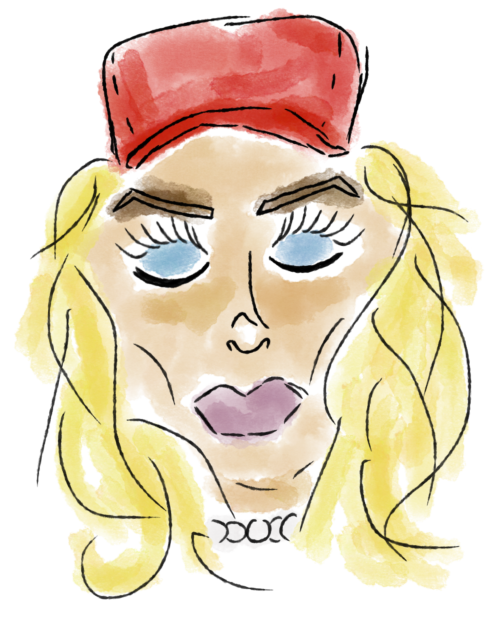
If you have ever wondered who is teaching America’s MAGA women how to look like a less fabulous version of RuPaul, look no further. The main culprit behind the infamous MAGA makeup, also called the “Mar-a-Lago” face, is Adrienne Gray, a former “Fox News” commentator turned makeup artist who has recently gained traction among conservative female politicians.
Gray’s look features heavy matte foundation, creased concealer (often a shade too light), blush that makes the cheeks extremely rosy, heavy contour, false eyelashes, and a thick ring of black eyeliner around the eyes. Some aspects of the look aren’t shaped by makeup alone: long blonde (but sometimes brunette—shoutout Kristi Noem) hair, big lips, and Botox are all classic additions.
Gray’s new way of decorating America’s most visible women gained so much attention that she hosted a makeup masterclass at Trump National Golf Club in Washington, D.C., in Virginia. The “Wall Street Journal” reported “varying degrees of unease” in the room as she painted the face of conservative lifestyle brand founder Jayme Franklin. This unease is not limited to the golf course. Users on TikTok have taken to creating parodies of the look, mocking the exaggerated features and poor technique.
But the problem with the MAGA look is not just bad hair extensions, filler, and unblended contour. The MAGA look is a signifier of one’s loyalty to the agenda; it enforces a narrow kind of femininity, and borrows features that are associated with women of color while still centering whiteness.
The MAGA look could not be a clearer representation of the way that white women borrow from women of color while discrediting them. A deep bronze tan, overfilled lips, sculpted cheeks: Eurocentric beauty culture mocked Black and Brown women for all these features. Features once considered “masculine” and “unattractive” have been repackaged as something you can buy at a doctor’s office or a medi-spa, and voila! It’s fabulous again; all the white women are doing it!
The rest of the template follows the same conservative script. Beauty writer Jessica DeFino told “Marie Claire” that for the aesthetic to exist, whiteness must be the foundation: light but tanned skin, blonde or highlighted waves, and narrow noses.
Another journalist, Inae Oh, has written extensively on the MAGA aesthetic and told NPR’s “Code Switch” that the ideal’s whiteness is “very much intentional.” Women of color in conservative spaces are consistently held to a contradictory standard. The look is borrowed from them, but it was never designed to include them.
Adrienne Gray, credited as the mother of the look, has painted the faces of all the “greats,” from Karoline Leavitt to Bettina and Lara Trump (reportedly her most frequent flier). Gray has described the look as the opposite of “clean girl” makeup, while critics call it cakey, unblended, and creasy. The look has also been faulted for making wearers indistinguishable and stripping them of individuality, which stands in stark contrast to Gray’s description of it as “niche.”
The irony of her process doesn’t just lie in its ridiculous visual; it lies in the products. She uses blush from Patrick Ta, an openly gay man, despite the MAGA movement’s rampant homophobia. And the hypocrisy does not stop with the makeup. Daniel Belkin, a New York dermatologist, compared Homeland Security Secretary Kristi Noem’s look to drag. He noted that although MAGA supporters tout lip filler and plastic surgery for themselves, they remain vehemently against gender-affirming care for transgender people. The MAGA look relies on a certain form of cognitive dissonance: conservative women can look however they want in search of some form of idealized “femininity,” but queer people who are breaking gender norms are prevented from doing so.
Melissa Rein Lively, a conservative influencer, described how much MAGA makeup meant to her. “It’s so much bigger than politics. It’s friendships. It’s relationships,” she told “Agence France-Presse,” a news organization headquartered in France. “That MAGA look really signals to other people that you’re on the same team.”
MAGA makeup, like many other fashion trends, also serves as in-group signaling. Coiffed hair and poorly contoured cheeks symbolize allegiance to the president. The look is certainly a departure from older conservatives, distinguishing what the classic conservative woman symbolized from the new MAGA era.
Juliet Williams, a professor of gender studies at the University of California, Los Angeles, noted that the MAGA look remains incredibly political. “It’s actually absolutely central because this Trump MAGA movement was able to return to the White House in 2024, I believe, essentially because of leveraging the gender war,” she said.
She was also resistant to the idea that MAGA women were merely victims of objectification or a fashion crime. “I see it as war paint,” she continued. “And, you know, embracing a system that is ultimately designed to work against them.” While MAGA women may be taking advantage of the system, they are also participating in it: their faces become ways to signal their attractiveness to men, a goal still heavily rooted in sexism and misogyny.
Concerns about submission and objectification related to the gaudy looks popular in the MAGA movement are not unfounded. Trump himself owned a beauty pageant, so these choices may not be independent political decisions but might instead reflect what Trump finds attractive. The goal for conservative women to look traditionally feminine also has ties to the patriarchy: conservative looks often attempt to uphold strict gender roles, focusing on appearing attractive to men. Popular MAGA women deny this, however.
“By absolutely nobody’s volition other than my own do I spend two hours in the gym every day, get my hair done every three and a half weeks on the button, get my nails done, get my eyebrows done, get my skincare done, get Botox,” Lively said in an interview with “Agence France-Presse.”
Unfortunately, this is not entirely true. While Lively, like many other conservative women, may enjoy her style and make those choices for her own happiness, aesthetic decisions rarely exist in a vacuum. MAGA makeup trends not only serve as a signifier for who they can trust, but are extensively shaped by pervasive societal pressure to conform to patriarchal beauty standards. While a woman might choose to wear dramatic lips and heavy bronzer, critics argue it is often subconsciously motivated by a goal of appearing desirable to the male gaze.
This is not just indicative of a group of women who “enjoy” the same styles of makeup, but rather it shows a culture that consistently uses patriarchal signaling tactics. The hypocrisy of the MAGA movement and its exclusion of women of color reflects that it is not just about looking pretty, but about a specific type of social currency that allows conservative, and often bigoted, white women to position themselves in relation to men.
Anika Gupta ’30 (anikagupta@college.harvard.edu) and Salma Gheith ’30 (salmagheith@college.harvard.edu) are comping the “Harvard Independent.”