When Goodness Becomes ObedienceDid growing up with faith make me patriarchy-conforming?
Graphic by Cara Cronin

It is a Sunday morning. I am in middle school, having just woken up at my best friend’s house from the sleepover we begged for. My friends are still asleep, so I tiptoe upstairs and rush out the door, my mom waiting outside to drive me to religion class. As I halfheartedly listen to my teacher share another biblical story, I watch with envy as the group chat fills with photos of the homemade breakfast for my friends to enjoy without me. When the hour ends, I walk across the parking lot from the school to church, preparing for another mundane hour of wishing I were someplace else.
I rarely paid close attention to the service. As a child prone to mind-wandering and knee-bouncing, I spent more time estimating how much time was left than listening to the Gospel. Yet, looking back, I wonder how much I was implicitly learning during those two hours I spent immersed in faith every weekend. I may not have been consciously listening, but I was learning what it meant to be good, to be obedient, and, perhaps, to be a woman.
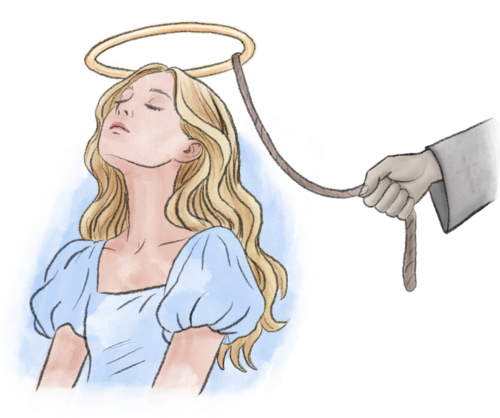
I have to wonder whether my religious upbringing reinforced the patriarchal expectations women encounter outside the church. When values like obedience and selflessness are presented as moral virtues, the expectation that women prioritize others’ comfort over their own can become a measure of goodness. As I’ve grown older and begun to question these teachings, I wonder how much independence I sacrificed to be good, and whether the very definition of a “good woman” was shaped by men who stood to benefit from my obedience.
Growing up Catholic, I was surrounded by male authority figures. God was called the Father, Jesus was His Son, and the priest who stood before me every Sunday was a man. I was taught that women could not become priests but was given little explanation beyond “that’s what God wanted.” And who am I to challenge God’s word?
I don’t remember ever consciously believing that men were better suited for leadership than women. In fact, I grew up playing sports, surrounded by women’s strength and talent. My mother was an elite athlete and an inspiring social worker who taught me the importance of a strong work ethic. Yet every Sunday, I entered an institution where an implicit hierarchy placed men in power.
What irks me the most about this routine is not that I was explicitly taught that men were superior—I wasn’t—but that I learned to accept their authority with no room for conversation. As I internalized this notion, I became more inclined to accept it in other aspects of life.
Beyond the Catholic Church’s hierarchical nature, the teachings themselves emphasize humility, forgiveness, selflessness, and obedience. While these are not inherently problematic virtues, and are not always presented as solely feminine, they reinforce the societal expectation that girls should be accommodating and agreeable.
I have always hated confrontation, extending kindness in situations where I should have stood up for myself. I have forgiven those I should have challenged, overlooking behavior that hurt me. At some point in my development, selflessness became a vulnerability; I learned to put other people’s needs before my own.
This is not solely a product of Catholicism, as girls are exposed to expectations of obedience in countless settings outside of religion. And I certainly wasn’t the only child taught to respect authority figures or put others first. Still, I wonder if my religious upbringing morphed societal expectations into moral frameworks, solidifying them into something stagnant and sure.
At the same time, I have to credit Catholic teachings with instilling in me values I hold dear. Honesty, loyalty, and compassion are ideals central to my character, and I not only practice them but am also drawn to others who do as well.
However, I can’t help but notice that men seem so much more comfortable expressing their wants and needs, even at the expense of others. I find myself apologizing when no apology is warranted and feeling guilty every time I say “no.” Even more troubling, disappointing a man feels heavier than disappointing a woman. I became so worried about what men would think of my actions that I started becoming less myself.
After attending a Bible study emphasizing the beauty of a Christian marriage, I was exposed to a series of Bible verses. Perhaps this is where religion has placed me within the patriarchy:
“Wives, in the same way, submit yourselves to your own husbands so that, if any of them do not believe the word, they may be won over without words by the behavior of their wives…” (1 Peter 3:1).
“To be discreet, chaste, keepers at home, good, obedient to their own husbands, that the word of God be not blasphemed” (Titus 2:5).
“But I would have you know, that the head of every man is Christ; and the head of the woman is the man; and the head of Christ is God” (1 Corinthians 11:3).
I was never explicitly taught that my purpose in life is to please men, but I was taught to be good, to be obedient, and, perhaps, to be a woman. I am grateful that Catholicism taught me to care deeply about others and to be kind and charitable. But the undertones that women should value men’s comfort over their own autonomy have reinforced the patriarchal belief that men can get away with anything, and women will remain silent. I strive to be a good woman. I aim to be kind. I am learning, though, that being good requires challenging the authority I once accepted.
Paige Cornelius ’28 (paigecornelius@college.harvard.edu) wonders if religion and feminism can coexist.