An Ode to MortalityThe case against living forever.
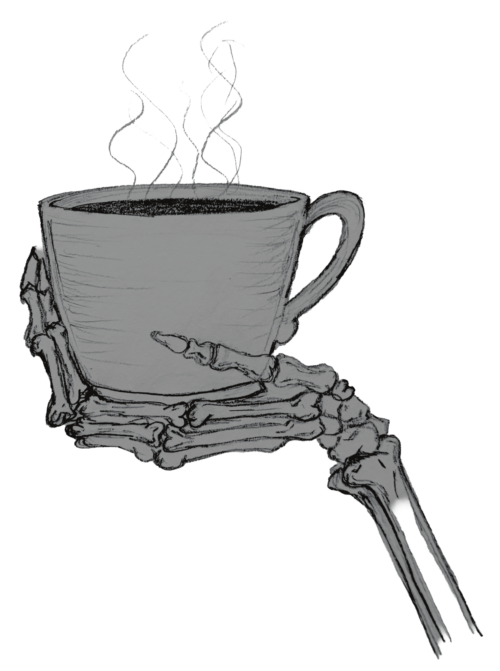
Graphic by Adriana St. Clair

Remember, we will die. I know this is true, but I had never truly considered it until my grandmother fell in February 2025. Perched beside her hospital bed, I could hardly believe what I saw: the woman who had once dragged me through every gallery in Manhattan suddenly seemed so fragile. That was the day death began to feel real.
The Romans had a phrase for this realization: memento mori. A philosophy tied to Stoic thought, and later a genre of art, memento mori flourished from the late Middle Ages through the Baroque and reminds viewers that human existence is finite. Memento mori addresses our fear of death, while also showing us that such anxiety is futile—we all ultimately perish.
In Ancient Rome, this philosophy was ingrained in war victory rituals. An enslaved attendant would stand behind the war generals who were being celebrated, remarking, “Memento mori! Respice post te, hominem te esse memento,” or “Remember that you will die! Look behind you, do not forget that you are only a man.” Even the most victorious general lacks the gods’ immortality.
Mortality connects us across class, power, and status, compelling us to live fully. Contemporary approaches to avoid death might seem tantalizing, but they risk disconnecting individuals from society and erasing the simple joys of life. Instead of focusing on optimizing our lifespans, we should redirect that attention to what adds value to our lives.
In 2026, the allure of longevity is packaged and marketed everywhere. For example, Equinox, a popular fitness chain, offers “Optimize by Equinox.” For $40,000, participants receive personalized wellness and longevity plans based on blood biomarkers. Celebrities like Kevin Hart and Matt Damon ’92 have invested in Function Health, a subscription service providing subscribers with over 100 lab tests to identify potential health issues.
Then there is Bryan Johnson, the founder of Project Blueprint and the “Don’t Die Protocol.” He spends over $2 million annually trying to extend his life. Through Project Blueprint, Johnson outlines how one can live longer by following a variety of regimens.
Some of these changes are accessible, like lowering your resting heart rate before bed to improve sleep or exercising more often. Other changes are more extreme. Johnson’s “Advanced Therapies” include injecting Mesenchymal Stem Cells into your bones, undergoing gene therapy, and using hyperbaric oxygen chambers.
Yet on June 30, Johnson was diagnosed with autoimmune gastritis, a condition in which the immune system attacks the stomach lining, slowing down acid production. Johnson, now 49, could have had AIG for years; he had an autoimmune thyroid disease at 21, and the two organs are closely linked. Still, his diagnosis calls into question the validity and effectiveness of the strict routines he adheres to.
Even the man who claimed he was “going to try and achieve immortality by 2039” is facing an illness. If death is guaranteed, why spend so much effort—financial and psychological—trying to outrun it?
When you prioritize longevity above all else, you are bound to enter an obsessive state that strips life of its fun spontaneity. Always focused on sleep, you forgo the wild nights out with friends—the ones you will talk about years, maybe even decades, later. Always counting macros, you will turn down the thrill of a midnight pizza run and the conversations that continue over dessert.
Above all else, if we believe that we are immortal, we might lose gratitude for life itself. When time is unlimited, and life becomes repetitive, we are likely to find less joy and novelty in simple pleasures—coffee shared with an old friend, spotting the Big Dipper on a summer evening, the bold hues of red and orange that canvas the trees in fall—because these moments are no longer fleeting.
Memento mori reminds us that our mortality should not scare us; rather, it should push us to appreciate life while we still have it. As Seneca emphasizes in “Letters from a Stoic,” “you may not wake up again! … you may not go to sleep again!” This unpredictability pushes us to seek light in dark moments, make time for loved ones, and strive to be our best selves.
My grandmother is 88 now. She has recovered from her fall and remains as sharp as ever, but that morning in the hospital never left me. Even in the busiest weeks of high school, when the SAT and college essays were eating away at me, I made time for our dinners and museum visits. Her fall showed me that it is impossible to know how many more of these remain—an uncertainty that makes me prioritize and cherish any time spent with her.
Now imagine Johnson’s goal: a life that never ends. When you consider longevity ethically, more issues emerge. Living forever means outlasting most, if not all, of the people you love. What’s the point of being alive once they are all gone? Life loses purpose without the people we love, and Johnson, ironically, seems to agree. But he gets the point wrong. He emphasizes the importance of family and relationships for a long, meaningful life. “Love and be loved. It will extend your life,” he wrote.
There is also the question of who lives longer. The Danse Macabre, or “Dance of Death,” is a memento mori motif that illustrates how death joins us all. These images depict citizens of different classes—emperors, farmers, children—walking together, paired with identical dancing skeletons. In death, everyone is the same.
The longevity movement, though, relies on financial access. The proposed “solutions” to mortality cost, at minimum, tens of thousands of dollars, even millions in Johnson’s case. When only the wealthy can afford to fight death, even mortality becomes a class divide. We relinquish what the Danse Macabre captured: the comfort that we all are one in death.
I am not against living a long and healthy life. I try to sleep eight hours a night; I try to exercise six days a week. The key word is that I try. I prioritize these behaviors, but not above all else. I allow myself to deviate. Put down the stem cells and call your parents. Go to dinner with your grandmother. Dance with your friends through the early hours of the morning.
Life is short. Savor it. As Marcus Aurelius reminds us in “The Meditations,” “It is possible you may depart from life at once, act and speak and think in every case accordingly.”
Zoë Macklowe ’30 (zmacklowe@college.harvard.edu) wants you to spend time with your friends and family.