Disillusionment, Distrust and Demand for ChangeThe Harvard Public Opinion Project’s Fall 2026 poll finds that young Americans have low hopes for the country’s future and their own.
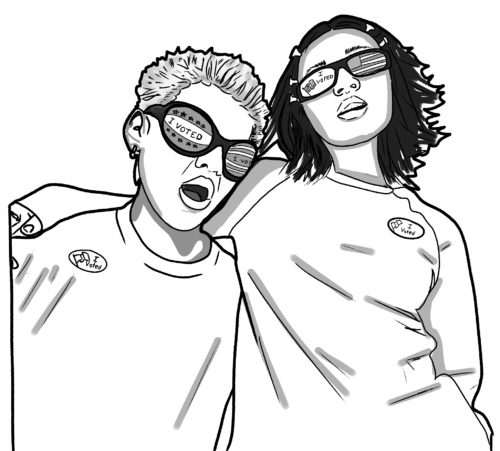
Graphic by Linden McCarl
The Harvard Public Opinion Project (HPOP) recently released its 53rd edition of the Harvard Youth Poll, the largest survey of young adults in the United States. Released on Oct. 22, the poll showed growing disillusionment among young Americans, consistent with the frustration young voters expressed in the midterm elections.
Run by the Institute of Politics (IOP) and supervised by John Della Volpe, IOP Director of Polling, the Youth Poll offers a unique way to track young Americans’ political, economic, and social values. This edition surveyed 2,024 Americans ages 18 to 29 on their faith in the government, their concerns for the future, and more.
Research Team Leaders, or student leaders within HPOP, lead smaller teams of four to five members, each writing different sections of the poll. The teams then come together to make final decisions on the poll, and they reconvene once the results come back to analyze the data as a whole team. The teams publish their final report each semester, providing a unique commentary on youth politics and serving as a benchmark for future generations.
This Fall 2026 poll cycle was unique due to the midterm elections. “In a midterm year, there’s two big changes to our poll,” Juan Wulff ’29, a Research Team Leader for HPOP, explained. “For this poll, we pretty much only asked questions relating to or adjacent to the midterms. We didn’t really do any more social science research questions or explore topics of those kinds.”
Because the midterms were in early November, the team also moved up its release: the poll, normally released in early December, was written on a faster timeline so the team could receive the data ahead of the elections.
“We focused on four big areas. The first was what are voters’ top issues and which party do they trust more to handle these issues,” Sophia Robertson ’28, the 2026 Chair of HPOP, explained. The other three areas were how those issues translated into positions, how they affected voters’ financial security, and what youth voter turnout would look like. “How are youth feeling about the state of the country? Are they feeling hopeful or fearful? Are they ready to participate or not?”
“We’re seeing a record low 9% of young Americans say that the country is on the right track. That’s down from 13% in the spring,” Robertson continued.
The poll also found that youth voting intention is below 2018 and 2022 levels, with a larger decline among young Republicans. Thirty-three percent of young people polled planned to vote in the elections, compared with 40% in 2018 and 2022. “Young voters, despite being disillusioned, are still turning out to the polls pretty consistently. Definitely at lower levels, however, than the average elector,” Wulff said.
Voter turnout is usually measured through exit polls or precinct-level analysis, so much of the data from these midterm elections has yet to be synthesized and isn’t yet available to compare with the poll’s predictions, according to Wulff.
Another key finding from the poll that is likely affecting many young Americans’ decision to vote is that this year is the first time in the poll’s history that more people believe they will be worse off financially than their parents, at 27%, compared to 25% who believe they will be better off. This may be affecting many young Americans’ decision to vote.
“I think a recurring message we see among candidates that won [in the midterm elections] is that they really focus their campaigns on economic policy and on the cost of living, and that’s what’s really driving young Americans,” Maurits Acosta ’29, the Director of Outreach and Partnership, added.
According to multiple HPOP members, the recent blue wave in the midterm elections reflects young people turning out to express the disillusionment captured in the poll data. Cited factors include the war in Iran and decisions by Republican lawmakers that have affected the current affordability crisis.
“I think a lot of people have qualified it. It’s not necessarily an affirmation of the Democratic Party, but it’s a rejection of the current ruling party, which is the Republicans,” Sydney Burns ’29, the Director of Community, explained.
Of those polled who supported Democratic control of Congress, 51% said they were voting against Republicans, compared with 49% who said they were voting for Democrats. Meanwhile, 62% of those who supported Republican control were for Republicans, compared with 38% against Democrats.
“There is this deep distrust in both the Democratic Party and the Republican Party that I think we see in election results,” Grant Shadman ’29, a Research Team Leader, added. “I think that that is an important thing to consider in future elections.”
Still, Democrats appear more energized to get more people to vote. “Some of that can be attributed to the party in power. You know, the party not in power is always more excited to vote in the midterms,” Robertson said. The partisan gap between Republicans and Democrats who plan to vote is 16 percentage points. “But looking back at 2018, we’re seeing less young Republicans likely to vote now than they were then, when their party was also in power.”
“I think Democratic candidates are really energizing young people in a way that we haven’t seen in a long time,” Robertson emphasized. While higher enthusiasm among Democrats might reflect anti-Republican sentiment, new dynamics are also shaping who feels motivated and excited to vote.
Beyond partisan dynamics, young voters had specific priorities. Some of the most important areas were what the team expected. “Cost of living has always been one of the biggest issues that is important to voters, and that’s what we saw this poll with an issue battery that we conducted,” Martina Jaramillo ’29, the Director of Communications, said.
The issue battery, a set of Likert-scale questions, asks respondents to rate how important each issue is to them; the team then ranks the issues by the percentage of respondents who rated them important. “Price of living came at the top of the ladder.”
However, some results surprised the HPOP team, including how much young Americans care about corruption in their government. Eighty-eight percent think corruption is important to their midterm vote (the only thing more important being the cost of living), with 56% saying it is extremely important. This outcome was unusual, as the share of Americans who say corruption is a major problem in government is usually lower. It rose 16 percentage points from 2024 to 2026, according to a 2026 Gallup survey of U.S. adults.
“Young people are thinking very critically about how politicians are speaking to them, how campaign finance works, who’s funding what candidates, and how all of those things directly affect their day-to-day cost of living, which is really new,” Robertson explained. “Historically, young people have thought about corruption in this more general way of ‘good governance is important’ and not kind of specific to ‘corruption is affecting the money in my pocket.’”
Another surprise was broader-than-expected support for democratic socialist policies. The poll included more questions on democratic socialism than in years past, given the rising popularity of self-described democratic socialists like Zohran Mamdani. “When we analyzed certain policies that you may associate with more socialist-like tendencies, like Medicare for All, we saw more uniform support across both political parties. So I think that was something that was also surprising to us,” Burns commented.
This trend also reflects the affordability-focused campaigns many of these candidates ran, which speak to young voters’ main priority heading into the voting booth: the cost of living. In a related finding, the cost of health care ranked as the third most important issue for voters, with 46% ranking it extremely important and 35% ranking it important. “Young Americans continue to vote based on their pocketbooks,” Acosta emphasized.
Normally, the poll covers a wider range of issues than just those directly related to the election. “Usually, our polls are very comprehensive in terms of thinking about all the things that underlie the political dynamics. So the social dynamics, the religion, the community, everything else that underlies political beliefs and voting outcomes,” Robertson said. For example, in Spring 2026, Wulff created questions around crime and how young Americans deal with disorder and safety in their communities.
The team also conducts focus groups in places with important upcoming elections, whether in key battleground states or in high-profile races like the 2025 New York City mayoral race. “We go and visit these states, talk to local young voters, and try to conduct focus groups that pull from bipartisan youth, so ages 18 to 29, and try to understand their views and what issues matter to them, and then we use that to build our survey questions for the following semester,” Jaramillo explained.
These focus groups give HPOP a sense of what is important to young Americans and what they expect to see in their upcoming poll; it was in these focus groups that the team first noticed the trend of disillusionment. “We get to help conduct those focus groups and talk to young Americans about the contextualized, richer picture behind our data. Because we just get the numbers, but they can tell us what they’re feeling,” Robertson added.
HPOP was founded in 2000 by two students at the College who were curious why youth voter turnout and political participation were low while youth community service levels were high, Robertson explained. Originally a small survey project, the organization has since grown into a national survey.
Looking from the past to the future, the HPOP team still sees a young America that cares about its country. “Many of [young voters] still expressed, regardless of whether it was hope or it was fear for the future, expressed a very strong buy-in to the direction that the country was heading,” Jaramillo said. “From at least these conversations, it does seem that young people are pretty powered up in terms of elections and invested in where the United States is going.”
Elle du Pont ’29 (edupont@college.harvard.edu) writes News for the “Harvard Independent.”