Harvard’s $68 Billion QuestionWhy, even with a record endowment, Harvard keeps cutting funding.
Graphic by Sarahluna Sassine

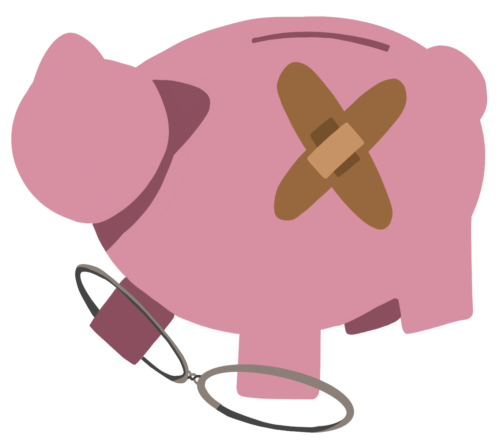
On Oct. 15, the Harvard Management Company released Harvard’s annual financial report, detailing the state of the University’s endowment. The report shows that Harvard’s endowment grew to a record $68 billion, generating a 27.1% return. At the same time, Harvard cut $104 million from salaries and wages, in part through layoffs.
The gap between those figures has angered unions and faculty and prompted calls for Harvard to draw more from its endowment. But Wellesley economist Phillip Levine, who studies university finances, told the “Harvard Independent” that a record endowment value does not create spending money. Harvard’s payout rules spread gains over several years, while new costs, from an 8% endowment tax to $210 million in legal fees, hit immediately.
“It is common to view an endowment as a piggy bank that a university can use however it wants,” Levine wrote. “That simply isn’t true.” Harvard’s endowment is a highly complex system of about 15,000 funds spanning seven asset classes. Private equity, including venture and growth equity, makes up 46% of the portfolio; hedge funds make up 29%; public equities 14%; and real estate, bonds and inflation-protected Treasuries, other real assets, and cash make up the last 11%.
Roughly 80% of the endowment’s value is restricted by donors to specific purposes, so most of the fund cannot be redirected to cover a budget gap. Less than 5% is fully unrestricted. Gains from restricted funds are also tied up. The endowment paid out $2.6 billion this year, about 39% of Harvard’s $6.7 billion revenue, at a 5% payout rate.
The payout rate is the share of the endowment’s value that Harvard distributes to its operational budget each year. Harvard’s rate generally runs 5% to 5.5%, with the logic that if the fund returns about 8% a year and inflation runs about 3% a year, a roughly 5% payout rate lets the endowment continue distributing the same real value in perpetuity. The Harvard Corporation approves the payout each year, generally as a dollar increase over the prior year, rather than a percentage of the endowment’s value.
“Endowment smoothing is a customary and valuable practice,” Levine wrote. The practice is meant to keep one strong year from reshaping a university’s budget.
“From the institution’s perspective, suppose it committed all that extra money this year to a variety of projects, and then investment returns crater next year? The disruption would be significant,” Levine continued. “Smoothing helps soften the blow in either direction.”
“In this [Harvard’s] case, it means that other immediate budgetary pressures may surmount the additional endowment draw that will occur and lead to spending to be cut,” Levine added.
Harvard’s funding has faced pressure from federal grant cuts, taxes, and legal costs. Federal research revenue fell about 20%, and nearly 33% if back payments on grants restored after Harvard’s court fight are excluded.
Legal costs, driven by Harvard’s fight with the Trump administration over research funding and international students, hit $210 million, up from $126.6 million the prior year.
In addition, the One Big Beautiful Bill Act, a federal law signed in July 2025, raised the endowment tax for the wealthiest universities—those with more than $2 million in endowment per student—from 1.4% to 8%, starting with the fiscal year that began in July 2026. Harvard estimates the higher rate will cost roughly $300 million a year. The University’s fiscal year 2026 financial report showed a $100 million operating surplus, meaning revenue exceeded expenses. But that surplus came from restricted funds, which ran about $180 million ahead, while unrestricted funds, which the University relies on for general operations, ran a $78.7 million deficit.
In response, Harvard has reduced spending across the University, which administrators say is necessary to combat those pressures. Salaries and wages, which are the University’s largest expense, fell 3.8% from last year. “A hiring freeze, attrition, and restructurings reduced Harvard’s workforce,” the financial report stated. The Faculty of Arts and Sciences (FAS) made the most aggressive cuts, eliminating 165 staff positions over the summer to address what its leaders call a $350 million structural deficit. Those positions made up about 10% of roles in the restructured units. Another 24% of staff in those units moved into new or restructured roles, and the social sciences saw the deepest cuts.
The restructuring halved Ph.D. admissions in the sciences, while other divisions planned enrollment drops of 50% to 70%. Some changes also reached undergraduates directly. The College closed the Dudley Community and laid off Jane Rosenzweig, who had directed the Writing Center for 22 years. The Phillips Brooks House Association, Harvard’s largest student-led public service organization, lost about a third of its employees.
Critics of the cuts, including labor unions, several faculty members, and some economists, largely do not dispute that the University faces new costs, but instead question whether those costs justify such sweeping cuts to staff and graduate programs. Union organizers argue that with the endowment at a record high, the cuts go further than Harvard’s finances require.
The most significant pushback has come from Harvard’s unions. More than 4,000 members of the Harvard Graduate Students Union (HGSU-UAW) went on strike on Oct. 27, the union’s second walkout this year after a 40-day strike that lasted from April 21 to June 1. “We are prepared to stay on strike until Harvard moves,” HGSU-UAW president Denish Jaswal said. Harvard Academic Workers (HAW), which represents about 2,600 non-tenure-track lecturers, preceptors, and researchers, joined them on Nov. 10, walking out after a final bargaining session ended without a contract.
Union staff organizers have focused on the pace of the restructuring when voicing their criticisms. Members of the Harvard Union of Clerical and Technical Workers (HUCTW) told the “Boston Globe” in June that they see Harvard as financially sound and believe the FAS is using the political crisis to justify cuts. Carrie Barbash, a HUCTW organizer, pointed to costs like deferred maintenance that come due over years.
In an open letter last spring, the union argued that Harvard’s efficiency efforts had already led to harmful layoffs, leaving thinner departments to handle the same workload while services for faculty and students eroded.
Many faculty members expressed concern about which cuts may prove permanent. As the FAS shrinks Ph.D. cohorts, one chemistry professor warned at a faculty meeting that Harvard was “destroying something here that we can’t actually bring back,” “Harvard Magazine” reported.
Some economists and legal scholars argue the endowment exists precisely for moments like this one. “Part of [endowments’] function is to be drawn down in the face of emergencies, and covering federal funding lapses surely counts as one,” former University President Lawrence H. Summers wrote in an April 2025 “New York Times” op-ed.
Ellen P. Aprill, a tax law professor emerita at Loyola Law School Los Angeles, noted that the law permits most universities to raise their payouts, a step she wrote could ease, though not fully solve, the mounting crises.
Levine was skeptical of calls for a larger payout. An endowment exists to fund its purpose permanently, he explained: a $10 million gift drawn at 5% a year supports about $500,000 in spending, indefinitely.
“If the institution chose to ‘raid’ the endowment by increasing the draw whenever it felt like it, that funding would deteriorate over time, and that would violate the purpose of the gift,” Levine wrote. “That isn’t a great strategy for maintaining the intended support and encouraging giving.”
Still, Levine said the limits on restricted gifts are sometimes overstated. A gift that pays a faculty salary, for example, frees up money Harvard would have spent on that salary anyway. “Regardless of the exact figure, truly restricted funds are substantial, so the point still stands,” he wrote.
The pressures on Harvard’s budget are not over. The 8% endowment tax took effect with the fiscal year that began in July, and the University has held this year’s endowment distribution flat in part to help pay it. A federal appeals court has yet to rule on the research grants a judge ordered restored last year, and HAW walked off the job on Nov. 10.
“$300 million is $300 million. That is not a trivial amount of money,” Levine wrote. “The exact composition of the cuts necessary is up to the university, but it will definitely be felt somewhere.”
Elliot Hunter Chung ’29 (elliotchung@college.harvard.edu) is comping the “Harvard Independent.”