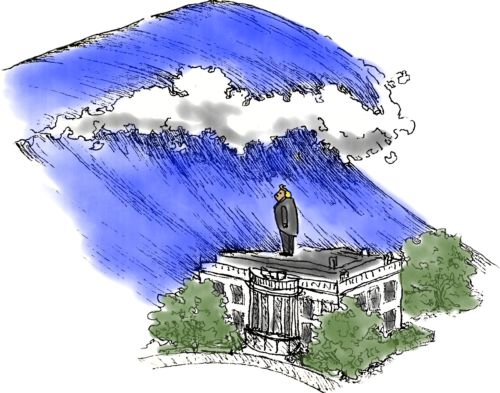
A Blue Wave and Red FlagsAfter a historic Democratic midterm sweep, Harvard students weigh hope and distrust in the federal government.
Graphic by Caleb Boyce
On Tuesday, Nov. 3, voters nationwide cast their ballots in one of the most contentious midterm elections in recent history after months of furor over federal policies, legal battles over voting rights, and aggressive campaign efforts by the Trump administration. The results were staggering: Democrats regained control of both chambers of Congress, flipping eight Senate seats, nearly 30 House districts, and five governorships. The election also marked a series of historic firsts, including the election of the nation’s first Black woman governor, first Muslim U.S. senator, and first openly gay male senator.
Young voters were pivotal to what some have dubbed a “blue wave.” The AP VoteCast found that seven in 10 voters under 30 voted blue, compared with a roughly even split among all voters in 2024. These results mirror the Harvard Institute of Politics Fall 2026 Youth Poll, which showed Democrats leading by 21 points among registered young voters and 37 points among what the IOP classified as “likely voters.”
At Harvard, this election comes amid broader questions about young Americans’ political engagement and priorities. Study after study has reported Gen Z’s disillusionment with government effectiveness and the partisan divide; in the IOP’s 2025 poll, only 19% of young voters trusted the federal government to do the right thing most or all of the time. In this context, Harvard students are reflecting on the midterm results and what this election means for the future of American politics.
“I feel like I would trust my local government more than the federal government,” Tess Sumner ’29 told the “Independent.” “For me specifically—in New Hampshire—living in such a rural place, there’s not a lot of money corruption because nobody rich really lives around there, so that’s not as much of a factor as it is in federal politics.”
New Hampshire’s election results reflected this distinction between state and national politics. Democrat Chris Pappas won the state’s open U.S. Senate seat, campaigning against the Trump administration’s policies on health care, tariffs, and the war in Iran. At the same time, Republican Gov. Kelly Ayotte won reelection by running on her first-term record and emphasizing housing affordability and low taxes. Ayotte maintained relatively high approval ratings despite Trump’s unpopularity in the state and her reluctance to engage with Trump.
“I wouldn’t necessarily say that I trust it completely,” Sumner continued. “I think that no matter what side of the aisle you’re on, there’s always some corruption because politics has become so money-focused. But hopefully, by winning back some of the control in Congress, we can finally have some accountability in the government.”
With Democrats set to take control of Congress in January, party leaders have signaled plans to oversee the Trump administration. They plan to prioritize investigations into the Department of Homeland Security, including the administration’s immigration enforcement practices and allegations of abuses of power.
“For me, honestly, the biggest [issue] was ICE and the dealing with immigration. Seeing people murdered in the street … Alex Pretti and stuff like that … was one of the worst things ever,” Harvard Graduate School of Arts and Sciences student Grant McIntyre said.
Pretti was fatally shot by a Border Patrol agent in January in Minneapolis during a federal immigration enforcement operation, amid protests following the earlier fatal shooting of another Minnesotan, Renée Good.
“To be honest, the fact that the federal government can go send masked agents into the streets and literally just shoot innocents and kill them. That was definitely the most important thing for me,” McIntyre said.
Beyond immigration enforcement and concerns over executive power, voters also expressed frustration with the more immediate effects of federal policy on their daily lives, particularly rising prices and the cost of living. “I am not a single-issue voter, but I think that abortion, immigration, and the economy are my top three issues,” Lauren Lee ’30, who voted in New Jersey, said.
Economic concerns dominated the election. According to an October Associated Press-NORC poll, roughly eight in 10 registered voters identified the economy or cost of living as among their top issues. The Harvard Youth Poll similarly found that 91% of registered young voters considered the cost of living important to their vote.
The war in Iran, tariffs, and rising health care costs further intensified these concerns. The conflict, which began in February, contributed to higher energy prices and mounting federal expenditures, with the Pentagon estimating its cost to taxpayers at $47.1 billion as of Oct. 16. Meanwhile, Trump’s tariff policies drew criticism for driving up consumer prices. Americans faced rising health insurance premiums, particularly as enhanced Affordable Care Act subsidies expired at the end of 2025.
These economic pressures were especially pronounced among young Americans. According to the Harvard Youth Poll, nearly half of respondents said their personal financial situation had worsened since Trump took office, while 77% disapproved of his handling of the economy.
“There’s really not much I’ve liked about the federal government,” McIntyre said. “Like the Big, Beautiful Bill. Pretty much all of the decisions the Congress has made in the past two years I’ve disagreed with—the Iran War? I disagree with the whole premise that they’ve used to wage the war in Iran.”
Reactions to federal policy aside, the election also marked a turning point for Harvard students who had spent the past two years organizing for Democratic candidates.
In an op-ed following former Vice President Kamala Harris’s defeat in 2024, former Harvard for Harris co-president Ethan C. Kelly ’25 and two fellow student organizers urged their peers to channel their disappointment into political action, particularly through local campaigns and the 2026 midterms.
Two years later, Kelly, who is now a House Aide in Leverett House, said he was “ecstatic” about the results, pointing to Democratic victories in traditionally Republican states, including Texas, where Democrats swept statewide races.
“I was also interested by the reversal of young men away from the Republican Party,” Kelly said. “After 2024, the media went on endlessly about young men being permanent members of the GOP. This election proved that wrong.”
Kelly explained how political engagement among Harvard students has “skyrocketed” since 2024, particularly following the Trump administration’s pressure campaign against the University in 2025. He pointed to students canvassing in Maine and taking time off from school to work on campaigns in Michigan and Texas as examples of campus activism translating into national political participation.
“The targeting of Harvard, and by extension, high educational institutions, has definitely made students more engaged, on a local and national level,” Kelly said.
Looking ahead, Kelly said the election underscored the importance of Democrats reaching voters across demographic groups and geographic regions, rather than assuming that recent electoral gains would translate into lasting support.
“Young voters care about the same issues as everyday Americans. Full stop,” Kelly said. “Democrats did well with young voters, but just as Trump did in 2024, they cannot take anything for granted.”
“If Democrats want to win everywhere, they must compete everywhere,” he added. Beyond partisan differences, the election also highlighted broader concerns about democratic institutions and public confidence in the electoral process. Harvard’s Fall 2026 Youth Poll found that only 34% of young Americans expressed a great deal or fair amount of trust that the midterm elections would be conducted fairly and accurately.
On election night, President Trump said he was “absolutely willing” to work with Democrats and accept the midterm election results. In the days since, however, he has reverted to his previous claims of election manipulation.
“Does anybody really believe that this ‘Election’ was honest. How could the Polls be so wrong???” Trump posted Monday, Nov. 9, on Truth Social. “Some early voting ‘dumps’ were so large that it was impossible to win, no matter how many people went to vote. It’s all about the machines, which are far more important than the voter!”
Despite lingering distrust in political institutions, students—and, it seems, young voters as a whole—are hopeful about the incoming Congress and the power of democratic engagement. The Harvard Youth Poll found that 66% of likely young voters believed political participation could make a great deal or a fair amount of difference on the issues that mattered to them.
“I’m very unhappy with the federal government, but I do trust the systems that we have to keep them in check,” Lee said. “I’m looking to the positive, and I’m open to the future here.”
Caroline Stohrer ’28 (carolinestohrer@college.harvard.edu) is the Breaking News Editor for the “Harvard Independent.”