Protesting Shouldn’t Destroy the ArtsThe arts have become a victim of demonstrations.
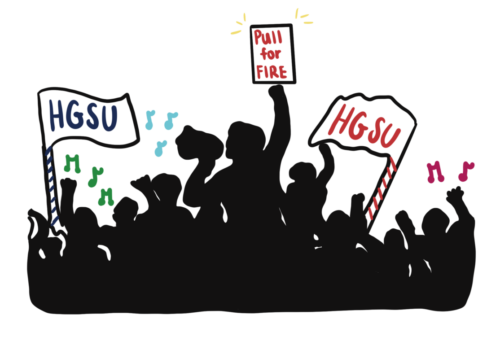
Graphic by Amelie Lima

“BEEEP BEEEP BEEEP.” The blaring of a fire alarm filled Sanders Theater around 7:40 p.m. on Nov. 6. Having lived in Adams House, I found it nothing new. However, the shrill alarms and flashing strobes interrupted a conversation between Yo-Yo Ma ’76 and Stephen Colbert, cutting short a performance featuring Ma and the Crimson Cellos. The alarm brought “Arts for Life’s Sake,” to an end, the alarm disrupted a highly anticipated, sold-out event.
In an emergency, I would have been upset but accepting of the evacuation. However, post-alarm analysis makes the situation seem suspicious. After investigation, the Cambridge Fire Department “found no reason for the alarm activation.”
Coincidentally, before and during the event, the Harvard Graduate Students Union was picketing in front of Sanders Theater. Even during the emergency evacuation, the Union continued to chant, hindering safety professionals’ ability to give instructions. The Union had specifically positioned themselves to force Ma and Colbert to cross the picket line—later posting about the event on Instagram. Suddenly, as the picket line seemed to fail its intended purpose of ending the event, one could deduce that a frustrated member might have taken matters into their own hands. This is all speculation, of course, and the union said it had no involvement in the fire alarm. The cause of the alarm remains unknown.
Regardless of whether an HGSU member pulled the fire alarm, the union’s goal was to cancel the event. And it leaves me wondering why “Arts for Life’s Sake” was targeted. Evan Lemire, the Vice President of the Union, offered an explanation for “Harvard Magazine.” “Harvard is an institution that holds prestigious events with prestigious speakers. That prestige is built on the labor of graduate student workers,” he said. “We were here to be loud, and to ask Yo-Yo Ma and Stephen Colbert not to cross our picket line.”
So, to restate this: because these speakers are prestigious and Harvard is taking advantage of the HGSU, the union is picketing the event. This logic is nonsensical and essentially gives the union free rein to protest anything and everything on campus regardless of its impact on the greater good.
A strike ends work to pressure a corporation to improve working conditions and benefits. I have no problem with this and applaud the union for advocating for improvement. But how does a fine arts speaking event designed for undergraduates fulfill this goal?
Unions have an inspirational history; this article is not a criticism of unions. From the General Motors sit-down strike to the Delano grape strike, collective labor has left lasting positive legacies through the benefits they have negotiated. In fact, I am in the very union I am criticizing; the HGSU has positively impacted my life as a Course Assistant, and I am grateful despite my decision not to strike.
However, my membership does not mean I agree with the actions HGSU has taken. In fact, I adamantly oppose the union’s apparent goal was to disrupt the event. The Office for the Arts organized the talk and concert, with a stated goal of “integrating the arts into the lives of Harvard College students.” Its events attract half of the undergraduate student body to participate each year. While striking is meant to pressure the corporation, this picket was held during a ticketed evening event—specifically attacking an undergraduate event and an appreciation of great performances. All so HGSU could get a social media post about Ma and Colbert crossing a picket line.
I wish destruction of art as a form of protest were rare, but unfortunately it is not. Climate activism groups, such as Just Stop Oil, Riposte Alimentaire, and Ultima Generazione, have used art galleries to stage their own protests. They throw paint, glue themselves to objects, and use other forms of vandalism to draw attention to their movements. Paintings such as Van Gogh’s Sunflowers, the Mona Lisa, and Primavera have been impacted.
Sure, the paintings sit behind protective glass, but that does not remove the impact on people who travel thousands of miles to see them. The goal here is not destruction, but shock value. The artwork and its admirers are just convenient victims.
But are these methods really effective? Does the destruction really create outrage about the environment and other movements, or does it needlessly damage a public good? Everyone has movements and views they are passionate about. But destruction at the cost of innocent bystanders benefits no one and creates animosity.
The Crimson Cellos spent hours preparing to perform with Ma, with over a thousand people packed in to hear the greatest cellist of our lives play in person—not to mention the knowledge and advice Ma and Colbert were offering. All this, and the HGSU made it about themselves. They tried (and succeeded) in destroying an event that had nothing to do with their movement, and little to do with the university office that they are negotiating with. And they got the outrage they wanted.
The problem is that when you incite such anger, it often gets misplaced. Many of the students attending the event were upset, not at the College, but at the Union. HGSU, which once was supported by the majority of undergraduates, has lost significant support from a key portion of Harvard’s campus.
Sidechat blew up in response to the picket and event. One post received 947 upvotes and stated, “Forget yo yo and Colbert for a second—grad students chanting during those student cellos performing is so selfish and shameful.”
Striking is a right; striking is necessary; striking is honorable. Disrupting students’ lives and intellectual growth for zero net benefit is shameful. Sure, one can argue that the union is advocating for living wages, but that should not burden bystanders (outside the classes directly impacted). It also calls into question: where do we draw the line? Should the union picket outside Harvard-Radcliffe Dramatic Club performances? Block student artwork from being showcased in public spaces? Disrupt sleep by protesting outside dorms at night?
I do not ask these questions to claim the union would do these things. Rather, just to point out that all of these would put pressure on the Corporation at the cost of student life and expression.
The arts are a public good that deserves public protection from all parties involved. The arts provide us with a safe space for creative expression and enjoyment. They are not and should not be expendable for movements, strikes, and protests. I call on the HGSU to consider the cost of what you deem dispensable or cancelable. I also call on leadership to apologize to the Crimson Cellos, the student body, and the arts community for their protest, which hurt on-campus creative outlets.
Kalvin Frank ’28 (kfrank@college.harvard.edu) is the Arts Editor for the “Harvard Independent.”