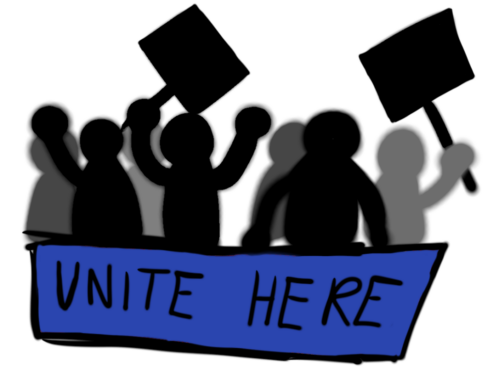
Harvard University Dining Workers Gear Up for Contract Talks
Graphic by Mia Stewart

*Editor’s note: The last names of Harvard University Dining Service workers have been excluded for privacy purposes.
As their contract with Harvard University nears its July 2026 expiration, Harvard University Dining Services workers, represented by UNITE HERE Local 26, a labor union that represents hospitality workers in Massachusetts and Rhode Island, are gearing up for negotiations with the University administration over pay, healthcare, and job security. Initially, Harvard management stalled these discussions. But now, after 18 months and 32 negotiation meetings, HUDS staff have yet to secure a contract, spurring anxiety about future employment.
Harvard’s campus could be significantly affected by these contract deliberations. If negotiations break down, students could face dining hall disruptions similar to the 2016 strike—leaving students with fewer food options, longer lines, limited hours, and Harvard relying on temporary hires or alternative meal setups to keep students fed. In this backdrop, workers may continue grappling with the challenge of trying to secure fair wages and stable benefits in Cambridge, one of the regions with the highest cost of living in Massachusetts.
HUDS employs about 500 full-time employees and hundreds of part-time staff who work from 7:30 a.m to 11 p.m. to provide meals to the 6,700 students who subscribe to the University meal plan. Represented by UNITE HERE Local 26, the same union that recently won major raises at Northeastern University and Tufts University, HUDS affiliates say their pay and benefits no longer keep pace with rising living costs or at peer institutions.
Northeastern leads the local wage landscape at around $30 per hour—as determined in 2026 under a new Local 26 contract. This is followed by Tufts workers who secured $9.92 per hour in raises over four and a half years to reach the low $30s. Massachusetts Institute of Technology workers, meanwhile, have faced their own fights over café closures and job security. Even as Local 26 claims MIT dining wages sit in the same general range as Harvard’s, Harvard still lags behind with a $35,000 annual minimum for full-time dining staff, or roughly $16.80 per hour when annualized, despite summer stipends, leaving worker wages below those of their peer institutions.
For Valerie, a pantry steward and dishroom lead at Harvard’s only first-year dining space, Annenberg Hall, working at Harvard is a profession as well as a home. “I was actually grandfathered in,” she said to the “Independent.” “My father works at Currier House, and when he told me he got me a job here, I wanted to work with him. Everyone was really nice—the quad felt like family.”
Valerie eventually found her rhythm in Annenberg’s fast-paced environment. “I check in wherever I’m needed … I gather stuff for brain break … take out frozen items,” she explained. “It’s simple, but when food runs out, it’s stressful.”
“Typically we have a night with 1,600 students, depending on the day … when we don’t have enough [food], it’s not because we don’t want to put it out—it’s because we really don’t have any,” Valerie continued, pointing to the staffing and resource pressures that are also central to the contract fight.
Resource pressures extended beyond food and into monetary compensation. “MIT and Northeastern have a higher pay grade than us,” Valerie noted. “We’re trying to negotiate our healthcare, more pay, our union dues. We’re trying to negotiate more money, but the University is trying to not give us more money.”
At Winthrop House, where five workers sat down for a group interview, HUDS members raised the same concerns. “It’s not bad pay,” Isabell said, “but if you compare it to other universities in the area, we’re the lowest, which makes sense because we’re the richest school.”
Beyond compensation, HUDS workers also grapple with the temporary nature of their roles. “We’re only here seven and a half months out of the year,” a different Winthrop staffer said, stressing that they would appreciate more permanent positions. “That’s one of the things we are looking for—so we can have a job in the summer.”
Others at Winthrop cited slow improvements, noting that more dining halls now remain open year-round. “It’s come a long way since I started,” another worker added. “We do have a lot of summer programs now, which benefits us.”
While recent progress has softened worries of losing hours or being left without work, many are concerned about what a strike could mean for their livelihoods. “Some of us are afraid,” Valerie admitted. “People think they might lose their jobs or need another job to cover bills. Many don’t even speak English well enough to understand what’s happening with the contract … it’s best to have awareness of our people right now.”
When the topic of current negotiations surfaced at Winthrop, workers fell silent at first. One member got up and walked away. “We can’t talk about that—we’re in negotiations [with the union],” another warned her coworkers after overhearing the question. Regardless, others spoke up on the larger context of the situation, recalling the 2016 strike and student support.
In 2016, nearly 700 Harvard dining workers went on strike for 22 days across Annenberg and undergraduate residential houses, after talks stalled over wages, healthcare copays, and job security. Students showed solidarity by signing petitions with thousands of names, attending rallies outside Massachusetts Hall, joining picket lines with signs reading “HUDS workers deserve fair pay,” and publishing op-eds urging the administration to settle. While the strike forced Harvard to concede a $35,000 minimum wage and better benefits, it cost workers weeks of lost pay and heightened job fears that linger today.
“We need you guys to help us—that’s what happened ten years ago,” another Winthrop worker added. “It would never happen without students protesting. If you voice what you want to happen, it’s gonna happen.”
Valerie agrees that solidarity matters. “It’s not just one person—it’s all of us,” she said. “Without the union, there wouldn’t be HUDS. We need everyone at the rally to show that we’re united. That’s how we’ll get a better contract.”
Valerie and her Winthrop colleagues pointed to Harvard’s “Text and Tell” system, which HUDS rolled out in July 2017. The system lets students text dining hall staff about anything related to their experience in a specific dining hall. For instance, messages about Annenberg begin with “Berg” and are sent to 55744. “We always encourage y’all to text and tell what improvements you want, what you don’t like,” Valerie urged. “Anything—just text and tell, because y’all’s voices matter more than ours.”
Despite frustrations, many HUDS workers express genuine affection for Harvard and its students. “I love the Harvard community,” Valerie said. “It really is like a family. But for our voice to be heard—I don’t think they’re trying to hear us … I think it would be better if we all were able to come together so that we can be heard.”
Aurora Charbonneau ’29 (auroracharbonneau@harvard.college.edu) and Rohan Tyagi ’29 (rohantyagi@college.harvard.edu) will be closely following the union’s negotiations.