“No Crown for the Orange Clown:” Harvard Affiliates Join 180,000 Protesters in the Boston No Kings Day Protest
Graphic by Ella Ricketts

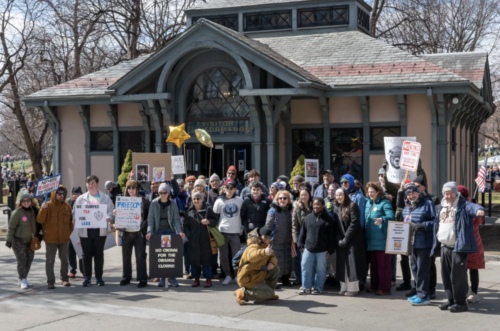
On March 28, approximately 180,000 people gathered in the Boston Common, marking the nation’s third No Kings Day protest. Organized by the American Civil Liberties Union of Massachusetts, Indivisible Mass Coalition, and Mass 50501, the demonstration was just one of 3,300 across the country and one of 160 in the state. Boston’s rally experienced a similar turnout to the ones in St. Paul and Chicago, which each drew an estimated 200,000 protesters. Demonstrators aired grievances against the Trump administration, including recent ICE raids, executive overreach, and ongoing wars in the Middle East, to name a few.
“Since the last No Kings, we’re seeing higher gas prices and groceries, all while there’s an illegal war in Iran,” Sarah Parker, a national coordinator for the 50501, told reporters earlier last week. “The people of America are pissed. They are the ones demanding for no kings.”
Before the event, coordinators estimated that this iteration of No Kings Day could be the “single largest non-violent day of action in U.S. history.” In line with organizers’ expectations, attendance at the Boston rally exceeded that of the October 2025 protest and lasted over two hours.
Still, despite the national turnout reaching eight million, White House spokesperson Abigail Jackson dismissed the significance of the No Kings Day protests. “The only people who care about these Trump Derangement Therapy Sessions are the journalists paid to cover them,” she said in a statement.
At the Boston protest, speakers included Massachusetts Governor Maura Healey, who urged demonstrators to remain politically active and engage in civil discourse. Alongside her stood fellow top lawmakers, including U.S. Senators Ed Markey and Elizabeth Warren, as well as Representative Ayanna Pressley.
“This is why I love Massachusetts,” Healey exclaimed to the energized crowd. “For 250 years, we haven’t had kings in Massachusetts, and we’re not going backwards.”
Throughout the afternoon, protesters used costumes and cardboard signs to communicate their discontent, with messages ranging from somber to satirical. One read: “IKEA has better cabinets.” “This is the only orange muppet I trust to tell me about science,” another joked, accompanied by a picture of the Muppet character Beaker.
Although there was diversity in the issues represented, immigration remained a major focal point. Marcelo Gomes da Silva, a teenager who was detained by federal agents just a year prior, spoke about the need for stable leadership free from fear. “Freedom isn’t about words on paper—it’s whether people actually feel safe enough to live their lives,” he said at the protest.
Massachusetts Attorney General Andrea Joy Campbell likewise reaffirmed her office’s commitment to protecting immigrants from government threats. Campbell sued the Trump administration 47 times in 2025 and indicates she has no intention of relenting. “We are protecting student visas, we are protecting birthright citizenship, which will be before the Supreme Court next week, and of course, we will be there,” she added.
Conserving democracy was another recurring theme—especially among Harvard affiliates. The “Independent” spoke to members of Crimson Goes Blue, a national organization of around 3,000 Harvard alumni founded in 2019. According to Co-founder and Managing Director Lisa Ulrich ’84, the organization started with the intention of helping elect Democrats but has since broadened its mission to include fighting what they characterize as authoritarianism.
Ulrich expressed worry regarding executive overreach and emphasized the need for collective action. “My biggest concern is the utter disregard for the ideals of our country and the rule of law,” she said. “It has become more urgent to show up and prove that there is a vital, committed resistance.”
Max Klau, a graduate of the Harvard Graduate School of Education, similarly discussed the need to preserve the U.S. Constitution as he criticized the Republicans’ inability to maintain checks and balances. “America’s in a fight for its soul,” he explained. “We have incredible values that we have never fully lived. We have very deep shadows that we have never fully confronted.”
Both the alumni and current Harvard students articulated a sense of pride in the institution’s response to conflicts with the federal government. Harvard University has faced significant opposition from the Trump administration, most recently a March 20 lawsuit alleging that the school violates civil rights law.
Multiple students cited the legal battle with the federal government as a reason for their No Kings attendance. “I think what motivates me is, over the past year, we’ve seen the attacks the administration has done to Harvard and other institutions of higher education,” Henry Pahlow ’28 said. “We have a role in coming out here and saying, ‘No, institutions like Harvard and education are a cause worth fighting for.’”
Pahlow was not the only one to stress the value of students taking action. Senior Tova Kaplan ’26 explained that while she thinks there is a sense of skepticism on campus about the ability of protests to work, Harvard students do have the power to make change. “It’s important that we don’t give up in advance, that we continue to show up when it’s hard,” she said. “Even if we don’t see the results of our actions immediately, it all builds up to something.”
Ella Ricketts ’28 (ericketts@college.harvard.edu) was impressed to learn that there were no arrests at the Boston No Kings protest.