Honeypot Meets JackpotJensen Huang and the failure of corporate morality under late-stage capitalism.
Graphic by Clara Lake

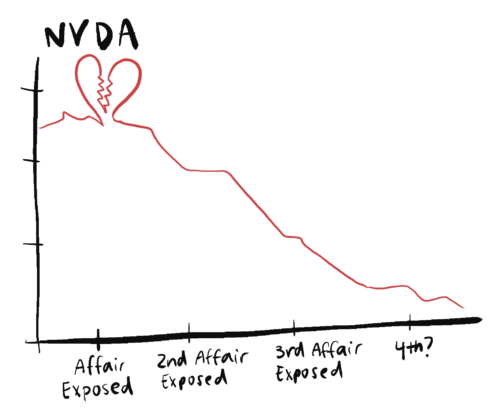
Former Nvidia CEO Jensen Huang wrote to Nvidia employees after multiple affairs were revealed: “I was unfaithful to my wife. My actions hurt her and our children. There is no excuse for what I did. I am deeply sorry.”
A personal apology combined with a juicy scandal to create what seemed like a classic story of an executive stepping down after being deemed immoral. Yet Jensen Huang’s fall from grace has less to do with a corporate ethical awakening than with what happens when liabilities are ignored in favor of prioritizing profits.
In late October 2026, reports surfaced that Nvidia co-founder and CEO Jensen Huang had an extramarital affair with Alice Huang, a Chinese national and former executive at Singapore-based “neocloud” firm Megaspeed. Intelligence officials in Singapore and the United States suspect she was recruited by Chinese intelligence, calling it a classic “honeypot” operation to gain access to restricted AI chips.
Megaspeed’s assets grew from $33 million in 2023 to $3 billion in 2024, and its Malaysian subsidiary, Speedmatrix, allegedly imported around $4 billion in Nvidia-equipped hardware, raising alarms about illegal chip smuggling into China. Huang had also been lobbying Washington to ease semiconductor export controls on China.
On Nov. 11, the “New York Times” revealed that Huang also had an affair with Kimberly Powell, Nvidia’s VP of Healthcare, who reported directly to him. Hours after his exit, a third relationship with another Nvidia employee was exposed.
On Nov. 12, Huang abruptly resigned as CEO, president, and director after 33 years, with CFO Colette Kress stepping in as interim CEO. The FBI, DOJ, Nvidia’s board, and Malaysian authorities have launched probes, and Huang has agreed to testify before Congress. Meanwhile, Donald Trump, Elon Musk, Bill Ackman, and a nearly 100,000-signature “Stand with Jensen” petition have rallied behind him, and the “Financial Times” reports Huang is already considering a comeback.
Huang’s string of affairs is frankly ridiculous: not only was he somehow tricked by an alleged Chinese spy (Silicon Valley’s worst nightmare), but he also hooked up with multiple employees. Cheating on his wife of over four decades and crossing lines with direct subordinates is indefensible, and the consequences of an affair are far worse when they involve a suspected intelligence asset tied to a $4 billion chip-supply partner.
But why are these relationships being revealed now? Top U.S. officials, including Marco Rubio and CIA director John Ratcliffe, had known details about the affair since 2025, and a classified memo warning about the relationship was drafted in May 2026 by Rubio. The memo was based on an underlying CIA report from electronic surveillance of Alice Huang, which Rubio, a prominent China hawk, recast in “his own more assertive terms.” But the information in this memo was only publicized in late October and November.
The timing is suspicious: the details of Huang’s sex life only became relevant once his push to expand chip trade with China began threatening Washington’s national security hawks. Huang also was not pushed out by the company’s board until his affairs began costing the company, despite the odd workplace dynamics they contained. As long as stock was growing, Nvidia reportedly brushed off what is now being framed as a national security red flag, calling it “nothing out of the ordinary.” His decision to leave is not a matter of moral obligation but is driven entirely by capitalist strategy.
Huang’s downfall is not necessarily a grand conspiracy theory of the government taking him down to assert its own interests. Instead, his series of affairs reflects the inevitable consequences of unchecked shareholder capitalism. For a $4 trillion company like Nvidia, maintaining its growth trajectory meant keeping high-end exports flowing to massive markets like China, despite attempted U.S. export controls. Nvidia’s shocking growth turned Huang into an untouchable monarch, allowing him to maintain a relationship with a potential spy and cross workplace boundaries without fear of accountability or retribution.
One man’s relationships should not wreck an economy. Espionage allegations took Nvidia’s stock down 4.3%, reflecting a very real threat to business. But when Huang resigned, the stock took another sharp dive. Investors had so deeply idealized Huang as an irreplaceable founder that losing him made the stock feel vulnerable, and Wall Street panicked over whether Nvidia, and the broader AI boom, could maintain dominance without him. These stock crashes reflect intentional ignorance that favors growth and the fetishization of a founder, keeping companies vulnerable.
The concept of personal morality as a benchmark of leadership is appealing because it is simple. Everyone understands a scandal. Export controls, board governance, and chip supply chains are much harder to follow. That simplicity is precisely what makes it dangerous. In Huang’s case, the affair was used selectively as a yardstick. Nvidia’s board reportedly ignored it while the stock climbed, but the moment Huang’s lobbying became inconvenient, it was suddenly the straw that broke the camel’s back. A standard enforced only when it is useful is not a standard—it is leverage.
None of this means Huang should walk away clean. But a CEO’s affairs do not inherently determine his ability to run a company, and few tech CEOs are pinnacles of kindness and humanity. Yes, he may have fallen for an intelligence trap. However, he should still have been able to save Nvidia and work with the government, especially given his close relationship with President Trump. Although Huang did not name a reason for his departure, it followed scrutiny of him, his character, and Nvidia’s durability following the espionage scandal. But his resignation is not proof that corporate America finally found a moral compass; it shows only that, in modern capitalism, personal ethics matter when they become a financial liability.
Anika Gupta ’30 (anikagupta@college.harvard.edu) and Salma Gheith ’30 (salmagheith@college.harvard.edu) are buying Nvidia stock now, while it’s low.