Tears in HeavenA young man’s thoughts on growing old.
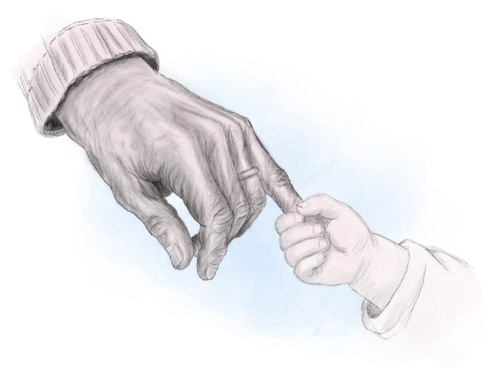
Graphic by Cara Cronin

I was recently “put on,” as the kids say, to a beautiful song by Eric Clapton called “Tears in Heaven.” Upon my first listen, I didn’t know the piece was written as a love letter from Clapton to his young, deceased son, Conor. The first line is a simple question from a grieving father: “Would you know my name if I saw you in heaven?” It’s a gut-wrenching opening, but an honest one. Would his son know his name, given that he tragically passed away at the age of four? The answer is ambiguous, and that is exactly what makes the question so heartbreaking. At age four, children typically know their parents as “Mom” and “Dad” rather than by name. So, Clapton seems to wonder whether that connection would be enough for his boy to recognize his father’s name when they eventually meet in the afterlife.
It is a question I have been pondering myself recently, albeit in reverse. My great-grandmother, my Nana, is 103 years old, and her memory is fading more and more between visits. I have gone from being a face and name she recognized to just a face. Now we’re unsure exactly who she thinks I am, but it’s clear she knows me and, with a little prodding, conveniently remembers I am the most handsome of her great-grandsons … I wonder who put that thought in her mind!
Jokes aside, I often wonder about dementia patients and their access to the people they love in this life and the next. I know Nana loves us; her face lights up when we walk into the room, and she showers us with hugs and kisses. She doesn’t nod off into one of her unscheduled naps when we’re talking, and she puts in a real effort to give us her full attention and energy. She may not be able to tell you who I am for certain, but I know she knows I belong to her, as she often reminds me when I ask if she knows my name, saying with a smile, “Hush hush, you are all my babies!” A cop-out if I’ve ever seen one, but at 103 years old, I let it slide.
Despite all this, I ask myself: Would she know my name if I saw her in heaven? The answer is obvious to me: yes. It is the redeemed soul, not the body or the mind worn down by time, that enters the kingdom of heaven. That is the most beautiful part of it all. A four-year-old only knows his father as “Dad,” but he knows his “Dad” is kind, keeps him safe, and picks him up when he falls. That was all a Dad had to be. In grief, we often ask ourselves hard questions that our minds, in the moment, cannot comprehend, but our hearts already know the answer. Of course, he would know his father in heaven; it was never a matter of knowing his name, but of recognizing love and care from his first day to his too-early, unfortunate last day.
I find this to be true of my Nana. I have spent many of my visits in the wrong frame of mind, worrying about what she has lost instead of appreciating what she had and still has. She has an army of grandchildren, great-grandchildren, and even a great-great-grandchild, though he speaks mainly in babbles at the moment—all of us ready to bring her a fresh cup of coffee at a moment’s notice. She has the love and admiration of generations and can revel in knowing she is older than over 100 countries.
That is not the life of a woman who has been forgotten. Each person who gets to call her Nana, as I do, carries with them a piece of her. For some, it’s her expert baking skills, her humor, her patience; the list goes on. It is still unclear what of hers I got, but, as I mentioned before, I’m her confessed (100% genuinely under no influence) most handsome great-grandson, so I’ve got that going for me.
Returning to the song, I cannot begin to imagine the depth of grief that the loss of a child could bring, and I know there is nothing I could write that would even scratch the surface of remedying a father’s pain. However, I believe that by sharing this song with his fans, he gave the grieving something no other song in his catalog does: permission to voice the thoughts they daren’t say aloud. An enduring bond between a loving parent and their child is consecrated at birth. A loving parent knows their child from the moment they set eyes on them, and a loving child knows their parent, not by name but by the arms that cradled them and the voice that sang them lullabies at night.
This is the thought that changed how I view my Nana when she says, “Hush hush, you are all my babies,” because that statement holds something deeper. She speaks as a mother who has known her children, and in particular my grandmother, by sight for over eighty years. She simply has widened her circle to include all of us. She needn’t know our names, or where we live, or who our parents are to know that we are of her. So, I do expect that when I get to the pearly gates of heaven, she’ll be there with a smile on her face and a hug to welcome me home.
Noah Basden ’29 (nhbasden@college.harvard.edu) needs to focus on what’s in front of him (midterms) and not what’s above his head.