The Bet on SportsAn introduction to the business behind the sports industry.
Graphic by Evelyn Ferguson

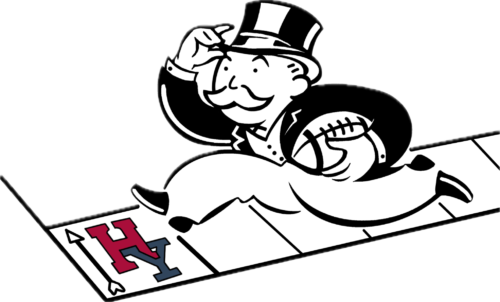
The Harvard-Yale football game is arguably the year’s most cherished tradition. Custom hoodies are everywhere, tickets sell out for the game itself and a slew of parties, and paraphernalia and merchandise show spirit. No other day can quite match the excitement and experience The Game brings.
Yet in those few days, a whole mini-ecosystem emerges without us realizing. Houses and organizations sell sweatshirts, food trucks and restaurants capitalize on the demand, and videos of The Game circulate on social media. The Game and student loyalty to Harvard become monetizable. This resembles—on a much smaller scale—the massive business behind the rapidly growing sports industry. While fans pay for tickets, concessions, and merchandise, sponsors pay to be associated with their favorite teams; sports teams themselves have become attractive investment opportunities with capital soaring in.
Over the past few years, sports teams’ valuations have skyrocketed. In August 2026, Josh Kushner and Bob Iger bought the Los Angeles Lakers for a record $12.5 billion. Later that month, the Seattle Seahawks sold to the Khosla Family for $9.6 billion. This comes a year after the Boston Celtics sold for a valuation of $6.1 billion in August 2025, then the record price for a sports team, to a private equity investor, Bill Chisholm, alongside Sixth Street and other individuals. As valuations rise, the number of ultra-high-net-worth individuals who have the capital to buy them cannot keep pace.
It is a relatively recent phenomenon for sports teams to be opened up to institutional capital and private equity investors. The four major U.S. leagues (NFL, NBA, MLB, NHL) barred private funds from ownership until 2019, when MLB allowed for private equity ownership; the NBA and NHL quickly did too, and the NFL lifted its ban in 2024 and allowed investors to purchase up to 10% of a franchise’s common equity as passive holders. Some teams are even publicly traded, including the Atlanta Braves, the New York Rangers and New York Knicks through Madison Square Garden Sports Corp, and Manchester United. The Green Bay Packers have been fan-owned since 1923, the NFL’s only such team, though their shares are not traded on an exchange. Sports are now seen as their own asset class.
Teams are valued based on revenue multiples and primarily generate such revenue from ticket sales, sponsorships, and media rights. Media rights have been the biggest driver of rising prices. With a universal turn towards streaming, sports uniquely provide live, appointment-viewing content. That makes watching sports valuable for advertisers and distributors, who get consistent, attentive, and live viewership during games. Networks and streaming platforms therefore pay a premium for media contracts, which drive higher franchise revenues, player salaries, and team valuations. These contracts provide predictable, durable revenue streams, making it clear how much each contract will pay out per year.
MLB’s deal with ESPN, Warner Bros. Discovery’s TBS, and Fox is worth $12 billion over seven years and ends in 2028. The NBA’s deal, which began in the 2025-2026 season with ESPN, NBCUniversal, and Amazon Prime Video, is worth $76 billion over 11 years, with games split across the platforms. The NBA’s deal was previously worth $24 billion, with ESPN and Warner Bros. Discovery’s TNT. The NFL’s current deal with NBC, CBS, Fox, ESPN, and Amazon, which runs from 2023 to 2033, is worth $110 billion over 11 seasons. For context, the NFL’s deals average roughly $10 billion a year, compared with the $8.7 billion cinemas in the U.S. and Canada sold in tickets in 2025.
Teams can further monetize logos, apparel, and other partnerships beyond event-day logistics, such as ticket sales and concessionaires. Many brands collaborate with teams, including Madhappy’s recent collection with the Los Angeles Lakers, expanding reach and driving engagement. Social media has also given fans another way to engage with teams, from sharing video clips to interacting with players, reinforcing loyalty and capturing attention.
In addition to predictable revenue streams and higher media contracts, fan bases are loyal and durable, with allegiance to a team typically based on family or where someone grew up. Sports viewership continues to rise, with the NFL hitting milestone numbers. Furthermore, in a world of artificial intelligence-powered automation, sports offer an emotional, human experience that machines or robots can never replace (and perhaps is now even more craved). And as artificial intelligence accelerates productivity, workers may have more hours to allocate to leisure, including attending or watching sports games. This accelerates teams’ potential revenue and the investment opportunity.
College sports might be the next target. In 2024, Weatherford Capital and RedBird Capital, sports-focused private equity firms, established Collegiate Athletic Solutions to invest in college sports in a 5-year deal with the Big 12 conference. The two are investing $12.5 million to develop sponsorships, media deals, and other ventures. College sports have seen similar monetization strategies since the Supreme Court ruled in 2021, in NCAA v. Alston, that the NCAA could not cap education-related benefits for athletes. Name, image, and likeness rules and later settlements then opened the way for pay, letting athletes move to schools offering more money. Certain colleges, however, have resisted this push toward institutional investment.
While outside investment does not seem to be approaching Harvard anytime soon, The Game is a testament to the strength of the growing sports industry, as every ticket sale, merchandise purchase, and fan’s excitement feeds the fervor and reinforces the business behind sports. On Sidechat, Harvard-Yale tickets are selling for north of $130, even though they’re free for Harvard undergraduates. House committees sell their own merchandise, and student organizations meet the demand by designing sweatshirts (including the Indy) and other items. Crewdog, founded by two Yale rowers, has also launched a Harvard-Yale collection and brought in Harvard students to help with its campaign. Ultimately, sports fans are loyal and eager to support their teams, and we are eager to support Harvard, which helps the business side thrive.
Meena Behringer ’27 (meenabehringer@college.harvard.edu) writes Sports for the “Harvard Independent.”