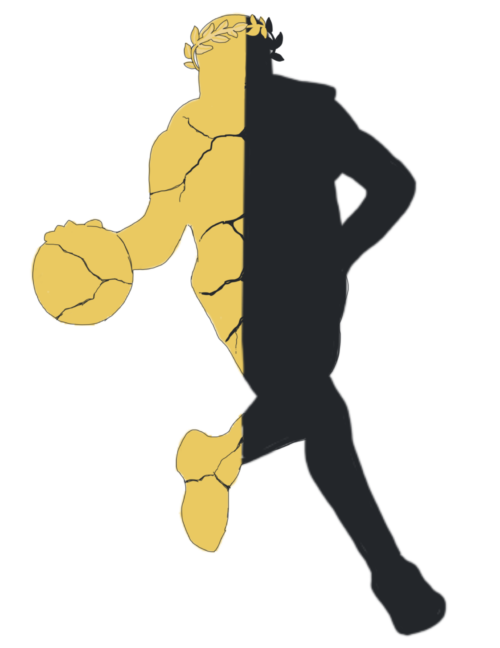
Holding out for a HeroShould we look up to athletes as heroes?
Graphic by Ella Cohen

Like most other kids, I was fascinated with superheroes growing up. Watching Marvel movies or reading DC Comics, I believed such paragons of hope and strength truly existed, if only for a few hours. Naturally, I returned to reality when the credits rolled, but the excitement for these heroes never died.
When I first took an interest in sports, I was amazed by the talent and athleticism these professionals displayed on the field each week: bursts of speed reminiscent of the Flash, or feats of strength akin to the Thing. Beyond the fact that I was from a state with dedicated teams, seeing the physical talent and skill of the players ignited my passion for sports.
But why do we herald these athletes as heroes? What tenets and characteristics do they display that make them idols worth looking up to? How do we reconcile reprehensible off-the-field actions with the heroic qualities on the field?
Some of the most famous heroes in Western culture come from Greek mythology. Hercules is seen as a hero because he possesses strength and courage in the face of adversity. We learn his legend because of his grit, even when facing insurmountable opposition.
Similarly, many modern athletes demonstrate great strength and perseverance. Take Dennis Rodman, a five-time NBA champion forward-center. His father abandoned his family while Rodman was young. He worked as an airport janitor, was kicked out by his mother and left homeless, and was arrested for theft. Yet Rodman turned his life around: he went to college, was drafted at 25, won five championships, and became a Hall of Famer. Moreover, he used his platform to rebel against institutions he disagreed with, such as restrictive male gender roles and hostility toward the LGBTQ+ community.
For all intents and purposes, Rodman meets the requirements to be considered a hero. And yet, the illusion dissipates when the credits roll. For all his successes, Rodman has made many mistakes in his life. In his Hall of Fame speech, Rodman acknowledged his personal failings, especially with his children. He apologized for not being present in their lives; his three children were largely raised by their mother. That was in 2011. A decade and a half later, his daughter Trinity, a very successful soccer player, revealed that he put little effort into making amends.
Sure, Rodman was a talented player who triumphed through great adversity and used his platform for good. And yet, his personal shortcomings and failure to reconnect with the family he built make it hard to look up to him as a role model unthinkingly. Taken as a whole, good and bad cannot simply be netted out against each other; noble attributes don’t outweigh flaws when determining whether someone should be considered a hero. However, we can identify these virtuous aspects alongside the imperfections. We can teach about the successes without promoting the person.
It’s important to recognize that, even in myth and teachings, heroes are not perfect. In most depictions, Hercules initially sets out on the twelve labors as penance for murdering his wife and children (though incited by the gods). Many Greek and Roman myths show heroes facing a tragic end because of hubris. Even one of the Bible’s most famous heroes demonstrates character flaws.
David, best known for defeating Goliath, eventually becomes king of Israel. One of David’s most significant flaws occurs when he sees Bathsheba, a married woman, and desires her, summoning her to his palace. When she becomes pregnant, he tries to hide it and then arranges for her husband to be killed in battle.
Still, we can laud an action and its meaning without endorsing the person. We can respect and take inspiration from Rodman’s perseverance and defiance toward restrictive social institutions without condoning his failings in his relationships.
In modern sporting culture, the issue arises when fans blindly follow and look up to athletes without recognizing their shortcomings. These followers still admire the displays of physical talent regardless of what occurs off the field. In fact, these fans often value athletic prowess so much that they actively dismiss players’ mistakes and offenses.
In 2003, Kobe Bryant was a three-time NBA champion. But that July, he was arrested and charged with felony sexual assault. Before the criminal trial, the accuser’s identity was leaked and reported, leading to death threats from fans. Eventually, the accuser refused to testify, so all charges were dropped. Bryant later released a statement acknowledging that she felt as though there was no mutual consent.
While court proceedings were ongoing, Bryant was named an All-Star for the 2003–04 season through a fan vote. After Bryant died in 2020, many in the sporting world quickly lauded his legacy on and off the court. When CBS journalist Gayle King asked about the case regarding Bryant’s legacy, she received swift backlash.
Similarly, NFL quarterback Ben Roethlisberger was accused of sexual assault twice, in 2008 and 2010. While no criminal charges resulted and he settled the 2008 civil suit out of court, the NFL originally suspended him for six games, later reduced to four. When Roethlisberger returned, Steelers fans cheered him on. Regardless of his off-the-field behavior, as long as he won games, many fans did not care.
I am not recommending ignorance of the court system’s complexity and the muddled history of false accusations against athletes. However, unthinkingly following athletes because of their on-field achievements ignores an important part of what it means to be a hero. To call these athletes heroes without acknowledging their faults fails to hold them accountable and spur them to improve.
We use heroes to teach the next generation how to interact constructively in society. We can encourage them to follow certain principles of these athletes while still cautioning them about their shortcomings. In this way, others can better learn what’s right and what is wrong.
As we think of the players we see on screen, we cannot view their actions in a vacuum. We can admire certain aspects that contribute to success, such as tenacity and physical strength. We can teach how these contribute to success. But we must also discuss their shortcomings. We must recognize that these players are people and not otherworldly heroes. Each athlete may possess heroic qualities, but they are not perfect. As such, we should not emulate them exactly. Just as we learn from Hercules or David, we should learn from players’ particular traits while acknowledging their failures.
After all, the appeal of superheroes is the hope that people have no flaws. And though these perfect people may not exist, we should still have hope. That hope means we want to improve and better ourselves. We should still look up to others for certain aspects of success, but we should also be aware of their failings to hold them accountable, as well as ourselves.
Tyler Dang ’28 (tylerdang@college.harvard.edu) is the Sports Editor for the “Harvard Independent.”