“I feel like people here are pretty open to hearing everyone’s perspectives,” Kai Thoma ’30 told the “Harvard Independent.”
That sentiment might surprise some: the University has long been under scrutiny for lacking conservative representation, especially after Donald Trump’s presidential win in 2024. On the night of the presidential election, conservative students faced backlash on the anonymous social media platform Sidechat: “Accept the consequences of your beliefs. Want lower taxes, take social alienation,” one user wrote.
Now, Thoma is among a Harvard class that entered the University amid its response to these criticisms as it pushes to engage with more conservative students’ voices on campus.
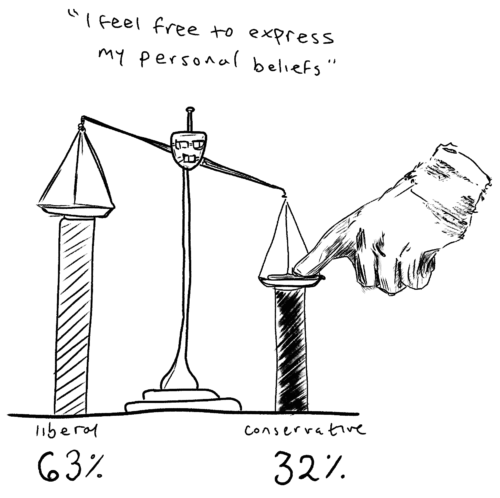
Harvard College’s Senior Survey, released Nov. 10, included responses from more than 97% of the graduating class, the College said. This year, the annual audit found that 54% of seniors said they felt comfortable expressing opposing views on controversial topics in their courses, up from 43% in 2025. Responses on a separate question, whether students felt free to express personal beliefs, split by political orientation: 63% of liberal seniors said they did, compared with 32% of conservative seniors and 43% of moderate seniors.
The small number of right-leaning students on campus willing to speak on their views means many students are not even able to identify their conservative peers. “I really don’t know who I’m talking about when I talk about conservative students on campus,” Brandy Figueroa ’28 said.
This phenomenon may be because conservatives are a minority at Harvard: in 2026, 66% of the student body self-identified as progressive, while only 10% identified as conservative.
For some students, the dominant political culture seems to create right and wrong answers to political questions. “You wouldn’t want to say something that you know is going to be viewed as a wrong answer,” Figueroa said. “I think, in reality, there’s still not much discussion on [controversial topics].”
“There still is definitely a slant where people who are part of the majority will feel much more willing and able to speak up about what they feel,” former Harvard Undergraduate Association co-president Caleb Thompson ’27 said in an interview with the “Harvard Independent.” “There’s still people that are in the minority that are willing to, but they often catch a lot of flak for it.”
Still, while conservative undergraduates have reported more discomfort discussing their views on campus, students on both sides of the political spectrum still feel unable to express their political beliefs at times. Yassin Mohamedy ’29, who identified as liberal, has found that his viewpoints could be difficult to communicate depending on his environment. “I have also felt in spaces I am in on campus that when people are aware [you] feel differently, it creates a bit of tension in the room.”
Additionally, the survey also found broad satisfaction with academics and campus life: 90% of seniors were satisfied or very satisfied with their academic experience, and 82% were satisfied or very satisfied with their sense of community on campus.
David Deming, Danoff Dean of Harvard College, described the results as evidence of progress on speech and civil discourse. “All students experienced similar increases in perceived freedom of expression and civil discourse over the last year, regardless of their political beliefs,” Deming wrote in an email accompanying the survey results.
Deming’s analysis contrasted with some students’ accounts of campus political culture. “At least among freshmen first-year students … I feel like people are more outwardly liberal,” Thoma said.
Current seniors recounted the broader political turbulence that shaped previous classes’ student life in ways later years may not understand. “I think our class has experienced a lot of controversy through our time being here, because of some of the things that have happened at the federal government level, within the University,” Thompson explained. “Something that might explain what happened last year with [the Class of 2026’s survey] is they faced a lot of the same experiences as us.”
Comfort is only one dimension of growing free speech on campus: the share of seniors who said they had expressed opposing views when they felt it was important also rose from 44% in 2023 to 67% in 2026, according to Deming.
These figures arrive amid renewed attention to ideological diversity at Harvard: since 2023, the College’s administration has worked to engage conservative undergraduates more through meetings, events, and policy changes.
“In the years around the pandemic, some faculty began to feel that they could no longer teach certain topics or assign certain works for fear of controversy or cancellation,” Amanda Claybaugh, Dean of Undergraduate Education, wrote on the official website of the Faculty of Arts and Sciences. “At the same time, some students felt that they had to censor themselves both in and out of class.”
Some faculty members voiced their own opinions on the institution’s shortcomings in including right-leaning representation: Kenan Professor of Government Harvey C. Mansfield published “Where Harvard Went Wrong: Fifty Years of Commentary That Fell on Deaf Ears” in May 2026.
“The way to regain public favor is not to pretend to be nonpartisan but rather to see to it that the one dominating party—the left—is brought to agree to the active presence of the other side,” Mansfield said in an interview with “Harvard Magazine.” “This needs to happen in the admission of students, the selection of deans, and especially in the hiring of faculty.”
University administration responded to these concerns by launching the “Intellectual Vitality” initiative. Led by the Student and Faculty Advisory Boards, the initiative seeks to implement new methods of promoting free speech in classrooms and residential life.
In addition, the Standing Committee on Undergraduate Educational Policy, made up of College faculty, held town halls and private meetings to create a case for improving open dialogue within the community. This eventually led to the formation of the Classroom Social Compact Committee, which produced a report on how students shy away from controversial topics. The document subsequently outlined how Harvard could create a more “transformative” education for students.
A semester later, in the fall of 2025, faculty began attempts to implement the report in their classes: Eric Beerbohm, director of the Edmond & Lily Safra Center for Ethics and co-chair of the Open Inquiry and Constructive Dialogue Working Group, lectured incoming first-year students—who had just arrived on campus for orientation—on intellectual vitality.
Beerbohm attempted to “strike the register that works” for students, never directly referring to intellectual vitality but encouraging them to make friends among those with whom they disagree.
This approach mirrored how students commonly engaged in controversial conversations on campus. “I don’t explicitly talk about politics,” Figueroa said. “We more so talk about ethical issues or issues relating to philosophy, which would [then have] political implications.”
Beerbohm, among other faculty, went on to say these strategies were effective in getting students to participate more in the classroom and in their residential communities. Claybaugh wrote on the FAS website, “First and second year students don’t really understand what I mean when I ask if they fear being canceled for their views.”
Still, accounts from first-years seem to complicate the administration’s understanding of growing dialogue. “People really keep their identities, like political ideologies, private,” Thoma said.
“It is pretty accurate to say that people actually aren’t that comfortable expressing controversial views because there is a high standard for people’s rationales,” Figueroa added. “Often, the expectation is that you follow [the] status quo.”
These efforts by the College have drawn differing responses from conservative students, some of whom have questioned whether the changes are substantive. The Administration’s push to include conservative voices also played out against the recent history of the conservative student publication “The Salient.” In March 2026, students spoke out against the journal’s revival after it had paused operations amid controversy over past material. This backlash mostly arose from a Sept. 2025 draft article by David Army ’28 that included lines closely mirroring rhetoric from Adolf Hitler’s 1939 Reichstag speech.
In December of 2025, “The Salient” subsequently rebuilt its board and condemned Army’s statements. “There is no place for antisemitism, misogyny, bigotry, or any kind of hate at the Salient—or in the conservative movement that it seeks to uphold,” Jason Morganbesser ’27, the newly appointed managing editor of “The Salient” following the incident, said in a statement to the “Harvard Independent” in 2025.
“I speak for the whole of the Salient’s editorial team when I say that we apologize to our readers, the entire Harvard community, and conservatives everywhere for allowing Harvard’s sole conservative publication to become a platform for hate.”
Sarah Steele ’26, former president of “The Salient,” argued in the spring that conservative students often felt isolated on campus by the time she graduated. “‘The Salient’ has served as a home base for students to learn, digest, and apply conservative thought on a campus where such opportunities are scarce,” she wrote. Some students welcomed the publication’s return, but others questioned whether it had meaningfully grown from its discourse.
Figueroa recounted a recent conversation she had with her friend about “The Salient.” “A person that they knew joined ‘The Salient’ because of that incident,” she said. “I’m assuming in hopes to change the way conservatives are viewed on campus.”
While Figueroa found the student’s interest in improving “The Salient” to be a meaningful step towards reconciliation, to her it did not erase what the publication had previously publicized. “I like to hope that people are not doing anything in bad faith, but obviously I still have a hesitant/reluctant distrust of conservative students on campus.”
Importantly, the survey does not explain why students feel more or less comfortable speaking, or whether they interpret “controversial topics” in the same way. It does show that 46% of seniors still did not agree or strongly agree that they felt comfortable expressing opposing views in courses.
“I still think in classroom settings people are very cagey and very hesitant to share, just because you really don’t know what the fallout of that will be socially or how people are going to interpret what you say,” Thompson said.
The survey also did not provide comparative data for student speech beyond the base left-right spectrum, though each student interview conducted by the “Harvard Independent” for this article named the Israel-Palestine conflict as one of the most contentious topics on campus. It particularly influenced interviewees’ experiences with speech at Harvard, especially the current senior class, the Class of 2027, who witnessed related student protests their first year on campus.
“Freshman year, it was just a very vivid memory because there was the encampment right outside of Holworthy, which is where I was living,” Thompson recounted. At the time of the encampment, which students built at the center of Harvard Yard in support of Palestine, he recalled being optimistic about students’ ability to hold difficult conversations. “I was able to play cricket with a lot of people at the encampment, and I saw their humanity and where they were coming from.”
He then explained that sentiment did not survive on campus. “I heard about friends of mine, or people that had known each other the first couple weeks of school, that weren’t talking to each other as much as a result of that issue. I know that a lot of those divides have persisted to this day.”
Mohamedy recalled how discussing the conflict led to an uncomfortable moment in one of his classes. “I called Israel a fascist state in response to something someone said,” he explained. The class quickly changed topics, but the atmosphere of the room remained tense.
Figueroa believed the Israel-Palestine conflict was, in some ways, even more difficult to discuss than many other political topics. “If someone says they’re fiscally conservative, people will roll their eyes, and it’s like, okay, whatever,” she said. “But when it comes to things that are more social or humanitarian, differing opinions are very uncommon.”
In Jan. 2024, Harvard President Alan Garber announced two task forces to examine campus bias: the Presidential Task Force on Combating Antisemitism and Anti-Israeli Bias and the Presidential Task Force on Combating Anti-Muslim, Anti-Arab, and Anti-Palestinian Bias. They released their final reports in April 2025.
Almost a year later, in March 2026, the Trump administration’s Justice Department sued Harvard, alleging it failed to protect Jewish and Israeli students from discrimination; a federal judge dismissed the case in August.
Harvard College’s required 2026-2027 online training module, “Harvard University Policies and Resources: Non-Discrimination, Title IX Sexual Harassment, and Other Sexual Misconduct,” covers the University’s nondiscrimination policies. Harvard’s policy FAQ lists “verbal abuse or use of antisemitic, racist, sexist, homophobic, anti-Zionist, anti-Arab, Islamophobic, anti-LDS, or anti-Catholic slurs or hostile behavior” as an example of conduct that may violate the policy; it also names excluding Zionists from open events as an example, provided the policy’s requirements are met.
In his message on the survey, Deming said he strove for the entire student body to feel comfortable voicing their opinions on controversial topics one day. “As a campus leader, I feel a strong duty to get these numbers as close to 100% as possible, and I am not satisfied with our progress,” he wrote.
Still, Thoma pointed to larger national and international divides beyond Harvard. “I think it’s just a reality that we see on campus, but I don’t know if it’s really that different anywhere else,” he said.
Courtney Hines ’28 (courtneyhines@college.harvard.edu) is the News Editor for the “Harvard Independent.”