Crew Dog is Back for The GameA conversation with one of Crew Dog Apparel’s founding members, Kiernan Liberman.
Graphic by Sarahluna Sassine

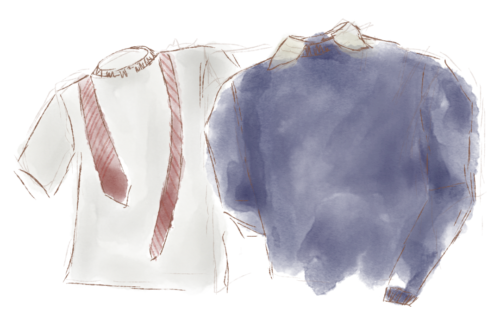
Last November, Crew Dog came to Harvard’s campus in velour. The Yale student-founded apparel brand made its retail debut at the Harvard Cooperative Society during the week of Harvard-Yale, selling hand-drawn college mascots stitched in intricate embroidery. A year later, they are back for The Game 2026. This year’s standout item is a rivalry design, featuring a Yale and Harvard mascot brawling over a football.
The brand launched in the spring of 2023. Constantine Polychronopoulos, a Yale lightweight rower, wanted his team’s custom T-shirts to feel more personal and visually appealing. He and fellow rower Coby Wagonfeld, along with Yale classmate Kiernan Liberman, expanded their bulldog rowing-gear brand into a multi-institution apparel company.
Now based in New York, the three co-founders split the work based on their strengths: Kiernan Liberman on product development, Polychronopoulos on events, strategy, branding, and marketing, and Wagonfeld as the overseer of operations.
The mascot design process goes something like this: First, in-house designers draw a black-and-white sketch for each university’s licensing directors. Then, they revise it until it fits the school’s culture and brand guidelines. Only after these steps can the designers decide what clothes the drawn mascot will don.
“That’s something that’s really fun for me and the team to do. What pieces do we want to put the mascot in?” Liberman explained. Finally, the drawing is colored and digitized so each part becomes stitches for the embroidery machine.
A year after its debut, Crew Dog’s Harvard mascot design was licensed, according to Liberman, a founder and the head of product development. “We’re now able to do really fun rivalry graphics,” he said in an interview with the “Harvard Independent.”
Since its inception, Crew Dog has been a form of merchandise “counterculture.” Crew Dog was uniquely positioned as a startup focused on craft and community at an institution that typically favors post-graduate corporate careers. According to the “Yale Daily News,” approximately 30% of Yale graduates pursue finance or consulting. Students who do take the startup route tend to chase venture-backed tech. Crew Dog built a model around something more tactile: carefully fashioned clothing, designed with care. A year later, the brand moved to New York and expanded onto over 90 college campuses around the United States. Yet the founders are working to ensure their once-homegrown brand preserves its identity despite expansion.
And company size is not the only thing changing. The garments themselves have also evolved over the years. In 2024, some Crew Dog pieces were printed and lighter. “Now you can really tell the premium quality from the actual feel of the lining,” Liberman said. “We now use over 50,000 embroidered stitches per design, which really makes a difference.”
Because the Crew Dog founders lacked a background in design and production, they had to leverage their market knowledge while learning the industry. “I designed the collection last year with minimal design experience, just graduating from Yale and studying economics,” Liberman said. “It was definitely a learning curve.” The iconic velour became one of their first milestones; matching velvet-like sets rode the 2025 Y2K revival, capitalizing on trends while generating steady profit.
The 2026 collection is now intended to dive deeper into the Ralph Lauren bear aesthetic that has become popularized across American and international fashion—especially at Ivy League schools like Harvard and Yale. Last year, Harvard was one of the only schools on their website not to feature an embroidered emblem due to the nebulousness of “Crimson.” But this year, Liberman made it clear their merch would feature a Harvard mascot.
“We finally got approval for this past spring … the past few years we haven’t had any mascot collections because Harvard we never had a mascot.” Approval was only the first step; once their design was authorized, Crew Dog had to envision brand representation for a novel character. The company team took on that challenge to create a recognizable symbol, a teddy bear dressed in the classic H sweater, that would make students feel like part of the “crew.”
Though The Game is one of the biggest weekends of the year for both schools’ communities, its economic rewards are short-lived. In other words, though the Harvard-Yale collection looks like a flagship, ultimately, it does not pay the bills. “I think Harvard-Yale is very minimal and—the overall profitability and financial success of the company—I think it’s more of a marketing play,” Liberman said. Creating a dedicated line for The Game lets the brand market strongly at one of the nation’s most prized college sporting events while also keeping the founders connected to their alma mater.
The Harvard-Yale collection adds nostalgic tradition that is meaningful to Crew Dog as a brand. The Harvard-Yale line also reinforces their “Made by students, for students” ethos, as described in their interview with the “Harvard Independent” last year. “Having the roots when we started at Yale still being nurtured, I think is beautiful, and it keeps the story very raw and authentic,” Liberman noted.
The annual collection also functions as a test run. Last year’s heritage design, a football with a school crest inside, performed well with HY buyers. Now, Crew Dog is rolling a similar design out to other universities across the nation, including American University, the University of Arkansas, Bucknell, and more.
Liberman has discovered that taste varies by region more than by specific school. “I think it’s more of a Northeastern regional thing versus the South versus the West Coast,” he said. “I need to understand, okay, what does the southern consumer want?”
To learn what college students want, he realized he needed to understand the southern student as well. “These schools are filled with people who are not from the South. So, what does that also, you know, how does that also tie into the collections that I design?” These are all questions being asked during the design process—which is still relatively foreign to the Crew Dog team as they expand into unfamiliar business territory.
Regardless of the challenges, Liberman’s motivation to persevere is rooted in the people he built the brand with. Watching the company grow alongside peers from college has been more than fulfilling. “It has also been very rewarding as a business owner to be able to see your own company and baby grow with people you really trust. I have an amazing team.”
Liberman said moving to New York helped the brand most because he could count on mentors and industry networks close at hand. “You just have to put yourself in the right places, at the right time.”
Natalie Cooper ’28 (ncooper@college.harvard.edu) has already picked out her Crew Dog fit for The Game.